Home
Department Of Physics text logo
  • Research
    • Our research
    • Our research groups
    • Our research in action
    • Research funding support
    • Summer internships for undergraduates
  • Study
    • Undergraduates
    • Postgraduates
  • Engage
    • For alumni
    • For business
    • For schools
    • For the public
  • Support
Menu
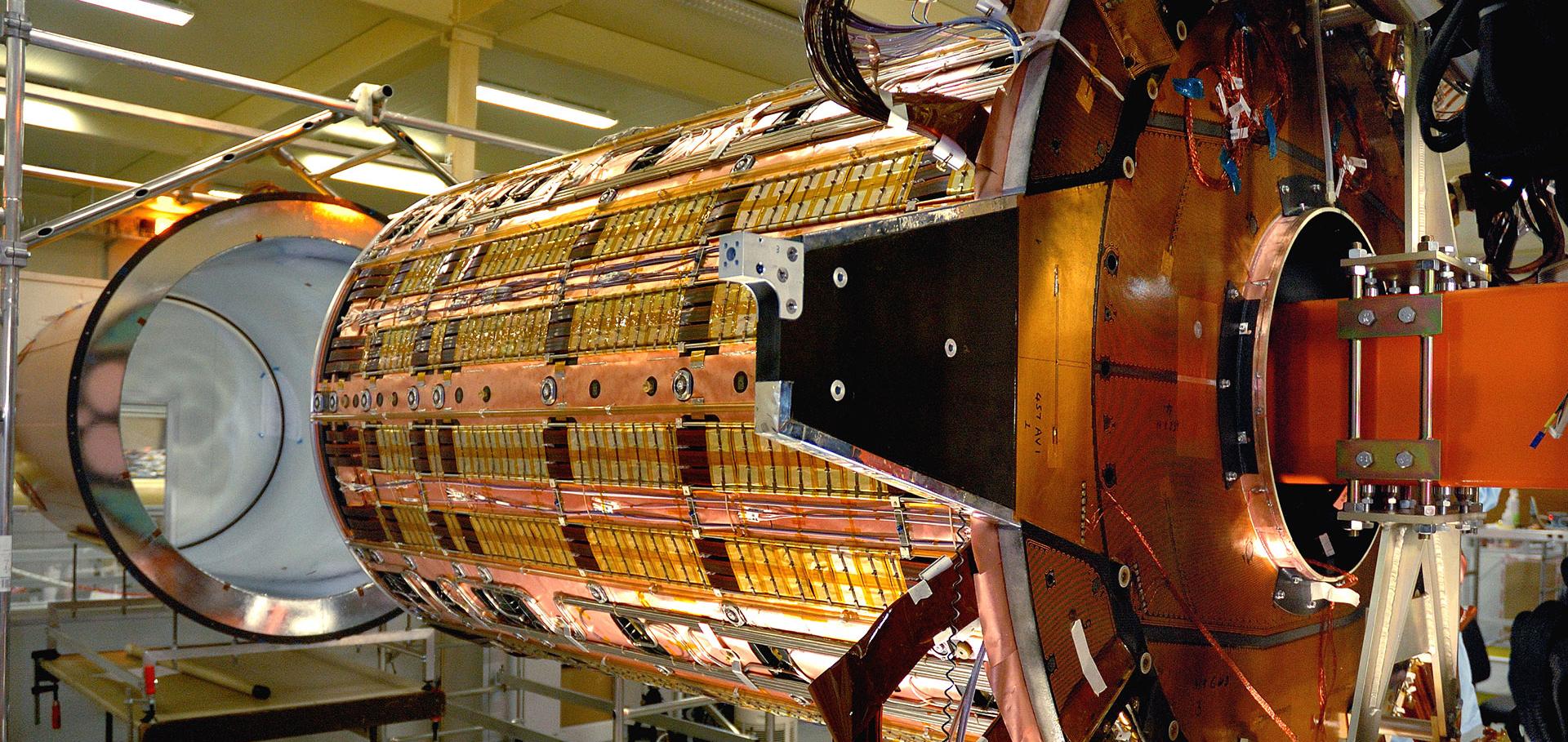
Insertion of STC into TRT at the Department of Physics, Oxford
Credit: CERN

Guy Wilkinson

Professor of Physics

Sub department

  • Particle Physics

Research groups

  • LHCb
Guy.Wilkinson@physics.ox.ac.uk
Telephone: 01865 (2)83110
Denys Wilkinson Building, room 608a
  • About
  • Publications

Consistent measurements of αs from precise oriented event shape distributions

European Physical Journal C 14:4 (2000) 557-584

Authors:

P Abreu, W Adam, T Adye, P Adzic, Z Albrecht, T Alderweireld, GD Alekseev, R Alemany, T Allmendinger, PP Allport, S Almehed, U Amaldi, N Amapane, S Amato, EG Anassontzis, P Andersson, A Andreazza, S Andringa, P Antilogus, WD Apel, Y Arnoud, B Åsman, JE Augustin, A Augustinus, P Baillon, P Bambade, F Barao, G Barbiellini, R Barbier, DY Bardin, G Barker, A Baroncelli, M Battaglia, M Baubillier, KH Becks, M Begalli, A Behrmann, P Beilliere, Y Belokopytov, NC Benekos, AC Benvenuti, C Berat, M Berggren, D Bertini, D Bertrand, M Besancon, M Bigi, MS Bilenky, MA Bizouard, D Bloch, HM Blom, M Bonesini, M Boonekamp, PSL Booth, AW Borgland, G Borisov, C Bosio, O Botner, E Boudinov, B Bouquet, C Bourdarios, TJV Bowcock, I Boyko, I Bozovic, M Bozzo, P Branchini, T Brenke, RA Brenner, P Bruckman, JM Brunet, L Bugge, T Buran, T Burgsmueller, B Buschbeck, P Buschmann, S Cabrera, M Caccia, M Calvi, T Camporesi, V Canale, F Carena, L Carroll, C Caso, MV Castillo Gimenez, A Cattai, FR Cavallo, V Chabaud, P Charpentier, L Chaussard, P Checchia, GA Chelkov, R Chierici, P Chochula, V Chorowicz, J Chudoba, K Cieslik, P Collins, R Contri, E Cortina, G Cosme

Abstract:

An updated analysis using about 1.5 million events recorded at √s = Mz with the DELPHI detector in 1994 is presented. Eighteen infrared and collinear safe event shape observables are measured as a function of the polar angle of the thrust axis. The data are compared to theoretical calculations in script O(α2s) including the event orientation. A combined fit of αs and of the renormalization scale xμ in script O(α2s) yields an excellent description of the high statistics data. The weighted average from 18 observables including quark mass effects and correlations is αs(M2z) = 0.1174±0.0026. The final result, derived from the jet cone energy fraction, the observable with the smallest theoretical and experimental uncertainty, is αs(M2z) = 0.1180 ± 0.0006(exp.) ± 0.0013(hadr.) ± 0.0008(scale) ± 0.0007(mass). Further studies include an αs determination using theoretical predictions in the next-to-leading log approximation (NLLA), matched NLLA and script O(α2s) predictions as well as theoretically motivated optimized scale setting methods. The influence of higher order contributions was also investigated by using the method of Padé approximants. Average αs values derived from the different approaches are in good agreement.
More details from the publisher
More details

Cross-sections and leptonic forward-backward asymmetries from the Z0 running of LEP

European Physical Journal C 16:3 (2000) 371-405

Authors:

P Abreu, W Adam, T Adye, P Adzic, GD Alekseev, R Alemany, PP Allport, S Almehed, U Amaldi, S Amato, EG Anassontzis, P Andersson, A Andreazza, P Antilogus, WD Apel, Y Arnoud, B Åsman, JE Augustin, A Augustinus, P Baillon, P Bambade, F Barao, R Barbier, DY Bardin, G Barker, A Baroncelli, M Battaglia, M Baubillier, KH Becks, M Begalli, P Beilliere, Y Belokopytov, AC Benvenuti, C Berat, M Berggren, D Bertini, D Bertrand, M Besancon, F Bianchi, M Bigi, MS Bilenky, MA Bizouard, D Bloch, M Bonesini, M Boonekamp, PSL Booth, AW Borgland, G Borisov, C Bosio, O Botner, E Boudinov, B Bouquet, C Bourdarios, TJV Bowcock, I Boyko, I Bozovic, M Bozzo, P Branchini, T Brenke, RA Brenner, P Bruckman, JM Brunet, L Bugge, T Buran, T Burgsmueller, P Buschmann, S Cabrera, M Caccia, M Calvi, AJ CamachoRozas, T Camporesi, V Canale, M Canepa, F Carena, L Carroll, C Caso, MV CastilloGimenez, A Cattai, FR Cavallo, C Cerruti, V Chabaud, M Chapkin, P Charpentier, L Chaussard, P Checchia, GA Chelkov, M Chen, R Chierici, P Chliapnikov, P Chochula, V Chorowicz, J Chudoba, P Collins, M Colomer, R Contri, E Cortina, G Cosme, F Cossutti, JH Cowell, HB Crawley

Abstract:

During 1993 and 1995 LEP was run at 3 energies near the Z0 peak in order to give improved measurements of the mass and width of the resonance. During 1994, LEP operated only at the Z0 peak. In total DELPHI accumulated data corresponding to an integrated luminosity of approximately 116 pb-1. Analyses of the hadronic cross-sections and of the cross-sections and forward-backward asymmetries in the leptonic channels used the most precise evaluations of the LEP energies. In the dimuon channel, events with a photon radiated from the initial state have been used to probe the cross-sections and asymmetries down to PETRA energies. Model independent fits to all DELPHI lineshape and asymmetry data from 1990 to 1995 have been carried out giving values of the resonance parameters: MZ = 91.1863 ± 0.0028 GeV ΓZ = 2.4876 ± 0.0041 GeV σ0 = 41.578 ± 0.069 nb R1 = 20.730 ± 0.060 AFB0 = 0.0187 ± 0.0019. These values are significantly more precise than those previously published. The results are interpreted in terms of the Standard Model.
More details from the publisher
More details

Determination of P(c → D*+) and BR(c → l+) at LEP 1

European Physical Journal C 12:2 (2000) 209-224

Authors:

P Abreu, W Adam, T Adye, P Adzic, I Ajinenko, Z Albrecht, T Alderweireld, GD Alekseev, R Alemany, T Allmendinger, PP Allport, S Almehed, U Amaldi, N Amapane, S Amato, EG Anassontzis, P Andersson, A Andreazza, S Andringa, P Antilogus, WD Apel, Y Arnoud, B Åsman, JE Augustin, A Augustinus, P Baillon, P Bambade, F Barao, G Barbiellini, R Barbier, DY Bardin, G Barker, A Baroncelli, M Battaglia, M Baubillier, KH Becks, M Begalli, A Behrmann, P Beilliere, Y Belokopytov, NC Benekos, AC Benvenuti, C Berat, M Berggren, D Bertini, D Bertrand, M Besancon, M Bigi, MS Bilenky, MA Bizouard, D Bloch, HM Blom, M Bonesini, W Bonivento, M Boonekamp, PSL Booth, AW Borgland, G Borisov, C Bosio, O Botner, E Boudinov, B Bouquet, C Bourdarios, TJV Bowcock, I Boyko, I Bozovic, M Bozzo, P Branchini, T Brenke, RA Brenner, P Bruckman, JM Brunet, L Bugge, T Buran, T Burgsmueller, B Buschbeck, P Buschmann, S Cabrera, M Caccia, M Calvi, T Camporesi, V Canale, F Carena, L Carroll, C Caso, MV Castillo Gimenez, A Cattai, FR Cavallo, V Chabaud, P Charpentier, L Chaussard, P Checchia, GA Chelkov, R Chierici, P Chliapnikov, P Chochula, V Chorowicz, J Chudoba, K Cieslik, P Collins

Abstract:

The probability P(c → D*+) that a charm quark fragments into a D*+ meson and the c → l+ semileptonic branching fraction were measured in Z0 decay into cc̄ events. From the analysis of 3.5 Million Z0 events collected from 1992 to 1995, a sample of charm meson decays with 81% cc̄ purity was selected. The product of the c → D*+ fragmentation probability times the D*+ → D0π+ branching fraction was measured to be: P(c → D*+) · BR(D*+ → D0π+) = 0.174 ± 0.010(stat) ± 0.004(syst). Using the world averaged value for BR(D*+ → D0π+), the fragmentation probability is inferred: P(c → D*+) = 0.255 ± 0.015(stat) ± 0.006(syst) ± 0.005(syst.BR). From the same sample, 1828 ± 51 identified leptons in the opposite hemisphere were selected. From this sample, the charm semileptonic branching fraction was measured to be: BR(c → l+) = 0.0958 ± 0.0042(stat) ± 0.0028(syst).
More details from the publisher
More details

Identified charged particles in quark and gluon jets

European Physical Journal C 17:2 (2000) 207-222

Authors:

P Abreu, W Adam, T Adye, P Adzic, Z Albrecht, T Alderweireld, GD Alekseev, R Alemany, T Allmendinger, PP Allport, S Almehed, U Amaldi, N Amapane, S Amato, EG Anassontzis, P Andersson, A Andreazza, S Andringa, P Antilogus, WD Apel, Y Arnoud, B Åsman, JE Augustin, A Augustinus, P Baillon, A Ballestrero, P Bambade, F Barao, G Barbiellini, R Barbier, DY Bardin, G Barker, A Baroncelli, M Battaglia, M Baubillier, KH Becks, M Begalli, A Behrmann, P Beilliere, Y Belokopytov, K Belous, NC Benekos, AC Benvenuti, C Berat, M Berggren, D Bertrand, M Besancon, M Bigi, MS Bilenky, MA Bizouard, D Bloch, HM Blom, M Bonesini, M Boonekamp, PSL Booth, AW Borgland, G Borisov, C Bosio, O Botner, E Boudinov, B Bouquet, C Bourdarios, TJV Bowcock, I Boyko, I Bozovic, M Bozzo, M Bracko, P Branchini, RA Brenner, P Bruckman, JM Brunet, L Bugge, T Buran, B Buschbeck, P Buschmann, S Cabrera, M Caccia, M Calvi, T Camporesi, V Canale, F Carena, L Carroll, C Caso, MV Castillo Gimenez, A Cattai, FR Cavallo, V Chabaud, M Chapkin, P Charpentier, P Checchia, GA Chelkov, R Chierici, P Chliapnikov, P Chochula, V Chorowicz, J Chudoba, K Cieslik, P Collins, R Contri, E Cortina

Abstract:

A sample of 2.2 million hadronic Z decays, selected from the data recorded by the DELPHI detector at LEP during 1994-1995 was used for an improved measurement of inclusive distributions of π+ K+ and p and their antiparticles in gluon and quark jets. The production spectra of the individual identified particles were found to be softer in gluon jets compared to quark jets, with a higher multiplicity in gluon jets as observed for inclusive charged particles. A significant proton enhancement in gluon jets is observed indicating that baryon production proceeds directly from colour objects. The maxima, £*, of the ξ -distributions for kaons in gluon and quark jets are observed to be different.
More details from the publisher
More details

Measurement of the B0s lifetime and study of B0s-B0s oscillations using Dsℓ events

European Physical Journal C 16:4 (2000) 555-578

Authors:

P Abreu, W Adam, T Adye, P Adzic, Z Albrecht, T Alderweireld, GD Alekseev, R Alemany, T Allmendinger, PP Allport, S Almehed, U Amaldi, N Amapane, S Amato, EG Anassontzis, P Andersson, A Andreazza, S Andringa, P Antilogus, WD Apel, Y Arnoud, B Åsman, JE Augustin, A Augustinus, P Baillon, P Bambade, F Barao, G Barbiellini, R Barbier, DY Bardin, G Barker, A Baroncelli, M Battaglia, M Baubillier, KH Becks, M Begalli, A Behrmann, P Beilliere, Y Belokopytov, K Belous, NC Benekos, AC Benvenuti, C Berat, M Berggren, D Bertini, D Bertrand, M Besancon, M Bigi, MS Bilenky, MA Bizouard, D Bloch, HM Blom, M Bonesini, M Boonekamp, PSL Booth, AW Borgland, G Borisov, C Bosio, O Botner, E Boudinov, B Bouquet, C Bourdarios, TJV Bowcock, I Boyko, I Bozovic, M Bozzo, M Bracko, P Branchini, T Brenke, RA Brenner, P Bruckman, JM Brunet, L Bugge, T Buran, T Burgsmueller, B Buschbeck, P Buschmann, S Cabrera, M Caccia, M Calvi, T Camporesi, V Canale, F Carena, L Carroll, C Caso, MV CastilloGimenez, A Cattai, FR Cavallo, V Chabaud, M Chapkin, P Charpentier, L Chaussard, P Checchia, GA Chelkov, R Chierici, P Chliapnikov, P Chochula, V Chorowicz, J Chudoba, K Cieslik

Abstract:

Lifetime and oscillations of B0s mesons have been studied in events with a large transverse momentum lepton and a Ds of opposite electric charge in the same hemisphere, selected from about, 3.6 million hadronic Z0 decays accumulated by DELPHI between 1992 and 1995. The B0s lifetime and the fractional width difference between the two physical B0s states have been found to be: τB0s = (1.42+0.14-0.13(stat.) ± 0.03(syst.)) ps ΔΓB0s/ΓB0s < 0.46 at the 95% C.L. In the latter result it has been assumed that τB0s = τB0d. Using the same sample, a limit on the mass difference between the physical B0s states has been set: ΔmB0s > 7.4 ps-1 at the 95% C.L. with a corresponding sensitivity equal to 8.1 ps-1.
More details from the publisher
More details

Pagination

  • First page First
  • Previous page Prev
  • …
  • Page 315
  • Page 316
  • Page 317
  • Page 318
  • Current page 319
  • Page 320
  • Page 321
  • Page 322
  • Page 323
  • …
  • Next page Next
  • Last page Last

Footer Menu

  • Contact us
  • Giving to the Dept of Physics
  • Work with us
  • Media

User account menu

  • Log in

Follow us

FIND US

Clarendon Laboratory,

Parks Road,

Oxford,

OX1 3PU

CONTACT US

Tel: +44(0)1865272200

University of Oxfrod logo Department Of Physics text logo
IOP Juno Champion logo Athena Swan Silver Award logo

© University of Oxford - Department of Physics

Cookies | Privacy policy | Accessibility statement

Built by: Versantus

  • Home
  • Research
  • Study
  • Engage
  • Our people
  • News & Comment
  • Events
  • Our facilities & services
  • About us
  • Giving to Physics
  • Current students
  • Staff intranet