Euclid preparation. TBD. The effect of linear redshift-space distortions in photometric galaxy clustering and its cross-correlation with cosmic shear
Submitted in A&A
Abstract:
Cosmological surveys planned for the current decade will provide us with unparalleled observations of the distribution of galaxies on cosmic scales, by means of which we can probe the underlying large-scale structure (LSS) of the Universe. This will allow us to test the concordance cosmological model and its extensions. However, precision pushes us to high levels of accuracy in the theoretical modelling of the LSS observables, in order not to introduce biases in the estimation of cosmological parameters. In particular, effects such as redshift-space distortions (RSD) can become relevant in the computation of harmonic-space power spectra even for the clustering of the photometrically selected galaxies, as it has been previously shown in literature studies. In this work, we investigate the contribution of linear RSD, as formulated in the Limber approximation by arXiv:1902.07226, in forecast cosmological analyses with the photometric galaxy sample of the Euclid survey, in order to assess their impact and quantify the bias on the measurement of cosmological parameters that neglecting such an effect would cause. We perform this task by producing mock power spectra for photometric galaxy clustering and weak lensing, as expected to be obtained from the Euclid survey. We then use a Markov chain Monte Carlo approach to obtain the posterior distributions of cosmological parameters from such simulated observations. We find that neglecting the linear RSD leads to significant biases both when using galaxy correlations alone and when these are combined with cosmic shear, in the so-called 3×2pt approach. Such biases can be as large as 5σ-equivalent when assuming an underlying ΛCDM cosmology. When extending the cosmological model to include the equation-of-state parameters of dark energy, we find that the extension parameters can be shifted by more than 1σ.
Euclid preparation: VI. Verifying the Performance of Cosmic Shear Experiments
Abstract:
Our aim is to quantify the impact of systematic effects on the inference of cosmological parameters from cosmic shear. We present an end-to-end approach that introduces sources of bias in a modelled weak lensing survey on a galaxy-by-galaxy level. Residual biases are propagated through a pipeline from galaxy properties (one end) through to cosmic shear power spectra and cosmological parameter estimates (the other end), to quantify how imperfect knowledge of the pipeline changes the maximum likelihood values of dark energy parameters. We quantify the impact of an imperfect correction for charge transfer inefficiency (CTI) and modelling uncertainties of the point spread function (PSF) for Euclid, and find that the biases introduced can be corrected to acceptable levels.
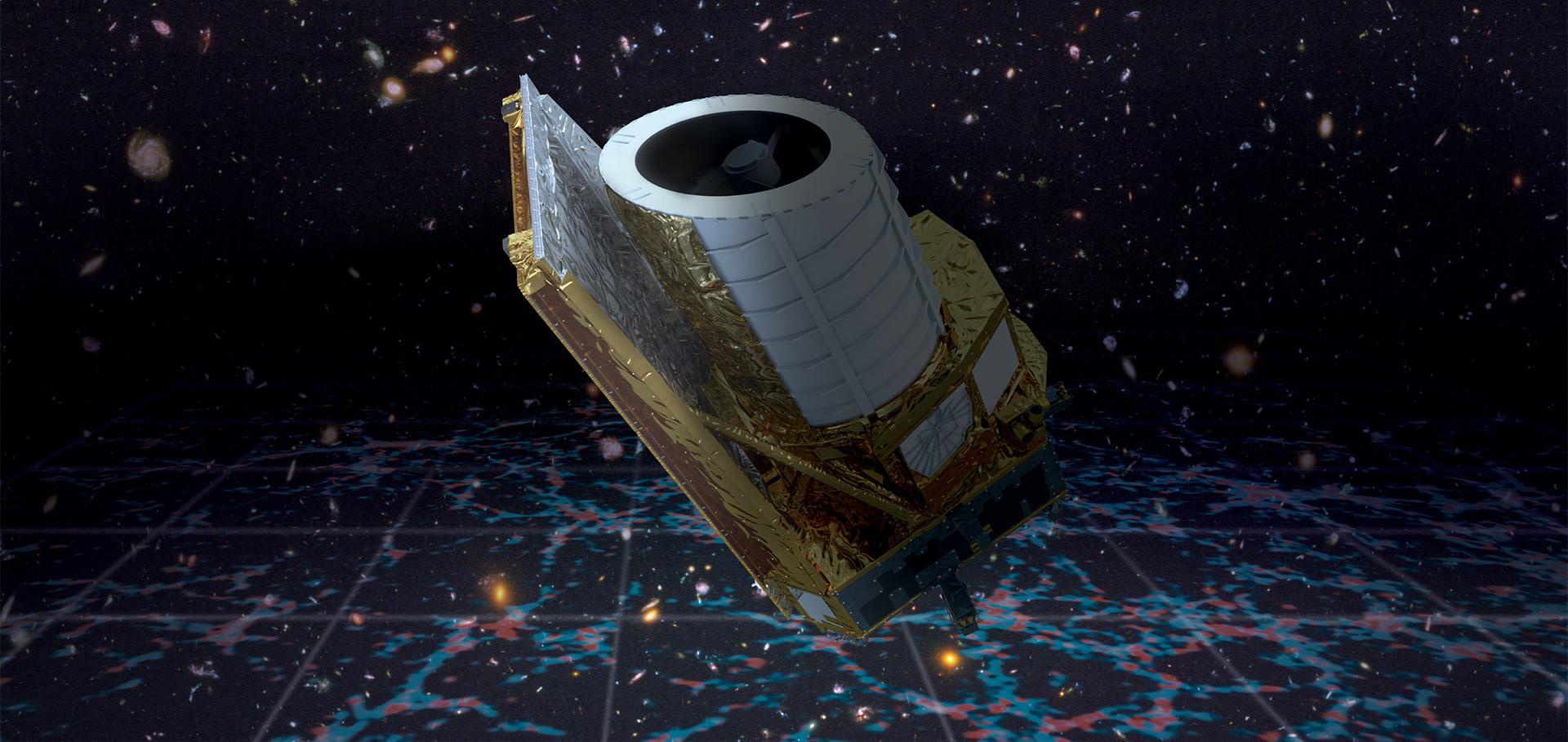
Euclid: I. Overview of the Euclid mission
Astronomy & Astrophysics, Volume 697, id.A1, 94 pp.
Abstract:
The current standard model of cosmology successfully describes a variety of measurements, but the nature of its main ingredients, dark matter and dark energy, remains unknown. Euclid is a medium-class mission in the Cosmic Vision 2015–2025 programme of the European Space Agency (ESA) that will provide high-resolution optical imaging, as well as near-infrared imaging and spectroscopy, over about 14 000 deg2 of extragalactic sky. In addition to accurate weak lensing and clustering measurements that probe structure formation over half of the age of the Universe, its primary probes for cosmology, these exquisite data will enable a wide range of science. This paper provides a high-level overview of the mission, summarising the survey characteristics, the various data-processing steps, and data products. We also highlight the main science objectives and expected performance.
Exploring the Masses of the Two Most Distant Gravitational Lensing Clusters at Cosmic Noon
The Astrophysical Journal, Volume 991, Issue 1, id.109, 10 pp.
Abstract:
Observations over the past decade have shown that galaxy clusters undergo the most transformative changes during the z = 1.5–2 epoch. However, challenges such as low lensing efficiency, high shape measurement uncertainty, and a scarcity of background galaxies have prevented us from characterizing their masses with weak gravitational lensing (WL) beyond redshift z ∼ 1.75. In this paper, we report the successful WL detection of JKCS 041 and XLSSC 122 at z = 1.80 and z = 1.98, respectively, utilizing deep infrared imaging data from the Hubble Space Telescope with careful removal of instrumental effects. These are the most distant clusters ever measured through WL. The mass peaks of JKCS 041 and XLSSC 122, which coincide with the X-ray peak positions of the respective clusters, are detected at the ∼3.7σ and ∼3.2σ levels, respectively. Assuming a single spherical Navarro–Frenk–White profile, we estimate that JKCS 041 has a virial mass of M200c = (5.4 ± 1.6) × 1014 M⊙, while the mass of XLSSC 122 is determined to be M200c = (3.3 ± 1.8) × 1014 M⊙. These WL masses are consistent with the estimates inferred from their X-ray observations. We conclude that although the probability of finding such massive clusters at their redshifts is certainly low, their masses can still be accommodated within the current ΛCDM paradigm.
Head-to-Toe Measurement of El Gordo: Improved Analysis of the Galaxy Cluster ACT-CL J0102-4915 with New Wide-field Hubble Space Telescope Imaging Data
The Astrophysical Journal, Volume 923, Issue 1, id.101, 20 pp.
Abstract:
We present an improved weak-lensing (WL) study of the high-z (z = 0.87) merging galaxy cluster ACT-CL J0102-4915 ("El Gordo") based on new wide-field Hubble Space Telescope imaging data. The new imaging data cover the ~3.5 × ~3.5 Mpc region centered on the cluster and enable us to detect WL signals beyond the virial radius, which was not possible in previous studies. We confirm the binary mass structure consisting of the northwestern (NW) and southeastern (SE) subclusters and the ~2σ dissociation between the SE mass peak and the X-ray cool core. We obtain the mass estimates of the subclusters by simultaneously fitting two Navarro-Frenk-White (NFW) halos without employing mass-concentration relations. The masses are MNW200c=9.9+2.1−2.2× 10¹⁴ and MSE200c=6.5+1.9−1.4× 10¹⁴ M ⊙ for the NW and SE subclusters, respectively. The mass ratio is consistent with our previous WL study but significantly different from the previous strong-lensing results. This discrepancy is attributed to the use of extrapolation in strong-lensing studies because the SE component possesses a higher concentration. By superposing the two best-fit NFW halos, we determine the total mass of El Gordo to be M200c=2.13+0.25−0.23× 10¹⁵ M ⊙, which is ~23% lower than our previous WL result [M 200c = (2.76 ± 0.51) × 1015 M ⊙]. Our updated mass is a more direct measurement, since we are not extrapolating to R 200c as in all previous studies. The new mass is compatible with the current ΛCDM cosmology.