

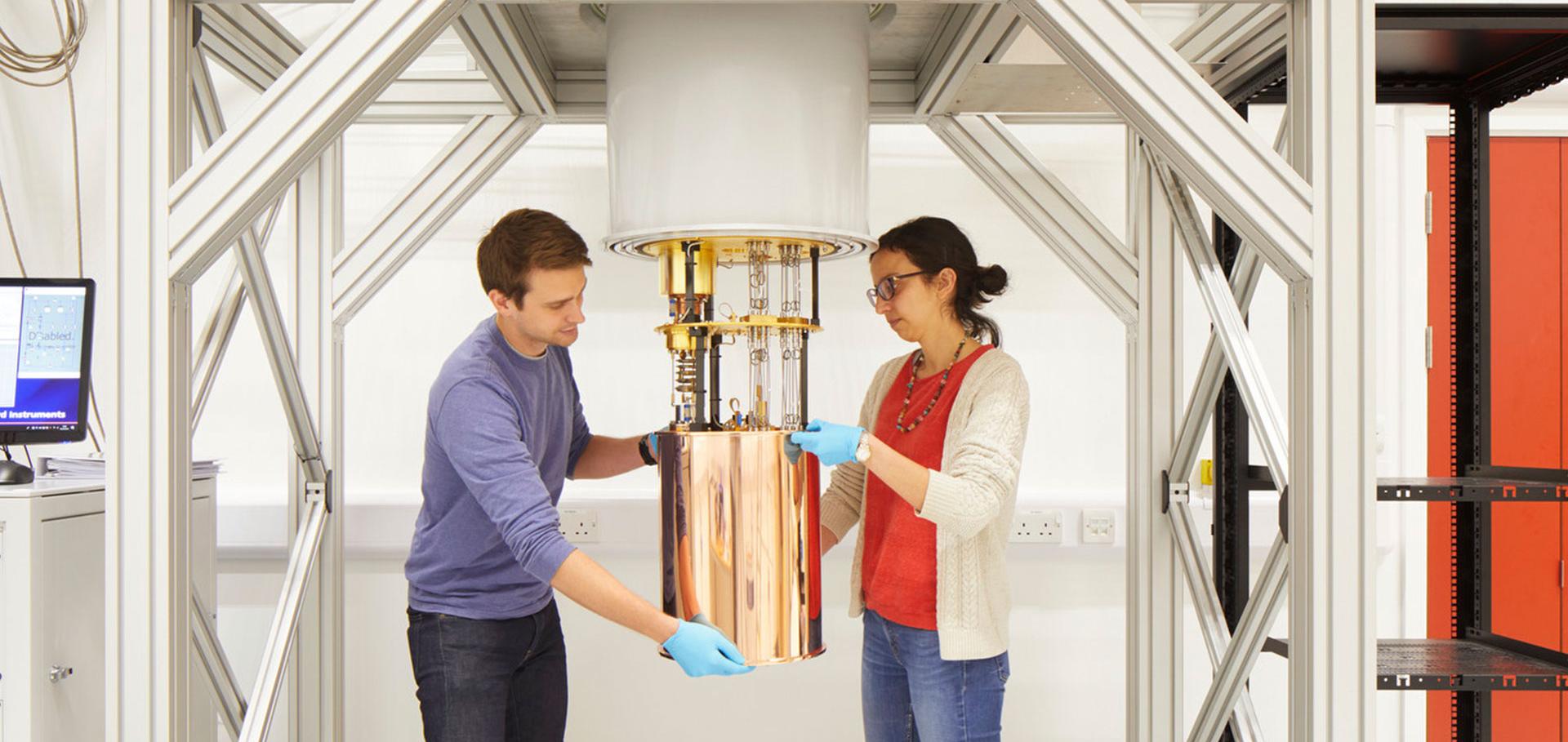
QSHS: an axion dark matter resonant search apparatus
New Journal of Physics IOP Publishing 27:10 (2025) 105002
Abstract:
We describe a resonant cavity search apparatus for axion dark matter constructed by the quantum sensors for the hidden sector collaboration. The apparatus is configured to search for QCD axion dark matter, though also has the capability to detect axion-like particles, dark photons, and some other forms of wave-like dark matter. Initially, a tuneable cylindrical oxygen-free copper cavity is read out using a low noise microwave amplifier feeding a heterodyne receiver. The cavity is housed in a dilution refrigerator (DF) and threaded by a solenoidal magnetic field, nominally 8 T. The apparatus also houses a magnetic field shield for housing superconducting electronics, and several other fixed-frequency resonators for use in testing and commissioning various prototype quantum electronic devices sensitive at a range of axion masses in the range 2.0– 40μeVc−2. The apparatus as currently configured is intended as a test stand for electronics over the relatively wide frequency band attainable with the TM010 cavity mode used for axion searches. We present performance data for the resonator, DF, and magnet, and plans for the first science run.Erratum: Modeling enclosures for large-scale superconducting quantum circuits [Phys. Rev. Applied 14, 024061 (2020)]
Physical Review Applied American Physical Society (APS) 24:4 (2025) 049901
Double-Bracket Algorithmic Cooling
(2025)
Automating quantum computing laboratory experiments with an agent-based AI framework
Patterns Elsevier (2025) 101372
Abstract:
Fully automated self-driving laboratories promise high-throughput, large-scale scientific discovery by reducing repetitive labor. However, they require deep integration of laboratory knowledge, which is often unstructured, multimodal, and hard to incorporate into current AI systems. This paper introduces the “k-agents” framework, designed to support experimentalists in organizing laboratory knowledge and automating experiments with agents. The framework uses large-language-model-based agents to encapsulate laboratory knowledge, including available operations and methods for analyzing results. To automate experiments, execution agents break multistep procedures into agent-based state machines, interact with other agents to execute steps, and analyze results. These results drive state transitions, enabling closed-loop feedback control. We demonstrate the system on a superconducting quantum processor, where agents autonomously planned and executed experiments for hours, successfully producing and characterizing entangled quantum states at human-level performance. Our knowledge-based agent system opens new possibilities for managing laboratory knowledge and accelerating scientific discovery.Characterization of nanostructural imperfections in superconducting quantum circuits
Materials for Quantum Technology IOP Publishing 5:3 (2025) 035201