Our group is based in the Clarendon Laboratory (Department of Physics), University of Oxford. We work closely with the Diamond Light Source on the Harwell Oxford campus, where we carry out advanced synchrotron-based spectroscopy and scattering experiments.

Research interests

Our research focuses on emergent phenomena in magnetic and topological quantum materials. We investigate how symmetry, electronic structure, and magnetic order combine to produce non-trivial band topology, chiral spin textures, and unconventional transport behaviour.

A central theme of the group is the stabilisation and control of topological magnetic states, including skyrmionic and other non-collinear spin configurations, and their coupling to electronic degrees of freedom.

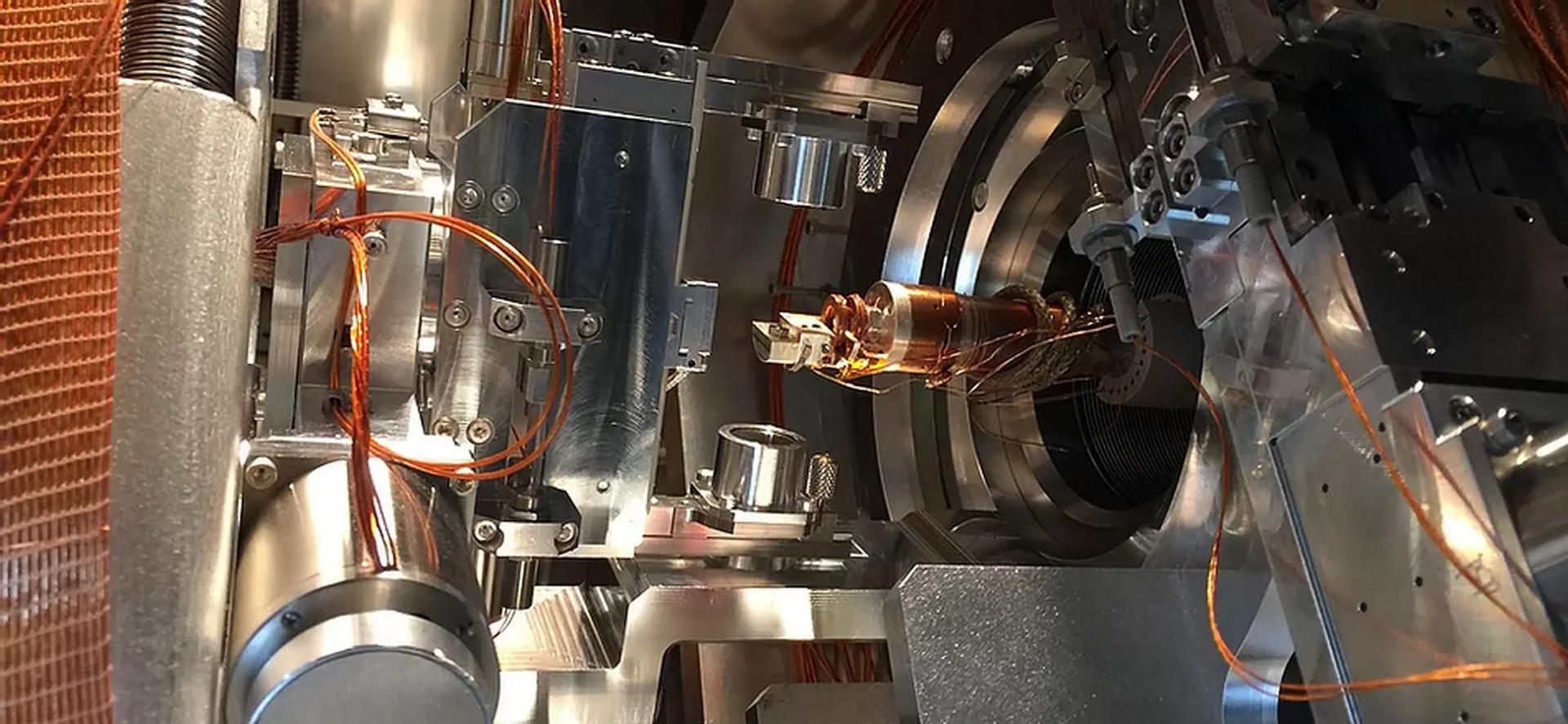
We combine materials development with advanced structural, magnetic, and electronic characterisation. A particular strength of the group is synchrotron-based x-ray spectroscopy and scattering, including time-resolved measurements that probe the dynamics of magnetic and electronic order on ultrafast timescales.
 

Research themes

Magnetic skyrmions - Easy reading

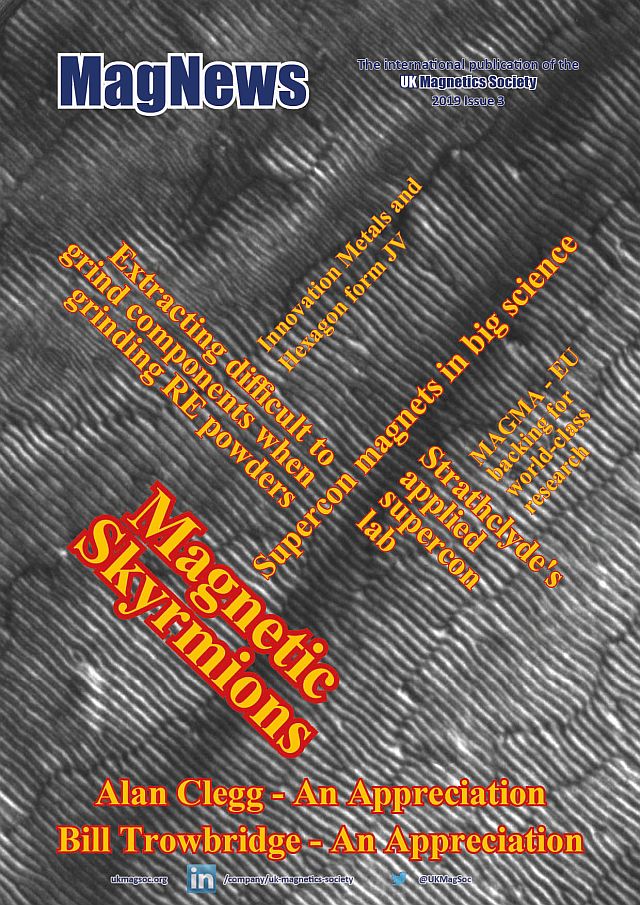
Read up about MAGNETIC SKYRMIONS in the UK Magnetic Society's quarterly magazine, MagNews.

MagNews

Skyrmions are topologically stable, vortex-like magnetization states that form periodic, three-fold symmetric lattices. They were observed in non-centrosymmetric crystals, such as B20 systems, in which the Dzyaloshinskii-Moriya interaction plays a role, using small angle neutron scattering and magnetotransport measurements (topological Hall effect), and in real space using Lorentz transmission electron microscopy. Since each Skyrmion can carry one bit of (binary) information, the crystal itself can be regarded as a high-density, non-volatile information matrix. Most interestingly, the Skyrmion state can be simply manipulated with current densities that are 5-6 orders of magnitude smaller than the ones needed for spin transfer torque (STT)-based schemes. Moreover, direct logic communication can be achieved by introducing the interaction and propagation of vortex/anti-vortex pairs. The value of the Skyrmionics devices lie in the fast and efficient evaluation of suitable materials for STT-MRAM scaling beyond the 65-nm- node, as well as novel emerging memory and logic applications which could become possible by making use of these intriguing physical properties.

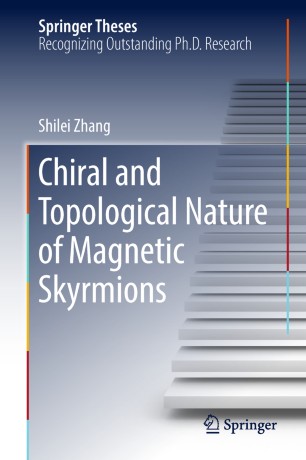
For more details on our work, we refer to Shilei Zhang's book on "Chiral and Topological Nature of Magnetic Skyrmions" (Springer, 2018).

Shilei's thesis