Home
Department Of Physics text logo
  • Research
    • Our research
    • Our research groups
    • Our research in action
    • Research funding support
    • Summer internships for undergraduates
  • Study
    • Undergraduates
    • Postgraduates
  • Engage
    • For young people
    • For teachers
    • For the public
    • For alumni
    • For business
  • Support
Menu
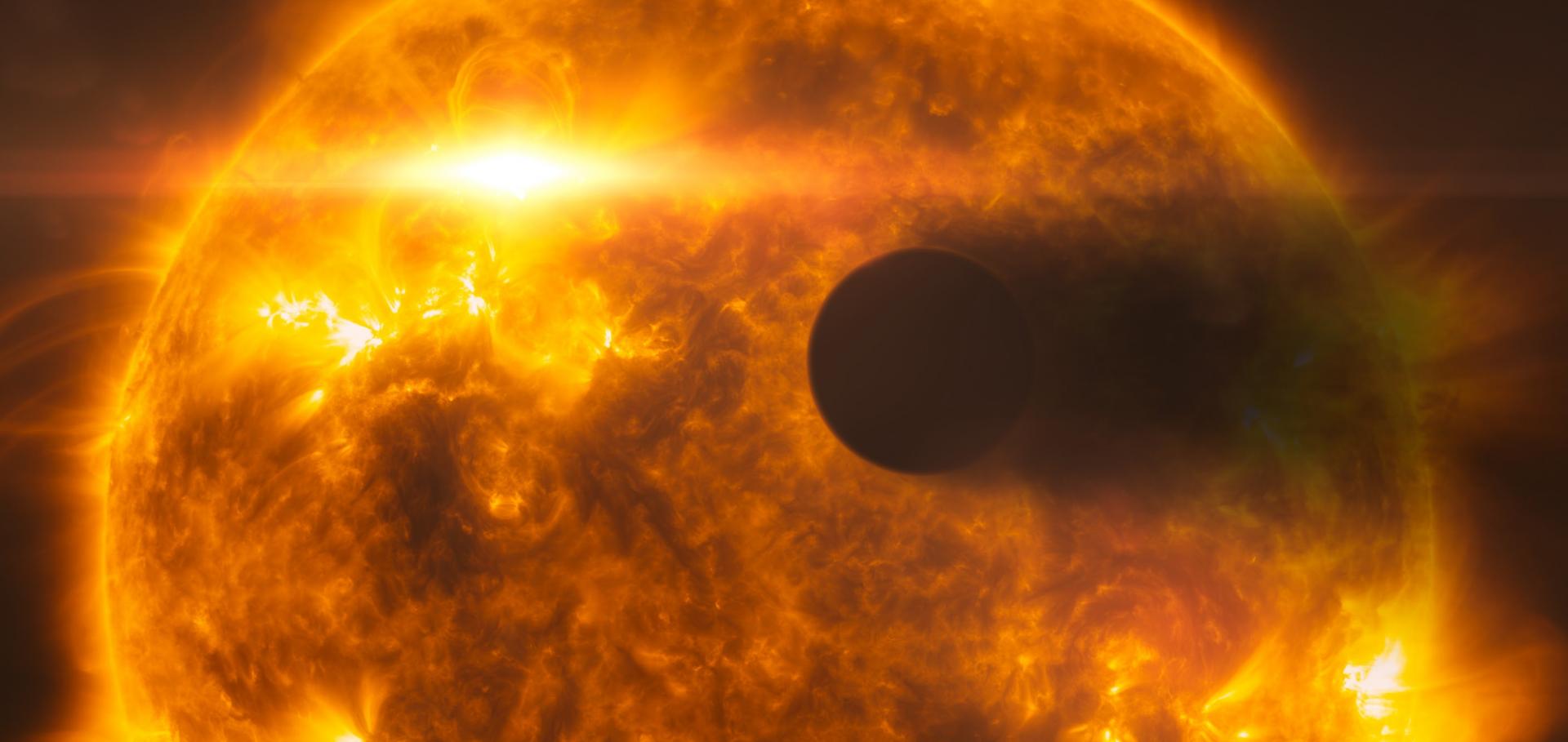
Stellar_flare_hits_HD_189733_b_(artist's_impression)

This artist's impression shows the hot Jupiter HD 189733b, as it passes in front of its parent star, as the latter is flaring, driving material away from the planet. The escaping atmosphere is seen silhouetted against the starlight. The surface of the star, which is around 80% the mass of the Sun, is based on observations of the Sun from NASA's Solar Dynamics Observatory.

Credit: NASA, ESA, L. Calçada, Solar Dynamics Observatory

Prof Suzanne Aigrain

Professor of Astrophysics

Research theme

  • Astronomy and astrophysics
  • Exoplanets and planetary physics

Sub department

  • Astrophysics

Research groups

  • Exoplanets and Stellar Physics
Suzanne.Aigrain@physics.ox.ac.uk
Telephone: 01865 (2)73339
Denys Wilkinson Building, room 762
Stars & Planets @ Oxford research group website
  • About
  • Publications

2.5-D retrieval of atmospheric properties from exoplanet phase curves: Application to WASP-43b observations

Monthly Notices of the Royal Astronomical Society Oxford University Press (OUP)

Authors:

Patrick GJ Irwin, Vivien Parmentier, Jake Taylor, Jo Barstow, Suzanne Aigrain, Graham KH Lee, Ryan Garland

Abstract:

We present a novel retrieval technique that attempts to model phase curve observations of exoplanets more realistically and reliably, which we call the 2.5-dimension (2.5-D) approach. In our 2.5-D approach we retrieve the vertical temperature profile and mean gaseous abundance of a planet at all longitudes and latitudes \textbf{simultaneously}, assuming that the temperature or composition, $x$, at a particular longitude and latitude $(\Lambda,\Phi)$ is given by $x(\Lambda,\Phi) = \bar{x} + (x(\Lambda,0) - \bar{x})\cos^n\Phi$, where $\bar{x}$ is the mean of the morning and evening terminator values of $x(\Lambda,0)$, and $n$ is an assumed coefficient. We compare our new 2.5-D scheme with the more traditional 1-D approach, which assumes the same temperature profile and gaseous abundances at all points on the visible disc of a planet for each individual phase observation, using a set of synthetic phase curves generated from a GCM-based simulation. We find that our 2.5-D model fits these data more realistically than the 1-D approach, confining the hotter regions of the planet more closely to the dayside. We then apply both models to WASP-43b phase curve observations of HST/WFC3 and Spitzer/IRAC. We find that the dayside of WASP-43b is apparently much hotter than the nightside and show that this could be explained by the presence of a thick cloud on the nightside with a cloud top at pressure $< 0.2$ bar. We further show that while the mole fraction of water vapour is reasonably well constrained to $(1-10)\times10^{-4}$, the abundance of CO is very difficult to constrain with these data since it is degenerate with temperature and prone to possible systematic radiometric differences between the HST/WFC3 and Spitzer/IRAC observations. Hence, it is difficult to reliably constrain C/O.
More details
More details from the publisher
Details from ArXiV

Bayesian Quadrature for Ratios

Authors:

MA Osborne, R Garnett, SJ Roberts, C Hart, S Aigrain, NP Gibson, S Aigrain

CoRoT 223992193: Investigating the variability in a low-mass, pre-main sequence eclipsing binary with evidence of a circumbinary disk

Astronomy and Astrophysics Springer Verlag

Authors:

E Gillen, S Aigrain, Caroline Terquem, J Bouvier, SHP Alencar, D Gandolfi, J Stauffer, A Cody, L Venuti, PV Almeida, G Micela, F Favata, HJ Deeg
More details from the publisher
Details from ORA
More details
Details from ArXiV

How does thermal scattering shape the infrared spectra of cloudy exoplanets? A theoretical framework and consequences for atmospheric retrievals in the JWST era

Monthly Notices of the Royal Astronomical Society Oxford University Press (OUP)

Authors:

Jake Taylor, Vivien Parmentier, Michael R Line, Graham KH Lee, Patrick GJ Irwin, Suzanne Aigrain

Abstract:

Observational studies of exoplanets are suggestive of an ubiquitous presence of clouds. The current modelling techniques used in emission to account for the clouds tend to require prior knowledge of the cloud condensing species and often do not consider the scattering effects of the cloud. We explore the effects that thermal scattering has on the emission spectra by modelling a suite of hot Jupiter atmospheres with varying cloud single-scattering albedos (SSAs) and temperature profiles. We examine cases ranging from simple isothermal conditions to more complex structures and physically driven cloud modelling. We show that scattering from nightside clouds would lead to brightness temperatures that are cooler than the real atmospheric temperature, if scattering is unaccounted for. We show that scattering can produce spectral signatures in the emission spectrum even for isothermal atmospheres. We identify the retrieval degeneracies and biases that arise in the context of simulated JWST spectra when the scattering from the clouds dominates the spectral shape. Finally, we propose a novel method of fitting the SSA spectrum of the cloud in emission retrievals, using a technique that does not require any prior knowledge of the cloud chemical or physical properties.
More details from the publisher
Details from ORA
More details
Details from ArXiV

Inferring probabilistic stellar rotation periods using Gaussian processes

Monthly Notices of the Royal Astronomical Society Blackwell Publishing Inc.

Authors:

R Angus, T Morton, S Aigrain, D Foreman-Mackey, V Rajpaul

Abstract:

Variability in the light curves of spotted, rotating stars is often non-sinusoidal and quasi-periodic --- spots move on the stellar surface and have finite lifetimes, causing stellar flux variations to slowly shift in phase. A strictly periodic sinusoid therefore cannot accurately model a rotationally modulated stellar light curve. Physical models of stellar surfaces have many drawbacks preventing effective inference, such as highly degenerate or high-dimensional parameter spaces. In this work, we test an appropriate effective model: a Gaussian Process with a quasi-periodic covariance kernel function. This highly flexible model allows sampling of the posterior probability density function of the periodic parameter, marginalising over the other kernel hyperparameters using a Markov Chain Monte Carlo approach. To test the effectiveness of this method, we infer rotation periods from 333 simulated stellar light curves, demonstrating that the Gaussian process method produces periods that are more accurate than both a sine-fitting periodogram and an autocorrelation function method. We also demonstrate that it works well on real data, by inferring rotation periods for 275 Kepler stars with previously measured periods. We provide a table of rotation periods for these 1132 Kepler objects of interest and their posterior probability density function samples. Because this method delivers posterior probability density functions, it will enable hierarchical studies involving stellar rotation, particularly those involving population modelling, such as inferring stellar ages, obliquities in exoplanet systems, or characterising star-planet interactions. The code used to implement this method is available online.
More details from the publisher
Details from ORA
More details
Details from ArXiV

Pagination

  • First page First
  • Previous page Prev
  • …
  • Page 95
  • Page 96
  • Page 97
  • Page 98
  • Page 99
  • Page 100
  • Current page 101
  • Page 102
  • Page 103
  • Next page Next
  • Last page Last

Footer Menu

  • Contact us
  • Giving to the Dept of Physics
  • Work with us
  • Media

User account menu

  • Log in

Follow us

FIND US

Clarendon Laboratory,

Parks Road,

Oxford,

OX1 3PU

CONTACT US

Tel: +44(0)1865272200

University of Oxfrod logo Department Of Physics text logo
IOP Juno Champion logo Athena Swan Silver Award logo

© University of Oxford - Department of Physics

Cookies | Privacy policy | Accessibility statement

Built by: Versantus

  • Home
  • Research
  • Study
  • Engage
  • Our people
  • News & Comment
  • Events
  • Our facilities & services
  • About us
  • Giving to Physics
  • Current students
  • Staff intranet