Home
Department Of Physics text logo
  • Research
    • Our research
    • Our research groups
    • Our research in action
    • Research funding support
    • Summer internships for undergraduates
  • Study
    • Undergraduates
    • Postgraduates
  • Engage
    • For young people
    • For teachers
    • For the public
    • For alumni
    • For business
  • Support
Menu
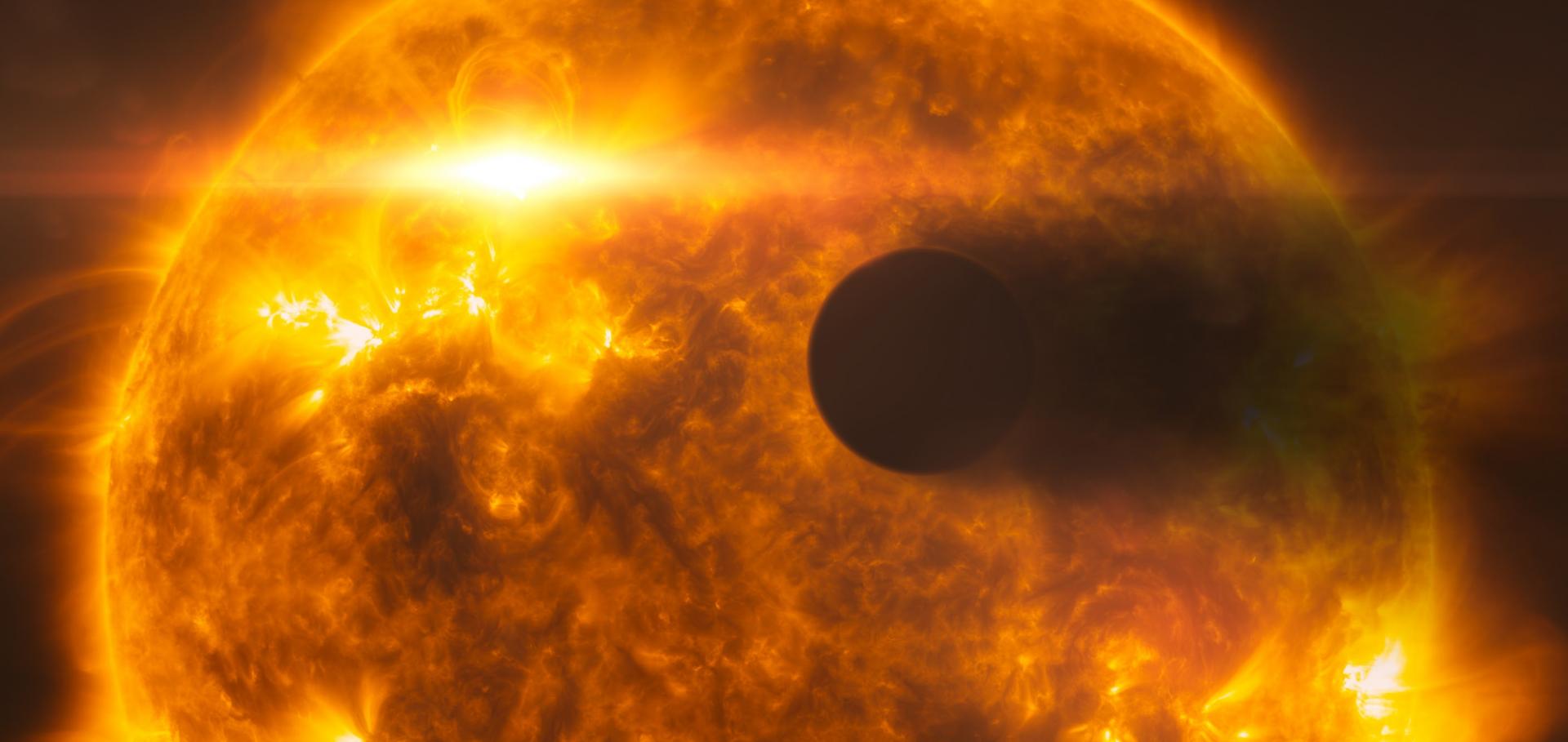
Stellar_flare_hits_HD_189733_b_(artist's_impression)

This artist's impression shows the hot Jupiter HD 189733b, as it passes in front of its parent star, as the latter is flaring, driving material away from the planet. The escaping atmosphere is seen silhouetted against the starlight. The surface of the star, which is around 80% the mass of the Sun, is based on observations of the Sun from NASA's Solar Dynamics Observatory.

Credit: NASA, ESA, L. Calçada, Solar Dynamics Observatory

Prof Suzanne Aigrain

Professor of Astrophysics

Research theme

  • Astronomy and astrophysics
  • Exoplanets and planetary physics

Sub department

  • Astrophysics

Research groups

  • Exoplanets and Stellar Physics
Suzanne.Aigrain@physics.ox.ac.uk
Telephone: 01865 (2)73339
Denys Wilkinson Building, room 762
Stars & Planets @ Oxford research group website
  • About
  • Publications

K2 photometry and HERMES spectroscopy of the blue supergiant rho Leo: rotational wind modulation and low-frequency waves

Monthly Notices of the Royal Astronomical Society: Letters Blackwell Publishing

Authors:

C Aerts, DM Bowman, S Simon-Diaz, B Buysschaert, CC Johnston, E Moravveji, PG Beck, PD Cat, SA Triana, S Aigrain, N Castro, D Huber, T White

Abstract:

We present an 80-d long uninterrupted high-cadence K2 light curve of the B1Iab supergiant rho Leo (HD 91316), deduced with the method of halo photometry. This light curve reveals a dominant frequency of $f_{\rmrot}=0.0373$d$^{-1}$ and its harmonics. This dominant frequency corresponds with a rotation period of 26.8d and is subject to amplitude and phase modulation. The K2 photometry additionally reveals multiperiodic low-frequency variability ($<1.5 $d$^{-1}$) and is in full agreement with low-cadence high-resolution spectroscopy assembled during 1800 days. The spectroscopy reveals rotational modulation by a dynamic aspherical wind with an amplitude of about 20km s$^{-1}$ in the H$\alpha$ line, as well as photospheric velocity variations of a few km s$^{-1}$ at frequencies in the range 0.2 to 0.6 d$^{-1}$ in the SiIII 4567\AA\ line. Given the large macroturbulence needed to explain the spectral line broadening of the star, we interpret the detected photospheric velocity as due to travelling super-inertial low-degree large-scale gravity waves with dominant tangential amplitudes and discuss why $\rho$~Leo is an excellent target to study how the observed photospheric variability propagates into the wind.
More details
More details from the publisher
Details from ORA
More details
Details from ArXiV

LHS 1903 provides evidence for gas-depleted formation of planets around M-dwarfs

Authors:

Thomas Wilson, Anna Simpson, Andrew Collier Cameron, Ryan Cloutier, Vardan Adibekyan, Ancy Anna John, Y Alibert, Manu Stalport, J Egger, Andrea Bonfanti, Nicolas Billot, Pascal Guterman, Pierre Maxted, Attila Simon, Sergio Sousa, Malcolm Fridlund, M Beck, Anja Bekkelien, S Salmon, Valerie Van Grootel, Luca Fossati, Alexander Mustill, Hugh Osborn, Tiziano Zingales, M Hooton, Laura Affer, Suzanne Aigrain, Roi Alonso, G Anglada-Escude, Alexandros Antoniadis-Karnavas, T Barczy, David Barrado, Susana Barros, Wolfgang Baumjohann, T Beck, W Benz, Federico Biondi, Xavier Bonfils, Luca Borsato, Alexis Brandeker, Christopher Broeg, Lars Buchhave, Maximilian Buder, Juan Cabrera, S Carrazco Gaxiola, Sébastien Charnoz, David Ciardi, Karen Collins, Kevin Collins, Rosario Cosentino, Szilard Csizmadia, P Cubillos, Shweta Dalal, Mario Damasso, James Davenport, Melvyn Davies, Magali Deleuil, L Delrez, Olivier Demangeon, Brice-Olivier Demory, Victoria DiTomasso, Diana Dragomir, Courtney Dressing, Xavier Dumusque, David Ehrenreich, Anders Erikson, Emma Esparza-Borges, Andrea Fortier, Izuru Fukuda, Akihiko Fukui, Davide Gandolfi, Adriano Ghedina, Steven Giacalone, Holden Gill, Michaël Gillon, Y Gomez Maqueo Chew, Manuel Güdel, Pere Guerra, Maximilian Günther, Nathan Hara, Avet Harutyunyan, Yuya Hayashi, Raphaëlle Haywood, Rae Holcomb, Keith Horne, S Hoyer, Chelsea Huang, Masahiro Ikoma, K Isaak, James Jackman, Jon Jenkins, Eric Jensen, Daniel Jontof-Hutter, Yugo Kawai, Laszlo Kiss, Ben Lakeland, J Laskar, David Latham, Alain Lecavelier des Etangs, Adrien Leleu, Monika Lendl, J de Leon, Florian Lienhard, Mercedes López-Morales, Christophe Lovis, Michael Lund, Rafael Luque, D Magrin, Luca Malavolta, Aldo Fiorenzano, Andrew Mayo, Michel Mayor, C Mordasini, Annelies Mortier, Felipe Murgas, Norio Narita, Valerio Nascimbeni, Belinda Nicholson, Göran Olofsson, Roland Ottensamer, Isabella Pagano, Larissa Palethorpe, Enric Palle, Hannu Parviainen, Marco Pedani, Francesco Pepe, Gisbert Peter, Matteo Pinamonti, Giampaolo Piotto, Don Pollacco, Ennio Poretti, Didier Queloz, Sam Quinn, R Ragazzoni, N Rando, David Rapetti, F Ratti, Heike Rauer, Federica Rescigno, Ignasi Ribas, William Rice, George Ricker, Paul Robertson, Thierry de Roche, L Sabin, Nuno Santos, Dimitar Sasselov, Arjun Savel, Gaetano Scandariato, Nicole Schanche, Urs Schroffenegger, Richard Schwarz, Sara Seager, Ramotholo Sefako, Damien Ségransan, Avi Shporer, André Silva, Alexis Smith, Alessandro Sozzetti, Manfred Steller, Gyula Szabo, Motohide Tamura, Nicolas Thomas, Amy Tuson, Stéphane Udry, Andrew Vanderburg, Roland Vanderspek, J Venturini, Francesco Verrecchia, Nicholas Walton, Christopher Watson, Robert Wells, Joshua Winn, Roberto Zambelli, Carl Ziegler
More details from the publisher

Planet Hunters TESS I: TOI 813, a subgiant hosting a transiting Saturn-sized planet on an 84-day orbit

Authors:

NL Eisner, O Barragán, S Aigrain, C Lintott, G Miller, N Zicher, TS Boyajian, C Briceño, EM Bryant, JL Christiansen, AD Feinstein, LM Flor-Torres, M Fridlund, D Gandolfi, J Gilbert, N Guerrero, JM Jenkins, K Jones, MH Kristiansen, A Vanderburg, N Law, AR López-Sánchez, AW Mann, EJ Safron, ME Schwamb, KG Stassun, HP Osborn, J Wang, A Zic, C Ziegler, F Barnet, SJ Bean, DM Bundy, Z Chetnik, JL Dawson, J Garstone, AG Stenner, M Huten, S Larish, LD Melanson, T Mitchell, C Moore, K Peltsch, DJ Rogers, C Schuster, DS Smith, DJ Simister, C Tanner, I Terentev, A Tsymbal

Abstract:

We report on the discovery and validation of TOI 813b (TIC 55525572 b), a transiting exoplanet identified by citizen scientists in data from NASA's Transiting Exoplanet Survey Satellite (TESS) and the first planet discovered by the Planet Hunters TESS project. The host star is a bright (V = 10.3 mag) subgiant ($R_\star=1.94\,R_\odot$, $M_\star=1.32\,M_\odot$). It was observed almost continuously by TESS during its first year of operations, during which time four individual transit events were detected. The candidate passed all the standard light curve-based vetting checks, and ground-based follow-up spectroscopy and speckle imaging enabled us to place an upper limit of $2 M_{Jup}$ (99 % confidence) on the mass of the companion, and to statistically validate its planetary nature. Detailed modelling of the transits yields a period of $83.8911_{ - 0.0031 } ^ { + 0.0027 }$ days, a planet radius of $6.71 \pm 0.38$ $R_{\oplus}$, and a semi major axis of $0.423_{ - 0.037 } ^ { + 0.031 }$ AU. The planet's orbital period combined with the evolved nature of the host star places this object in a relatively under-explored region of parameter space. We estimate that TOI-813b induces a reflex motion in its host star with a semi-amplitude of $\sim6$ ms$^{-1}$, making this system a promising target to measure the mass of a relatively long-period transiting planet.
More details from the publisher
Details from ORA
More details
Details from ArXiV

The Kepler Smear Campaign: Light curves for 102 Very Bright Stars

Astrophysical Journal Supplement American Astronomical Society

Authors:

Benjamin JS Pope, Guy R Davies, Keith Hawkins, Timothy R White, Amalie Stokholm, Allyson Bieryla, David W Latham, Madeline Lucey, Conny Aerts, Suzanne Aigrain, Victoria Antoci, Timothy R Bedding, Dominic M Bowman, Douglas A Caldwell, Ashley Chontos, Gilbert A Esquerdo, Daniel Huber, Paula Jofre, Simon J Murphy, Timothy van Reeth, Victor Silva Aguirre, Jie Yu

Abstract:

We present the first data release of the Kepler Smear Campaign, using collateral 'smear' data obtained in the Kepler four-year mission to reconstruct light curves of 102 stars too bright to have been otherwise targeted. We describe the pipeline developed to extract and calibrate these light curves, and show that we attain photometric precision comparable to stars analyzed by the standard pipeline in the nominal Kepler mission. In this paper, aside from publishing the light curves of these stars, we focus on 66 red giants for which we detect solar-like oscillations, characterizing 33 of these in detail with spectroscopic chemical abundances and asteroseismic masses as benchmark stars. We also classify the whole sample, finding nearly all to be variable, with classical pulsations and binary effects. All source code, light curves, TRES spectra, and asteroseismic and stellar parameters are publicly available as a Kepler legacy sample.
More details
More details from the publisher
Details from ORA
More details
Details from ArXiV

The Search for Living Worlds and the Connection to Our Cosmic Origins

Authors:

MA Barstow, SUZANNE Aigrain, J Barstow, M Barthelemy, B Biller, A Bonanos, L Buchhave, S Casewell, C Charbonnel, S Charlot, R Davies, N Devaney, C Evans, M Ferrari, L Fossatti, B Gaensicke, M Garcia, AGD Castro, T Henning, C Lintott, C Knigge, C Neiner, L Rossi, C Snodgrass, D Stam, E Tolstoy, M Tosi

Abstract:

One of the most exciting scientific challenges is to detect Earth-like planets in the habitable zones of other stars in the galaxy and search for evidence of life. The ability to observe and characterise dozens of potentially Earth-like planets now lies within the realm of possibility due to rapid advances in key space and imaging technologies. The associated challenge of directly imaging very faint planets in orbit around nearby very bright stars is now well understood, with the key instrumentation also being perfected and developed. Such advances will allow us to develop large transformative telescopes, covering a broad UV-optical-IR spectral range, which can carry out the detailed research programmes designed to answer the questions we wish to answer: Carry out high contrast imaging surveys of nearby stars to search for planets within their habitable zones. Characterise the planets detected to determine masses and radii from photometric measurements. Through spectroscopic studies of their atmospheres and surfaces, search for habitability indicators and for signs of an environment that has been modified by the presence of life. Active studies of potential missions have been underway for a number of years. The latest of these is the Large UV Optical IR space telescope (LUVOIR), one of four flagship mission studies commissioned by NASA in support of the 2020 US Decadal Survey. LUVOIR, if selected, will be of interest to a wide scientific community and will be the only telescope capable of searching for and characterizing a sufficient number of exoEarths to provide a meaningful answer to the question - Are we alone?. This paper is a submission to the European Space Agency Voyage 2050 call for white papers outlining the case for an ESA contribution to a Large UVOIR telescope.
Details from ArXiV

Pagination

  • First page First
  • Previous page Prev
  • …
  • Page 95
  • Page 96
  • Page 97
  • Page 98
  • Page 99
  • Page 100
  • Page 101
  • Current page 102
  • Page 103
  • Next page Next
  • Last page Last

Footer Menu

  • Contact us
  • Giving to the Dept of Physics
  • Work with us
  • Media

User account menu

  • Log in

Follow us

FIND US

Clarendon Laboratory,

Parks Road,

Oxford,

OX1 3PU

CONTACT US

Tel: +44(0)1865272200

University of Oxfrod logo Department Of Physics text logo
IOP Juno Champion logo Athena Swan Silver Award logo

© University of Oxford - Department of Physics

Cookies | Privacy policy | Accessibility statement

Built by: Versantus

  • Home
  • Research
  • Study
  • Engage
  • Our people
  • News & Comment
  • Events
  • Our facilities & services
  • About us
  • Giving to Physics
  • Current students
  • Staff intranet