Home
Department Of Physics text logo
  • Research
    • Our research
    • Our research groups
    • Our research in action
    • Research funding support
    • Summer internships for undergraduates
  • Study
    • Undergraduates
    • Postgraduates
  • Engage
    • For alumni
    • For business
    • For schools
    • For the public
  • Support
Menu
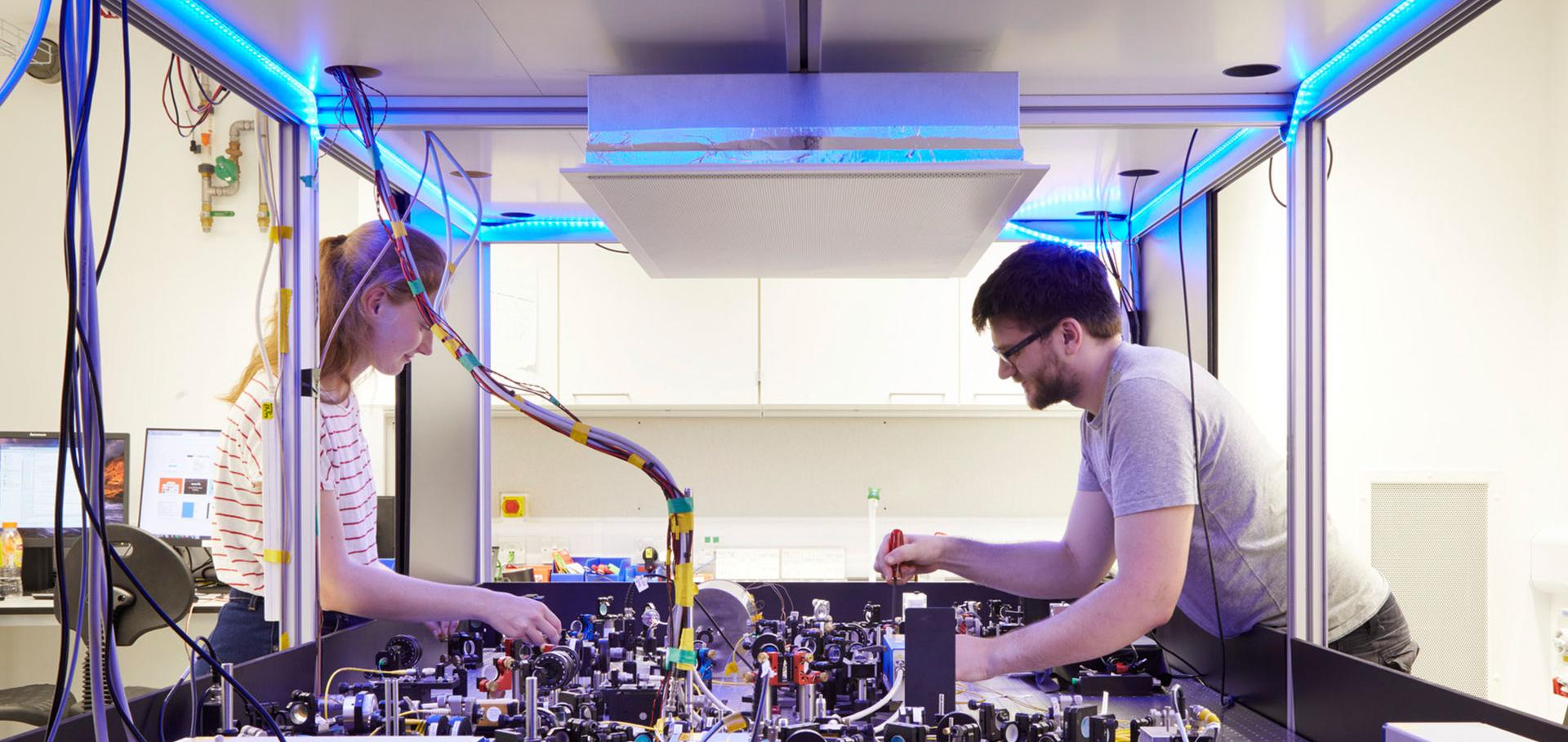
Atomic and Laser Physics
Credit: Jack Hobhouse

Professor Andrew Daley

Professor of Quantum Physics

Research theme

  • Quantum information and computation
  • Quantum optics & ultra-cold matter

Sub department

  • Atomic and Laser Physics

Research groups

  • Theory of quantum systems
andrew.daley@physics.ox.ac.uk
Clarendon Laboratory, room 316.3
  • About
  • Publications

High-fidelity multiqubit Rydberg gates via two-photon adiabatic rapid passage

Quantum Science and Technology IOP Publishing 7:4 (2022) 045020

Authors:

G Pelegrí, AJ Daley, JD Pritchard
More details from the publisher

Variational Quantum Algorithms for Computational Fluid Dynamics

(2022)

Authors:

Dieter Jaksch, Peyman Givi, Andrew J Daley, Thomas Rung
More details from the publisher
Details from ArXiV

Propagation of errors and quantitative quantum simulation with quantum advantage

Quantum Science and Technology IOP Publishing 7:4 (2022) 045025-045025

Authors:

S Flannigan, N Pearson, GH Low, A Buyskikh, I Bloch, P Zoller, M Troyer, AJ Daley

Abstract:

The rapid development in hardware for quantum computing and simulation has led to much interest in problems where these devices can exceed the capabilities of existing classical computers and known methods. Approaching this for problems that go beyond testing the performance of a quantum device is an important step, and quantum simulation of many-body quench dynamics is one of the most promising candidates for early practical quantum advantage. We analyse the requirements for quantitatively reliable quantum simulation beyond the capabilities of existing classical methods for analogue quantum simulators with neutral atoms in optical lattices and trapped ions. Considering the primary sources of error in analogue devices and how they propagate after a quench in studies of the Hubbard or long-range transverse field Ising model, we identify the level of error expected in quantities we extract from experiments. We conclude for models that are directly implementable that regimes of practical quantum advantage are attained in current experiments with analogue simulators. We also identify the hardware requirements to reach the same level of accuracy with future fault-tolerant digital quantum simulation. Verification techniques are already available to test the assumptions we make here, and demonstrating these in experiments will be an important next step
More details from the publisher
Details from ORA
More details

Practical quantum advantage in quantum simulation

Nature Springer Nature 607:7920 (2022) 667-676

Authors:

Andrew J Daley, Immanuel Bloch, Christian Kokail, Stuart Flannigan, Natalie Pearson, Matthias Troyer, Peter Zoller
More details from the publisher
More details
More details

Density Matrix Renormalization Group for Continuous Quantum Systems

Physical Review Letters American Physical Society (APS) 128:23 (2022) 230401

Authors:

Shovan Dutta, Anton Buyskikh, Andrew J Daley, Erich J Mueller
More details from the publisher
More details
More details

Pagination

  • First page First
  • Previous page Prev
  • …
  • Page 6
  • Page 7
  • Page 8
  • Page 9
  • Current page 10
  • Page 11
  • Page 12
  • Page 13
  • Page 14
  • …
  • Next page Next
  • Last page Last

Footer Menu

  • Contact us
  • Giving to the Dept of Physics
  • Work with us
  • Media

User account menu

  • Log in

Follow us

FIND US

Clarendon Laboratory,

Parks Road,

Oxford,

OX1 3PU

CONTACT US

Tel: +44(0)1865272200

University of Oxfrod logo Department Of Physics text logo
IOP Juno Champion logo Athena Swan Silver Award logo

© University of Oxford - Department of Physics

Cookies | Privacy policy | Accessibility statement

Built by: Versantus

  • Home
  • Research
  • Study
  • Engage
  • Our people
  • News & Comment
  • Events
  • Our facilities & services
  • About us
  • Giving to Physics
  • Current students
  • Staff intranet