


Update on NASA’s New Horizons Mission: Kuiper Belt Science Results and Future Plans
Copernicus Publications (2025)
Abstract:
NASA’s New Horizons spacecraft continues to explore the Kuiper belt after its historic close flybys of the Pluto system in 2015 at ~33 astronomical units (AU) [1] and the cold classical Kuiper belt object (KBO) Arrokoth in 2019 at ~43 AU [2]. New Horizons is located at ~61.7 AU as of this writing in May 2025, and travels about 3 AU per year. New Horizons has sufficient power, propellant, and communications capability to continue operations until the mid-to-late 2040s and, thus, should be able to collect data out to distances of ~120 AU or greater. In its extended mission, New Horizons’ main planetary science focus is studying Kuiper belt dwarf planets and small KBOs, and their environment. We will provide an overview of results for the dwarf planets and smaller KBOs observed by New Horizons from a distance ([3-6]; also see Porter et al., 2025 abstract at this conference). New Horizons can observe KBOs from much higher phase angles than possible from Earth, and some of the observed KBOs come as close as 0.1 AU to the spacecraft. This allows for the study of shapes, poles, surface properties, and searches for close satellites in some cases. New Horizons also made high-phase, color observations of the ice giants Uranus and Neptune [7] in coordination with the Hubble Space Telescope and as an exoplanet observation analogue. Further, the New Horizons Student Dust Counter continues to observe elevated dust fluxes at larger distances than expected, and the team is exploring possible explanations for why the dust flux has not yet started to decrease as predicted by previous models [8, 9]. We will also highlight some new products and findings related to Arrokoth, including a new shape model [10], images draped onto the shape model, and a study placing Arrokoth’s crater size-frequency distribution into the context of those on other small bodies [11]. Looking towards the future of New Horizons: We will provide a status update on the ground-based, Subaru Telescope search [12-14] for a future close flyby target and other KBOs that New Horizons could observe as point sources. We will also discuss how future work would enhance the chances of finding a future flyby target for New Horizons, including the additional use of machine learning/artificial intelligence, supercomputing, and potential observations from the Vera Rubin Observatory (also see Kavelaars et al. 2025 abstract in this conference) or the Roman Space Telescope.References:[1] Stern S. A. et al., 2015, The Pluto system: Initial results from its exploration by New Horizons, Science 350, id.aad1815. doi:10.1126/science.aad1815[2] Stern S. A. et al., 2019, Initial results from the New Horizons exploration of 2014 MU69, a small Kuiper Belt object, Science 364. doi:10.1126/science.aaw9771[3] Verbiscer A. J. et al., 2024, The New Horizons Photometric Phase Angle Survey of Deep Outer Solar System Objects: From the Kuiper Belt to the Scattered Disk, 55th Lunar and Planetary Science Conference. 3040, 2531.[4] Verbiscer A. J. et al., 2022, The Diverse Shapes of Dwarf Planet and Large KBO Phase Curves Observed from New Horizons, The Planetary Science Journal 3, 95. doi:10.3847/PSJ/ac63a6[5] Verbiscer A. J. et al., 2019, Phase Curves from the Kuiper Belt: Photometric Properties of Distant Kuiper Belt Objects Observed by New Horizons, Astron. J. 158. doi:10.3847/1538-3881/ab3211[6] Porter S. B. et al., 2016, The First High-phase Observations of a KBO: New Horizons Imaging of (15810) 1994 JR1 from the Kuiper Belt, ApJ Letters 828. doi:10.3847/2041-8205/828/2/L15[7] Hasler S. N. et al., 2024, Observations of Uranus at High Phase Angle as Seen by New Horizons, The Planetary Science Journal 5, 267. doi:10.3847/PSJ/ad8cdb[8] Corbett T. et al., 2025, Production, Transport, and Destruction of Dust in the Kuiper Belt: The Effects of Refractory and Volatile Grain Compositions, Astrophys J. 979, L50. doi:10.3847/2041-8213/adab75[9] Doner A. et al., 2024, New Horizons Venetia Burney Student Dust Counter Observes Higher than Expected Fluxes Approaching 60 AU, pp. arXiv:2401.01230.[10] Porter S. B. et al., 2024, The Shape and Formation of Arrokoth, 55th Lunar and Planetary Science Conference. 3040, 2332.[11] Knudsen I. E. et al., 2024, An Analysis of Impact Craters on Small Bodies Throughout the Solar System, The Trans-neptunian Solar System.[12] Yoshida F. et al., 2024, A deep analysis for New Horizons' KBO search images, Publications of the Astronomical Society of Japan 76, 720-732. doi:10.1093/pasj/psae043[13] Fraser W. C. et al., 2024, Candidate Distant Trans-Neptunian Objects Detected by the New Horizons Subaru TNO Survey, The Planetary Science Journal 5, 227. doi:10.3847/PSJ/ad6f9e[14] Buie M. W. et al., 2024, The New Horizons Extended Mission Target: Arrokoth Search and Discovery, The Planetary Science Journal 5, 196. doi:10.3847/PSJ/ad676dUpdate to thermal inertia and albedo maps of Enceladus
Copernicus Publications (2025)
Abstract:
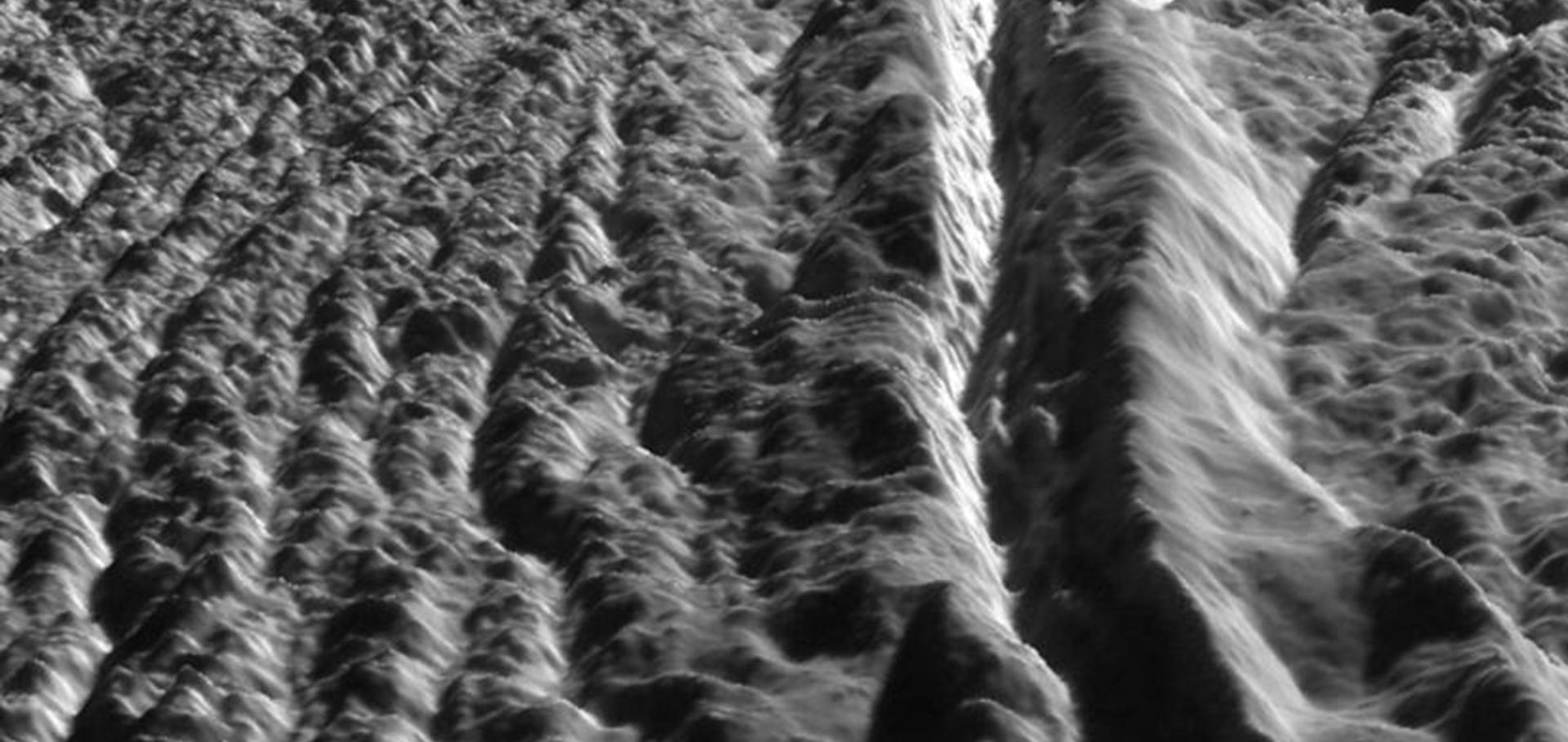
We present work to update current maps of the thermal properties of Enceladus using thermal observations from the Cassini Composite InfraRed Spectrometer (CIRS). In 2010, the first maps of Enceladus’ thermal inertia were published that used what CIRS data was available at the time (Howett et al., 2010). These maps were resolved into some latitude zones, and overall conveyed lower thermal inertia and albedo at higher latitudes, and confirmed that like other cold, icy moons of Saturn its surface had low (< 50 MKS) thermal inertia. Improvements to these maps using the totality of the CIRS Focal Plane 1 data (10-600 cm-1 / 16.7-1000 μm) from the mission with updated error estimates will yield better spatial resolution in addition to higher precision estimates of thermal inertia and albedo. This will be particularly useful for improving models of surface temperature or estimating endogenic heat fluxes, like those at Enceladus’ south pole, associated with dissipation of heat from beneath.Acknowledgements: Thanks are given to the NASA Cassini Data Analysis program that funded this work (80NSSC20K0477 and 80NSSC24K0373). Reference:Howett, C.J.A., Spencer, J.R., Pearl, J. and Segura, M., 2010. Thermal inertia and bolometric Bond albedo values for Mimas, Enceladus, Tethys, Dione, Rhea and Iapetus as derived from Cassini/CIRS measurements. Icarus, 206(2), pp.573-593.Thermal-IR Observations of (152830) Dinkinesh during the Lucy Mission Flyby
The Planetary Science Journal American Astronomical Society 6:7 (2025) 168
Abstract:
NASA’s Lucy spacecraft flew by the main-belt asteroid (152830) Dinkinesh on 2023 November 1, providing a test of its instruments and systems prior to its encounters with the Jupiter Trojans and enabling an opportunity for scientific investigation of this asteroid. Analysis of disk-integrated radiance spectra of Dinkinesh collected by the Lucy Thermal Emission Spectrometer (L’TES) instrument during the close approach reveals a thermal inertia for Dinkinesh of 91 ± 24 J m−2 K−1 s−1/2 and a surface roughness of 35° ± 7° rms slope. These values for the thermal inertia and surface roughness are comparable to values derived for other small S-type asteroids such as (65803) Didymos. The Dinkinesh flyby also provided the opportunity to develop new techniques for extracting data when the target body does not fill the field of view of the L’TES instrument, which proved challenging for predecessors of this instrument such as OTES on OSIRIS-REx. The grain size of the regolith of Dinkinesh, estimated to be r=1.2−0.6+0.9 mm, is below expected trends with size but is comparable to that of similarly sized asteroids that are either binaries or may have undergone rotational fission in the past. These findings imply that fine-grained materials are being preferentially retained on the primaries of multiple systems, either by cohesive forces or by redeposition after impact events on the secondaries.Constraining the Mass and Energy of Enceladus’ Dissipation Systems
Space Science Reviews Springer 221:5 (2025) 56
Abstract:
NASA’s Cassini mission revealed endogenic activity at the south pole of Saturn’s moon Enceladus. The activity is concentrated along four fractures in Enceladus’ ice shell, which are much warmer than their surroundings and the source of Enceladus’ plumes. This work provides a review of the current state of knowledge of the energy and mass lost by Enceladus through this activity. Specifically, we discuss the composition of the plumes, along with their spatial and temporal variation. The mass flux loss predicted for the three plume constituents (gas, dust and charged particles) is reviewed and a total mass flux of ejected material that subsequently escapes Enceladus is estimated to be 2.1×10¹¹ kg over a Saturn year. Given that Enceladus’ ocean is predicted to be 1019 kg this loss is sustainable in the very long term (∼1.5 billion Earth years). However, unless a resupply mechanism (such as serpentinization) exists molecular hydrogen is expected to be depleted within ∼1 million Earth years. The difficulty in determining Enceladus’ current heat flow is outlined, along with the advantages and disadvantages of the various techniques used to derive it. We find a robust lower limit for Enceladus’ exogenic production is 7.3 GW. Tidal heating models show endogenic emission of this level is sustainable, and Enceladus may have long-term near-surface heating (a result supported by studies of Enceladus’ geology). Finally, we offer suggestions for future observations, instrumentation, and missions. Enceladus remains a high-priority target for NASA, and as such it is highly likely that we will return to study this enigmatic world. Hopefully these missions will answer some of the questions that remain.Lucy L′Ralph In-flight Calibration and Results at (152830) Dinkinesh
The Planetary Science Journal IOP Publishing 6:1 (2025) 7