Home
Department Of Physics text logo
  • Research
    • Our research
    • Our research groups
    • Our research in action
    • Research funding support
    • Summer internships for undergraduates
  • Study
    • Undergraduates
    • Postgraduates
  • Engage
    • For alumni
    • For business
    • For schools
    • For the public
  • Support
Menu
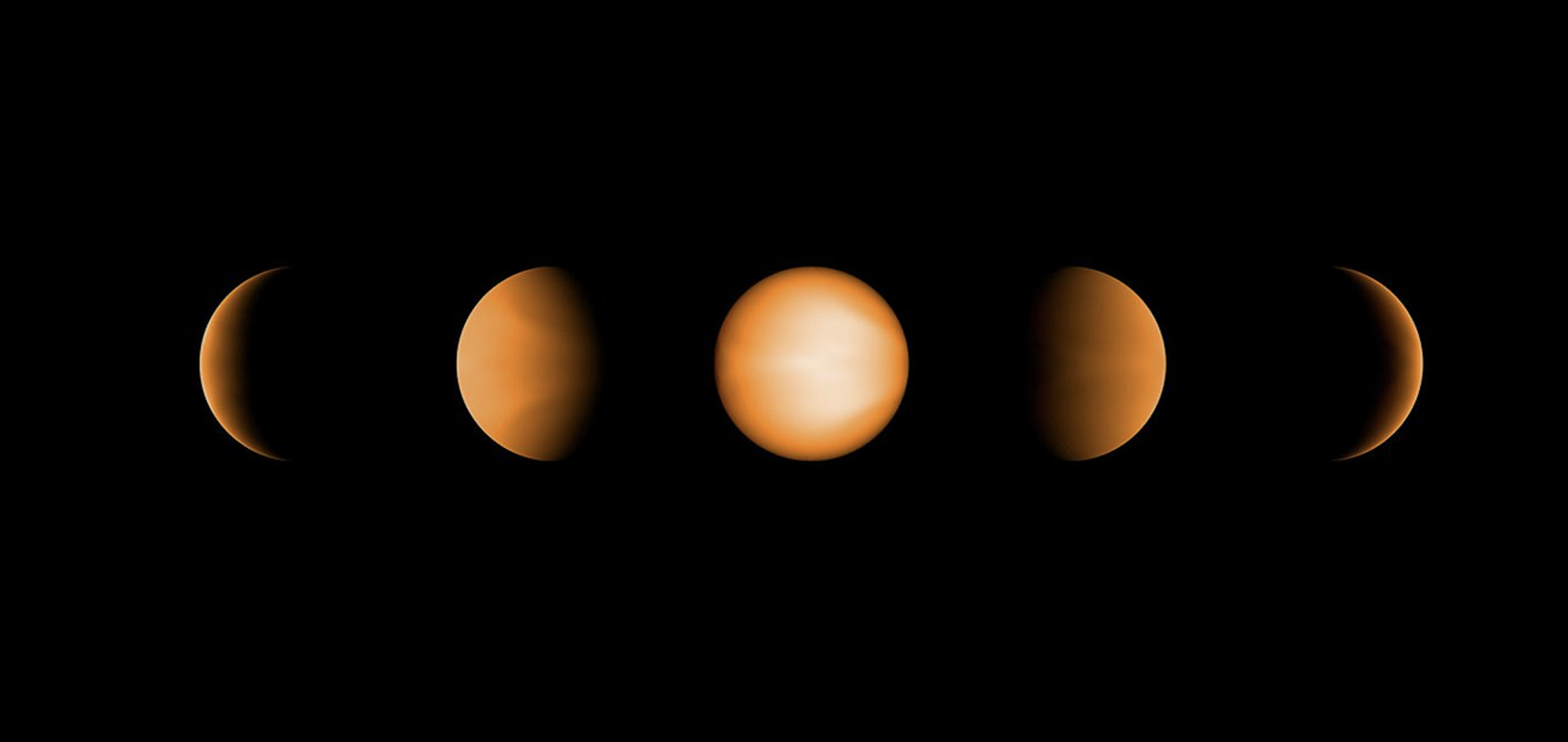
WASp-121b at different phases as would be seen by an observer, modelled with the 3D SPARC/MITgcm.

The hot Jupiter WASP-121b at different phases as would be seen by an observer, modelled with the 3D SPARC/MITgcm.

Credit: Vivien Parmentier

Vivien Parmentier

Visitor

Research theme

  • Astronomy and astrophysics
  • Exoplanets and planetary physics

Sub department

  • Atmospheric, Oceanic and Planetary Physics

Research groups

  • Exoplanet atmospheres
  • Exoplanets and Stellar Physics
vivien.parmentier@physics.ox.ac.uk
Telephone: 01865282458
Atmospheric Physics Clarendon Laboratory, room 116
Current website
  • About
  • Publications

Transitions in the cloud composition of hot Jupiters

The Astrophysical Journal American Astronomical Society

Authors:

Vivien Parmentier, Jonathan J Fortney, Adam P Showman, Caroline V Morley, Mark S Marley

Abstract:

Over a large range of equilibrium temperatures, clouds shape the transmission spectrum of hot Jupiter atmospheres, yet their composition remains unknown. Recent observations show that the Kepler lightcurves of some hot Jupiters are asymmetric: for the hottest planets, the lightcurve peaks before secondary eclipse, whereas for planets cooler than $\sim1900\rm\,K$, it peaks after secondary eclipse. We use the thermal structure from 3D global circulation models to determine the expected cloud distribution and Kepler lightcurves of hot Jupiters. We demonstrate that the change from an optical lightcurve dominated by thermal emission to one dominated by scattering (reflection) naturally explains the observed trend from negative to positive offset. For the cool planets the presence of an asymmetry in the Kepler lightcurve is a telltale sign of the cloud composition, because each cloud species can produce an offset only over a narrow range of effective temperatures. By comparing our models and the observations, we show that the cloud composition of hot Jupiters likely varies with equilibrium temperature. We suggest that a transition occurs between silicate and manganese sulfide clouds at a temperature near $1600\rm\,K$, analogous to the L/T transition on brown dwarfs. The cold trapping of cloud species below the photosphere naturally produces such a transition and predicts similar transitions for other condensates, including TiO. We predict that most hot Jupiters should have cloudy nightsides, that partial cloudiness should be common at the limb and that the dayside hot spot should often be cloud-free.
More details from the publisher
Details from ORA
More details
Details from ArXiV

Pagination

  • First page First
  • Previous page Prev
  • …
  • Page 25
  • Page 26
  • Page 27
  • Page 28
  • Page 29
  • Page 30
  • Page 31
  • Page 32
  • Current page 33

Footer Menu

  • Contact us
  • Giving to the Dept of Physics
  • Work with us
  • Media

User account menu

  • Log in

Follow us

FIND US

Clarendon Laboratory,

Parks Road,

Oxford,

OX1 3PU

CONTACT US

Tel: +44(0)1865272200

University of Oxfrod logo Department Of Physics text logo
IOP Juno Champion logo Athena Swan Silver Award logo

© University of Oxford - Department of Physics

Cookies | Privacy policy | Accessibility statement

Built by: Versantus

  • Home
  • Research
  • Study
  • Engage
  • Our people
  • News & Comment
  • Events
  • Our facilities & services
  • About us
  • Giving to Physics
  • Current students
  • Staff intranet