Home
Department Of Physics text logo
  • Research
    • Our research
    • Our research groups
    • Our research in action
    • Research funding support
    • Summer internships for undergraduates
  • Study
    • Undergraduates
    • Postgraduates
  • Engage
    • For young people
    • For teachers
    • For the public
    • For alumni
    • For business
  • Support
Menu
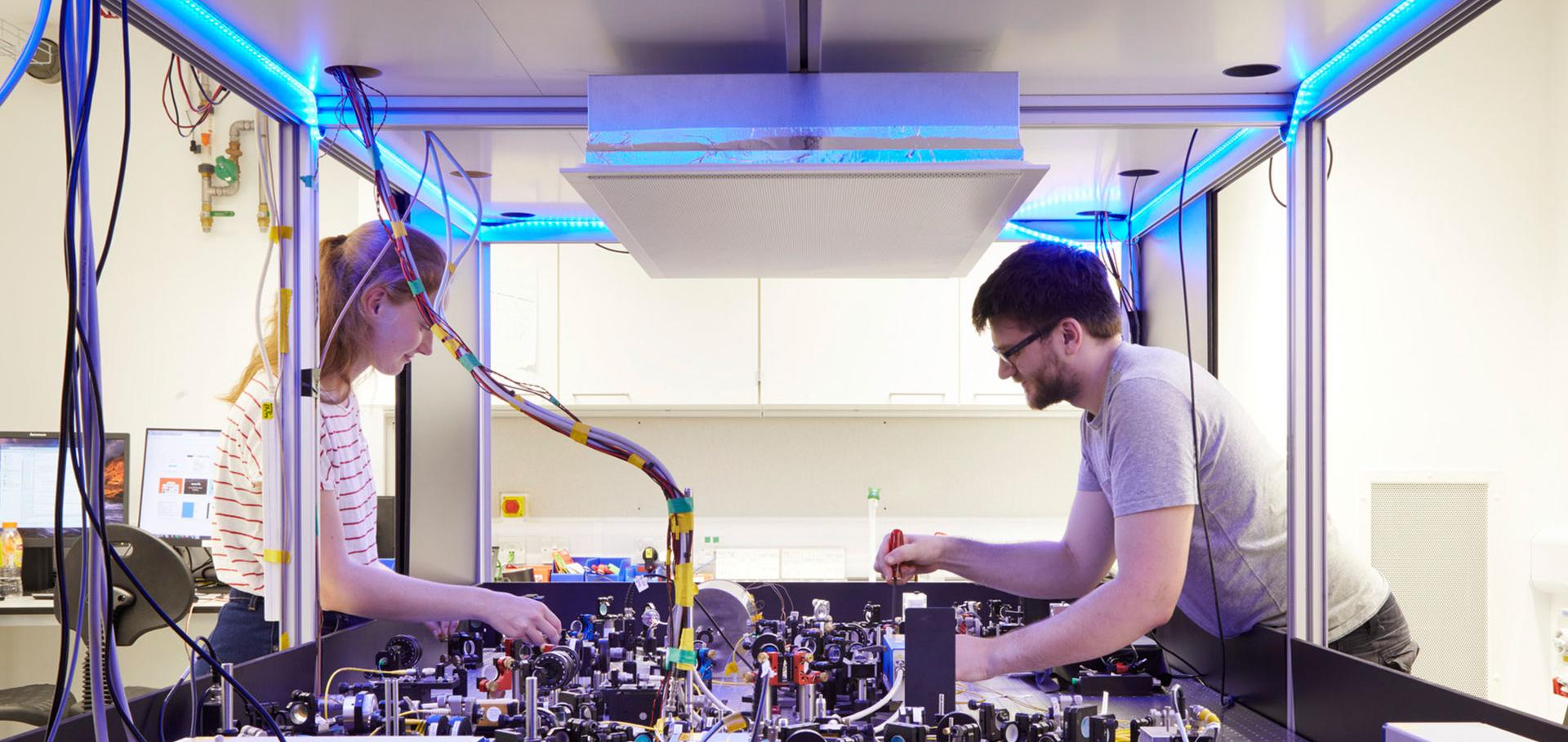
Atomic and Laser Physics
Credit: Jack Hobhouse

Prof Vlatko Vedral FInstP

Professor of Quantum Information Science

Sub department

  • Atomic and Laser Physics

Research groups

  • Frontiers of quantum physics
vlatko.vedral@physics.ox.ac.uk
Telephone: 01865 (2)72389
Clarendon Laboratory, room 241.8
  • About
  • Publications

Unpredictability is perfectly possible in a deterministic universe

(2022)

Authors:

Chiara Marletto, Vlatko Vedral
More details from the publisher

Classical and quantum orbital correlations in molecular electronic states

NEW JOURNAL OF PHYSICS 24:10 (2022) ARTN 102001

Authors:

Onur Pusuluk, Mahir H Yesiller, Gokhan Torun, Ozgur E Mustecaplioglu, Ersin Yurtsever, Vlatko Vedral
More details from the publisher
More details

Witnessing superpositions of causal orders before the process is completed

(2022)

Authors:

Onur Pusuluk, Zafer Gedik, Vlatko Vedral
More details from the publisher

Amplification of gravitationally induced entanglement

PHYSICAL REVIEW D 106:6 (2022) ARTN 066013

Authors:

Tianfeng Feng, Vlatko Vedral
More details from the publisher
Details from ORA
More details
More details

Perturbative quantum simulation

Physical Review Letters American Physical Society 129:12 (2022) 120505

Authors:

Jinzhao Sun, Suguru Endo, Huiping Lin, Patrick Hayden, Vlatko Vedral, Xiao Yuan

Abstract:

Approximation based on perturbation theory is the foundation for most of the quantitative predictions of quantum mechanics, whether in quantum many-body physics, chemistry, quantum field theory, or other domains. Quantum computing provides an alternative to the perturbation paradigm, yet state-of-the-art quantum processors with tens of noisy qubits are of limited practical utility. Here, we introduce perturbative quantum simulation, which combines the complementary strengths of the two approaches, enabling the solution of large practical quantum problems using limited noisy intermediate-scale quantum hardware. The use of a quantum processor eliminates the need to identify a solvable unperturbed Hamiltonian, while the introduction of perturbative coupling permits the quantum processor to simulate systems larger than the available number of physical qubits. We present an explicit perturbative expansion that mimics the Dyson series expansion and involves only local unitary operations, and show its optimality over other expansions under certain conditions. We numerically benchmark the method for interacting bosons, fermions, and quantum spins in different topologies, and study different physical phenomena, such as information propagation, charge-spin separation, and magnetism, on systems of up to 48 qubits only using an 8+1 qubit quantum hardware. We demonstrate our scheme on the IBM quantum cloud, verifying its noise robustness and illustrating its potential for benchmarking large quantum processors with smaller ones.
More details from the publisher
Details from ORA
More details
More details

Pagination

  • First page First
  • Previous page Prev
  • …
  • Page 12
  • Page 13
  • Page 14
  • Page 15
  • Current page 16
  • Page 17
  • Page 18
  • Page 19
  • Page 20
  • …
  • Next page Next
  • Last page Last

Footer Menu

  • Contact us
  • Giving to the Dept of Physics
  • Work with us
  • Media

User account menu

  • Log in

Follow us

FIND US

Clarendon Laboratory,

Parks Road,

Oxford,

OX1 3PU

CONTACT US

Tel: +44(0)1865272200

University of Oxfrod logo Department Of Physics text logo
IOP Juno Champion logo Athena Swan Silver Award logo

© University of Oxford - Department of Physics

Cookies | Privacy policy | Accessibility statement

Built by: Versantus

  • Home
  • Research
  • Study
  • Engage
  • Our people
  • News & Comment
  • Events
  • Our facilities & services
  • About us
  • Giving to Physics
  • Current students
  • Staff intranet