Home
Department Of Physics text logo
  • Research
    • Our research
    • Our research groups
    • Our research in action
    • Research funding support
    • Summer internships for undergraduates
  • Study
    • Undergraduates
    • Postgraduates
  • Engage
    • For young people
    • For teachers
    • For the public
    • For alumni
    • For business
  • Support
Menu
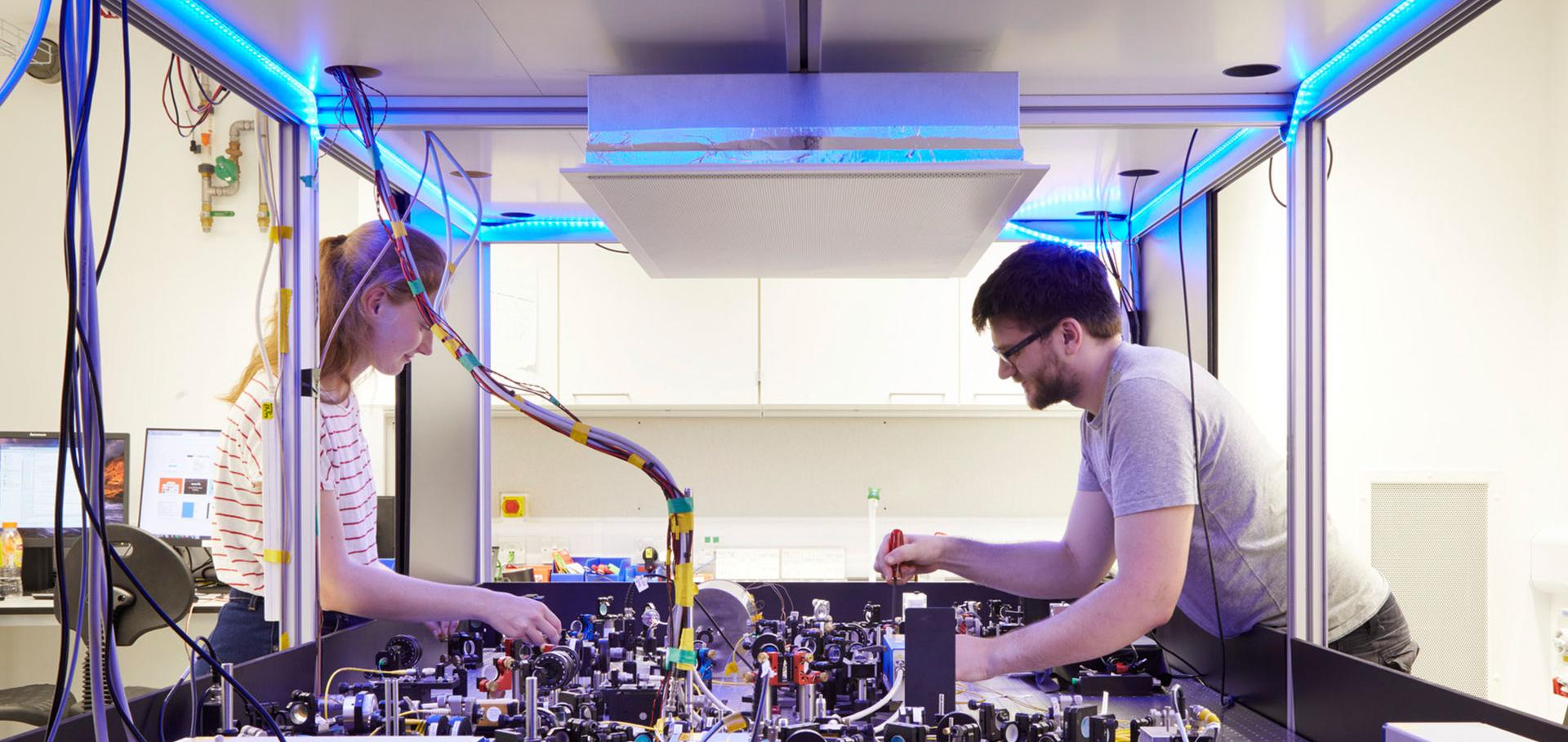
Atomic and Laser Physics
Credit: Jack Hobhouse

Prof Vlatko Vedral FInstP

Professor of Quantum Information Science

Sub department

  • Atomic and Laser Physics

Research groups

  • Frontiers of quantum physics
vlatko.vedral@physics.ox.ac.uk
Telephone: 01865 (2)72389
Clarendon Laboratory, room 241.8
  • About
  • Publications

Practical blind quantum computation with parity quantum computing framework

Quantum Science and Technology IOP Publishing 11:2 (2026) 025033

Authors:

Yuxun Wang, Qin Li, Shao-Ming Fei, Vlatko Vedral

Abstract:

Blind quantum computation (BQC) allows clients with limited quantum capabilities to delegate computational tasks to remote quantum servers while keeping the privacy of their data. However, existing BQC protocols often fail to balance resource consumption and practical feasibility, which is particularly significant in the noisy intermediate-scale quantum era. In this paper, we propose a practical BQC model based on the parity quantum computing framework. It requires the server to perform operations only on adjacent qubits and eliminates the need for additional SWAP gates when two-qubit gates should be applied to non-adjacent qubits, greatly facilitating the physical implementation on real quantum devices. Furthermore, we prove that the proposed BQC model ensures the privacy of client’s information and satisfies the property of verifiability which enables clients to identify dishonest servers. Finally, a detailed example is given and simulated on the IBM’s quantum platform to demonstrate its feasibility.
More details from the publisher
Details from ORA

Using spatiotemporal Born rule for testing macroscopic realism: some applications to the pseudo-density matrices and nonclassical temporal correlations

(2026)

Authors:

Naim Elias Comar, Lucas C Céleri, Mia Stamatova, Vlatko Vedral, Aditya Varna Iyer, Rafael Chaves

Repulsive Gravitational Force as a Witness of the Quantum Nature of Gravity

(2026)

Authors:

Pablo L Saldanha, Chiara Marletto, Vlatko Vedral

Extensible universal photonic quantum computing with nonlinearity

(2026)

Authors:

Shang Yu, Jinzhao Sun, Kuan-Cheng Chen, Zhi-Huai Yang, Zhenghao Li, Ewan Mer, Yazeed K Alwehaibi, Shana H Winston, Dayne Marcus D Lopena, Zi-Cheng Zhang, Guang Yang, Runxia Tao, Mingti Zhou, Gerard J Machado, Ying Dong, Roberto Bondesan, Vlatko Vedral, MS Kim, Ian A Walmsley, Raj B Patel
More details from the publisher

Observing Ghost Entanglement Beyond Scattering Amplitudes in Quantum Electrodynamics

Symmetry MDPI 17:12 (2025) 2179

Authors:

Chiara Marletto, Vlatko Vedral

Abstract:

A fully local quantum account of the interactions experienced between charges requires us to use all four modes of the electromagnetic vector potential in the Lorenz gauge. However, it is frequently stated that only the two transverse modes of the vector potential are “real” in that they contain photons that can actually be detected. The photons present in the other two modes, the scalar and the longitudinal, are considered unobservable and are referred to as “virtual particles” or “ghosts”. Here we argue that this view, which is rooted in standard quantum electrodynamics, is a consequence of assuming that charges are always dressed in such modes and that naked charges do not have an independent existence. In particular, we present a thought experiment where, assuming that naked charges can be independently manipulated, one can then measure the entanglement generated between a charge and the scalar modes. This entanglement is a direct function of the number of photons present in the scalar field. Our conclusion, therefore, is that the scalar quantum variables, under this assumption, would be as “real” as the transverse ones, where reality is defined by their ability to affect the charge. A striking consequence of this is that there is a critical value of charge beyond which we cannot detect its spatial superposition by local means.
More details from the publisher
Details from ORA

Pagination

  • First page First
  • Previous page Prev
  • Page 1
  • Page 2
  • Page 3
  • Current page 4
  • Page 5
  • Page 6
  • Page 7
  • Page 8
  • Page 9
  • …
  • Next page Next
  • Last page Last

Footer Menu

  • Contact us
  • Giving to the Dept of Physics
  • Work with us
  • Media

User account menu

  • Log in

Follow us

FIND US

Clarendon Laboratory,

Parks Road,

Oxford,

OX1 3PU

CONTACT US

Tel: +44(0)1865272200

University of Oxfrod logo Department Of Physics text logo
IOP Juno Champion logo Athena Swan Silver Award logo

© University of Oxford - Department of Physics

Cookies | Privacy policy | Accessibility statement

Built by: Versantus

  • Home
  • Research
  • Study
  • Engage
  • Our people
  • News & Comment
  • Events
  • Our facilities & services
  • About us
  • Giving to Physics
  • Current students
  • Staff intranet