Home
Department Of Physics text logo
  • Research
    • Our research
    • Our research groups
    • Our research in action
    • Research funding support
    • Summer internships for undergraduates
  • Study
    • Undergraduates
    • Postgraduates
  • Engage
    • For young people
    • For teachers
    • For the public
    • For alumni
    • For business
  • Support
Menu
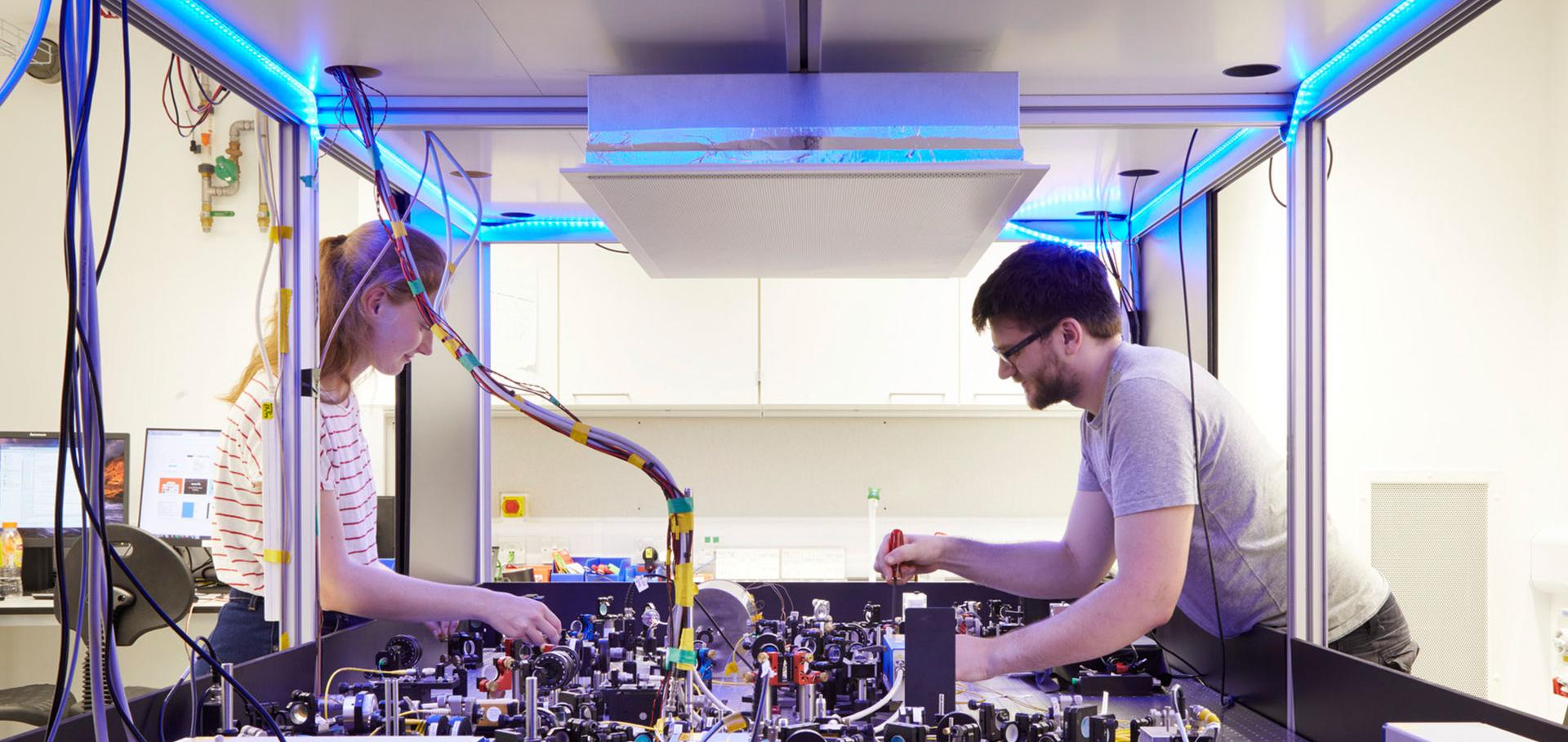
Atomic and Laser Physics
Credit: Jack Hobhouse

Prof Vlatko Vedral FInstP

Professor of Quantum Information Science

Sub department

  • Atomic and Laser Physics

Research groups

  • Frontiers of quantum physics
vlatko.vedral@physics.ox.ac.uk
Telephone: 01865 (2)72389
Clarendon Laboratory, room 241.8
  • About
  • Publications

Device-independent tests of quantum measurements

(2016)

Authors:

Michele Dall'Arno, Sarah Brandsen, Francesco Buscemi, Vlatko Vedral
More details from the publisher

Unbounded memory advantage in stochastic simulation using quantum mechanics

(2016)

Authors:

Andrew JP Garner, Qing Liu, Jayne Thompson, Vlatko Vedral, Mile Gu
More details from the publisher

Thinking big thoughts

Physics World IOP Publishing 29:8 (2016) 35-36
More details from the publisher

Quantum Quasi-Zeno Dynamics: Transitions mediated by frequent projective measurements near the Zeno regime

Phys. Rev. A APS 94:7 (2016) 012118

Authors:

TJ Elliott, V Vedral

Abstract:

Frequent observation of a quantum system leads to quantum Zeno physics, where the system evolution is constrained to states commensurate with the measurement outcome. We show that, more generally, the system can evolve between such states through higher-order virtual processes that pass through states outside the measurement subspace. We derive effective Hamiltonians to describe this evolution, and the dependence on the time between measurements. We demonstrate application of this phenomena to prototypical quantum many-body system examples, spin chains and atoms in optical lattices, where it facilitates correlated dynamical effects.
Details from ORA
More details from the publisher
More details

Pinning of fermionic occupation numbers: Higher spatial dimensions and spin

Physical Review A American Physical Society 94:1 (2016) 012120

Authors:

Felix Tennie, Vlatko Vedral, Christian Schilling

Abstract:

The role of the generalized Pauli constraints (GPCs) in higher spatial dimensions and by incorporating spin degrees of freedom is systematically explored for a system of interacting fermions confined by a harmonic trap. Physical relevance of the GPCs is confirmed by analytical means for the ground state in the regime of weak couplings by finding its vector of natural occupation numbers close to the boundary of the allowed region. Such quasipinning is found to become weaker in the intermediate- and strong-coupling regime. The study of crossovers between different spatial dimensions by detuning the harmonic trap frequencies suggests that quasipinning is essentially an effect for systems with reduced spatial dimensionality. In addition, we find that quasipinning becomes stronger by increasing the degree of spin polarization. Consequently, the number of states available around the Fermi level plays a key role for the occurrence of quasipinning. This suggests that quasipinning emerges from the conflict between energy minimization and fermionic exchange symmetry.
More details from the publisher
Details from ORA
More details
Details from ArXiV
More details

Pagination

  • First page First
  • Previous page Prev
  • …
  • Page 51
  • Page 52
  • Page 53
  • Page 54
  • Current page 55
  • Page 56
  • Page 57
  • Page 58
  • Page 59
  • …
  • Next page Next
  • Last page Last

Footer Menu

  • Contact us
  • Giving to the Dept of Physics
  • Work with us
  • Media

User account menu

  • Log in

Follow us

FIND US

Clarendon Laboratory,

Parks Road,

Oxford,

OX1 3PU

CONTACT US

Tel: +44(0)1865272200

University of Oxfrod logo Department Of Physics text logo
IOP Juno Champion logo Athena Swan Silver Award logo

© University of Oxford - Department of Physics

Cookies | Privacy policy | Accessibility statement

Built by: Versantus

  • Home
  • Research
  • Study
  • Engage
  • Our people
  • News & Comment
  • Events
  • Our facilities & services
  • About us
  • Giving to Physics
  • Current students
  • Staff intranet