

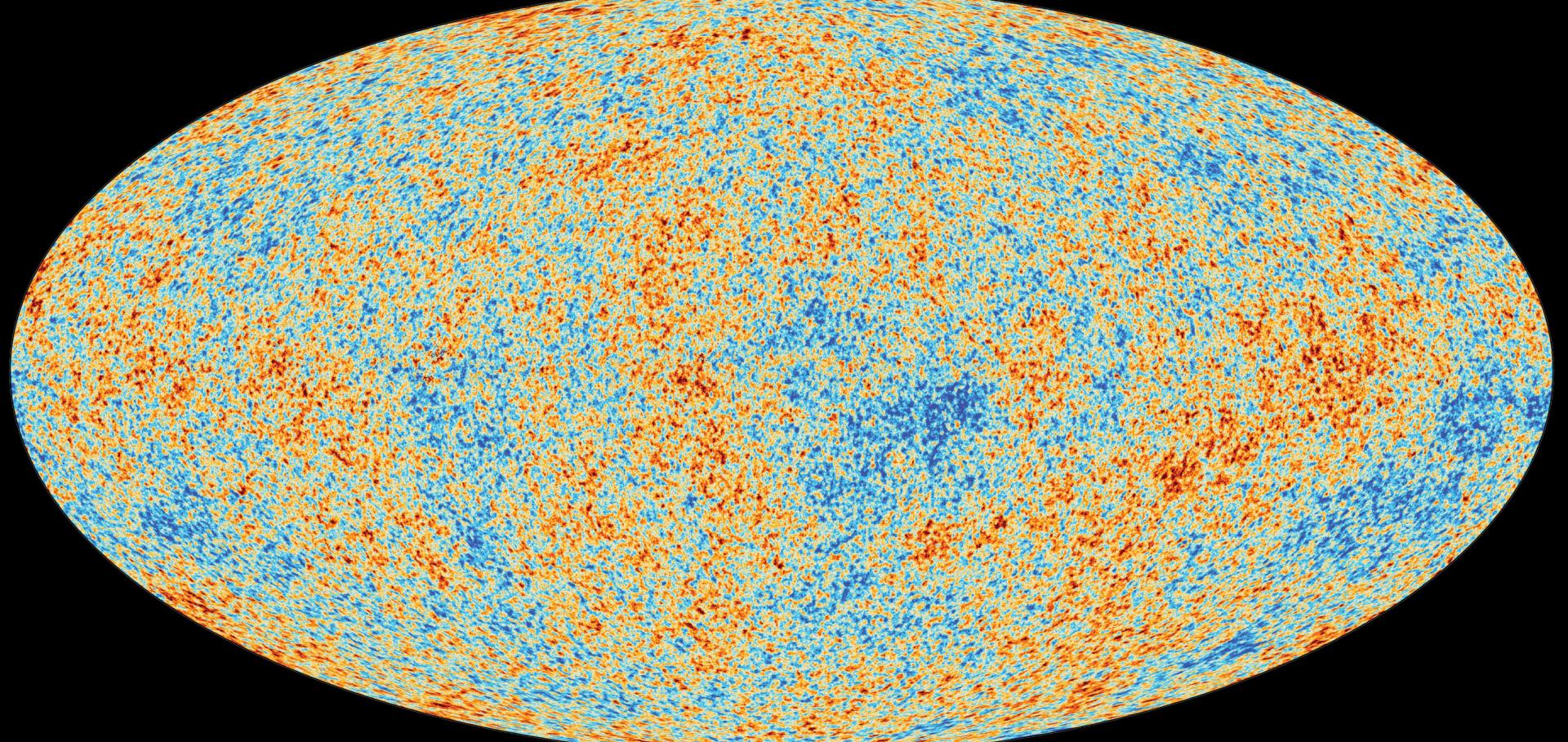
The Atacama Cosmology Telescope: a measurement of the Cosmic Microwave Background power spectra at 98 and 150 GHz
Journal of Cosmology and Astroparticle Physics IOP Publishing 2020:12 (2020) 045-045
The Atacama Cosmology Telescope: DR4 maps and cosmological parameters
Journal of Cosmology and Astroparticle Physics IOP Publishing 2020:12 (2020) 047-047
Abstract:
We present new arcminute-resolution maps of the Cosmic Microwave Background temperature and polarization anisotropy from the Atacama Cosmology Telescope, using data taken from 2013-2016 at 98 and 150 GHz. The maps cover more than 17,000 deg$^2$, the deepest 600 deg$^2$ with noise levels below 10 $\mu$K-arcmin. We use the power spectrum derived from almost 6,000 deg$^2$ of these maps to constrain cosmology. The ACT data enable a measurement of the angular scale of features in both the divergence-like polarization and the temperature anisotropy, tracing both the velocity and density at last-scattering. From these one can derive the distance to the last-scattering surface and thus infer the local expansion rate, $H_0$. By combining ACT data with large-scale information from WMAP we measure $H_0 = 67.6 \pm 1.1$ km/s/Mpc, at 68% confidence, in excellent agreement with the independently-measured Planck satellite estimate (from ACT alone we find $H_0 = 67.9 \pm 1.5$ km/s/Mpc). The $\Lambda$CDM model provides a good fit to the ACT data, and we find no evidence for deviations: both the spatial curvature, and the departure from the standard lensing signal in the spectrum, are zero to within 1$\sigma$; the number of relativistic species, the primordial Helium fraction, and the running of the spectral index are consistent with $\Lambda$CDM predictions to within $1.5 - 2.2\sigma$. We compare ACT, WMAP, and Planck at the parameter level and find good consistency; we investigate how the constraints on the correlated spectral index and baryon density parameters readjust when adding CMB large-scale information that ACT does not measure. The DR4 products presented here will be publicly released on the NASA Legacy Archive for Microwave Background Data Analysis.Beyond halo mass: quenching galaxy mass assembly at the edge of filaments
Monthly Notices of the Royal Astronomical Society Oxford University Press 501:3 (2020) 4635-4656
Abstract:
We examine how the mass assembly of central galaxies depends on their location in the cosmic web. The HORIZON-AGN simulation is analysed at z ∼ 2 using the DISPERSE code to extract multi-scale cosmic filaments. We find that the dependency of galaxy properties on large-scale environment is mostly inherited from the (large-scale) environmental dependency of their host halo mass. When adopting a residual analysis that removes the host halo mass effect, we detect a direct and non-negligible influence of cosmic filaments. Proximity to filaments enhances the build-up of stellar mass, a result in agreement with previous studies. However, our multi-scale analysis also reveals that, at the edge of filaments, star formation is suppressed. In addition, we find clues for compaction of the stellar distribution at close proximity to filaments. We suggest that gas transfer from the outside to the inside of the haloes (where galaxies reside) becomes less efficient closer to filaments, due to high angular momentum supply at the vorticity-rich edge of filaments. This quenching mechanism may partly explain the larger fraction of passive galaxies in filaments, as inferred from observations at lower redshifts.Beyond halo mass: the role of vorticity-rich filaments in quenching galaxy mass assembly
Monthly Notices of the Royal Astronomical Society Oxford University Press (OUP) (2020)
Abstract:
We examine how the mass assembly of central galaxies depends on their location in the cosmic web. The HORIZON-AGN simulation is analysed at z~2 using the DISPERSE code to extract multi-scale cosmic filaments. We find that the dependency of galaxy properties on large-scale environment is mostly inherited from the (large-scale) environmental dependency of their host halo mass. When adopting a residual analysis that removes the host halo mass effect, we detect a direct and non-negligible influence of cosmic filaments. Proximity to filaments enhances the build-up of stellar mass, a result in agreement with previous studies. However, our multi-scale analysis also reveals that, at the edge of filaments, star formation is suppressed. In addition, we find clues for compaction of the stellar distribution at close proximity to filaments. We suggest that gas transfer from the outside to the inside of the haloes (where galaxies reside) becomes less efficient closer to filaments, due to high angular momentum supply at the vorticity-rich edge of filaments. This quenching mechanism may partly explain the larger fraction of passive galaxies in filaments, as inferred from observations at lower redshifts.CODEX weak lensing mass catalogue and implications on the mass-richness relation
Monthly Notices of the Royal Astronomical Society 502:1 (2020) 1494-1526