

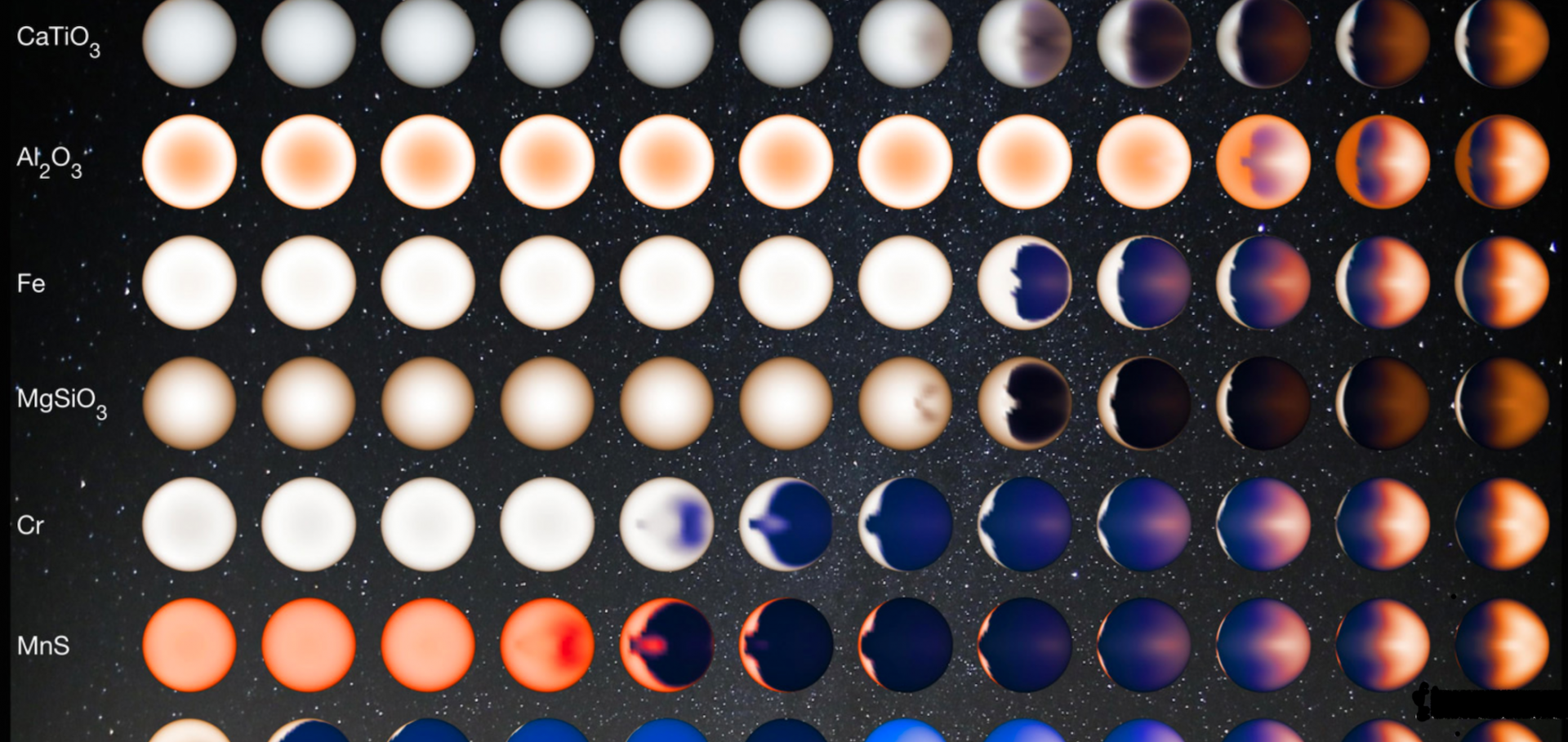
Vertical structure of temperature, composition, and clouds
Chapter in GIANT PLANETS OF OUR SOLAR SYSTEM: ATMOSPHERES, COMPOSITION, AND STRUCTURE, SECOND EDITION, (2009) 73-+
System design and analysis of the exo-planet imaging camera and spectrograph (EPICS) for the European ELT
Proceedings of SPIE the International Society for Optical Engineering 7014 (2008)
Abstract:
One of the main science objectives of the European ELT is the direct imaging of extrasolar planets. The large aperture of the telescope has the potential to significantly enlarge the discovery space towards older gas giant exo-planets seen in reflected light. In this paper, we give an overview of the EPICS system design strategy during the phase A study. In order to tackle the critical limitations to high contrast, extensive end-to-end simulations will be developed since the start to test different scenarios and guide the overall design. Keywords: Extremely Large Telescope, high contrast imaging, extrasolar planets, instrumentation, adaptive optics.Intense polar temperature inversion in the middle atmosphere on Mars
Nature Geoscience 1:11 (2008) 745-749
Abstract:
Current understanding of weather, climate and global atmospheric circulation on Mars is incomplete, in particular at altitudes above about 30 km. General circulation models for Mars are similar to those developed for weather and climate forecasting on Earth and require more martian observations to allow testing and model improvements. However, the available measurements of martian atmospheric temperatures, winds, water vapour and airborne dust are generally restricted to the region close to the surface and lack the vertical resolution and global coverage that is necessary to shed light on the dynamics of Mars middle atmosphere at altitudes between 30 and 80 km (ref.7). Here we report high-resolution observations from the Mars Climate Sounder instrument on the Mars Reconnaissance Orbiter. These observations show an intense warming of the middle atmosphere over the south polar region in winter that is at least 10-20 K warmer than predicted by current model simulations. To explain this finding, we suggest that the atmospheric downwelling circulation over the pole, which is part of the equator-to-pole Hadley circulation, may be as much as 50 more vigorous than expected, with consequences for the cycles of water, dust and CO"2 that regulate the present-day climate on Mars. © 2008 Macmillan Publishers Limited.Band parameters for self-broadened ammonia gas in the range 0.74 to 5.24 μm to support measurements of the atmosphere of the planet Jupiter
Icarus 196:2 (2008) 612-624
Abstract:
We present new measurements and modelling of low-resolution transmission spectra of self-broadened ammonia gas, one of the most important absorbers found in the near-infrared spectrum of the planet Jupiter. These new spectral measurements were specifically designed to support measurements of Jupiter's atmosphere made by the Near-Infrared Mapping Spectrometer (NIMS) which was part of the Galileo mission that orbited Jupiter from 1995 to September 2003. To reach approximate jovian conditions in the lab, a new gas spectroscopy facility was developed and used to measure self-broadened ammonia spectra from 0.74 to 5.2 μm, virtually the complete range of the NIMS instrument, for the first time. Spectra were recorded at temperatures varying from 300 to 215 K, pressures from 1000 to 33 mb and using three different path lengths (10.164, 6.164 and 2.164 m). The spectra were then modelled using a series of increasingly complex physically based transmittance functions. © 2008 Elsevier Inc. All rights reserved.Axisymmetric, nearly inviscid circulations in non‐condensing radiative‐convective atmospheres
Quarterly Journal of the Royal Meteorological Society Wiley 134:634 (2008) 1269-1285