

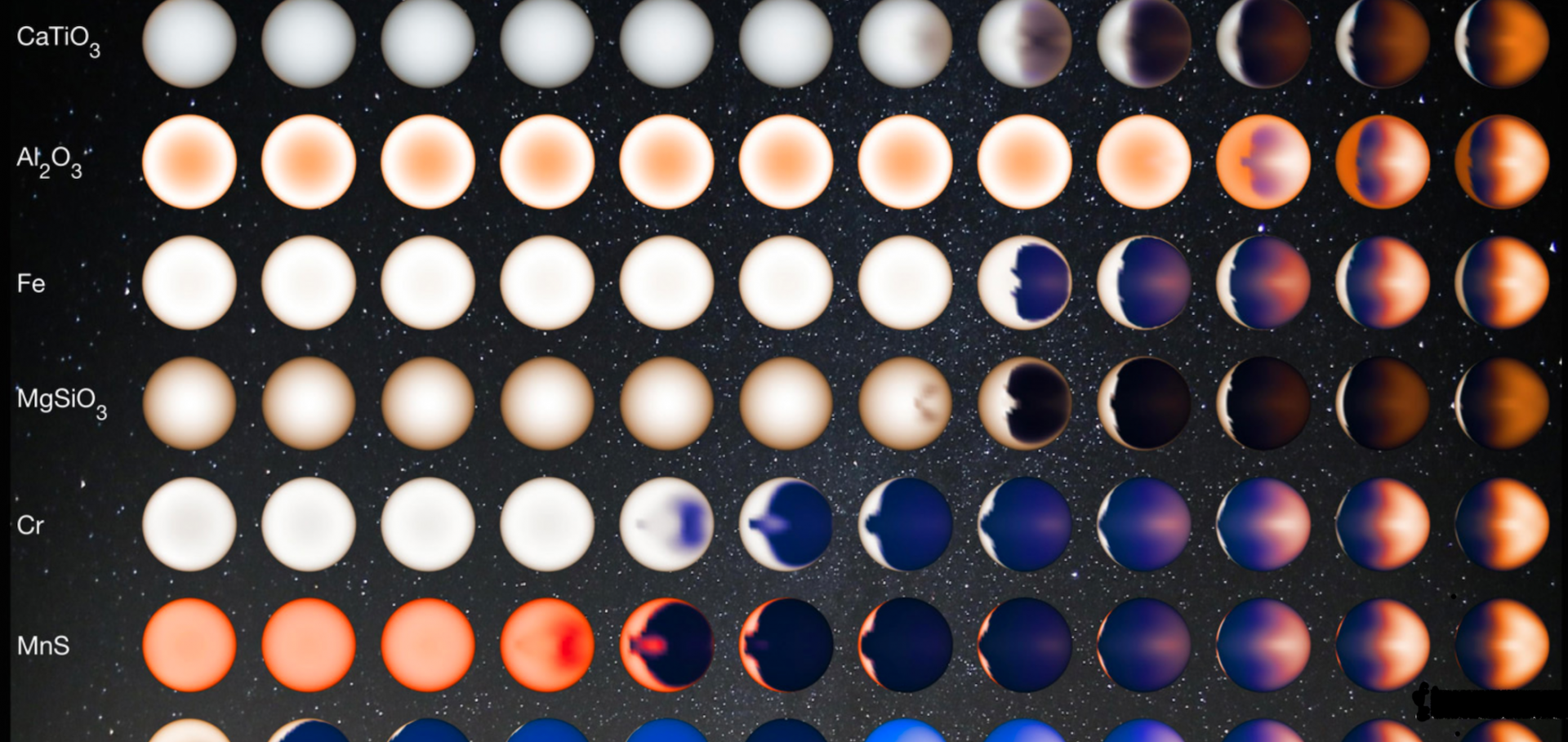
Modelling the day–night temperature variations of ultra-hot Jupiters: confronting non-grey general circulation models and observations
Monthly Notices of the Royal Astronomical Society Oxford University Press (OUP) 528:1 (2024) 1016-1036
Modeling Noncondensing Compositional Convection for Applications to Super-Earth and Sub-Neptune Atmospheres
The Astrophysical Journal American Astronomical Society 961:1 (2024) 35-35
Abstract:
Abstract Compositional convection is atmospheric mixing driven by density variations caused by compositional gradients. Previous studies have suggested that compositional gradients of atmospheric trace species within planetary atmospheres can impact convection and the final atmospheric temperature profile. In this work, we employ 3D convection-resolving simulations using Cloud Model 1 (CM1) to gain a fundamental understanding of how compositional variation influences convection and the final atmospheric state of exoplanet atmospheres. We perform 3D initial value problem simulations of noncondensing compositional convection for Earth-air, H 2 , and CO 2 atmospheres. Conventionally, atmospheric convection is assumed to mix the atmosphere to a final, marginally stable state defined by a unique temperature profile. However, when there is compositional variation within an atmosphere, a continuous family of stable end states is possible, differing in the final state composition profile. Our CM1 simulations are used to determine which of the family of possible compositional end states is selected. Leveraging the results from our CM1 simulations, we develop a dry convective adjustment scheme for use in general circulation models (GCMs). This scheme relies on an energy analysis to determine the final adjusted atmospheric state. Our convection scheme produces results that agree with our CM1 simulations and can easily be implemented in GCMs to improve modeling of compositional convection in exoplanet atmospheres.Modeling the day-night temperature variations of ultra-hot Jupiters: confronting non-grey general circulation models and observations
(2024)
Into the red: an M-band study of the chemistry and rotation of β Pictoris b at high spectral resolution
Monthly Notices of the Royal Astronomical Society, Volume 531, Issue 2, pp.2356-2378
Abstract:
High-resolution cross-correlation spectroscopy (HRCCS) combined with adaptive optics has been enormously successful in advancing our knowledge of exoplanet atmospheres, from chemistry to rotation and atmospheric dynamics. This powerful technique now drives major science cases for ELT instrumentation including METIS/ELT, GMTNIRS/GMT, and MICHI/TMT, targeting biosignatures on rocky planets at 3-5 μm, but remains untested beyond 3.5 μm where the sky thermal background begins to provide the dominant contribution to the noise. We present 3.51-5.21 μm M-band CRIRES+/VLT observations of the archetypal young directly imaged gas giant β Pictoris b, detecting CO absorption at S/N = 6.6 at 4.73 μm and H2O at S/N = 5.7, and thus extending the use of HRCCS into the thermal background noise dominated infrared. Using this novel spectral range to search for more diverse chemistry, we report marginal evidence of SiO at S/N = 4.3, potentially indicative that previously proposed magnesium-silicate clouds in the atmosphere are either patchy, transparent at M-band wavelengths, or possibly absent on the planetary hemisphere observed. The molecular detections are rotationally broadened by the spin of β Pic b, and we infer a planetary rotation velocity of vsin(i) = 22 ± 2 km s-1 from the cross-correlation with the H2O model template, consistent with previous K-band studies. We discuss the observational challenges posed by the thermal background and telluric contamination in the M-band, the custom analysis procedures required to mitigate these issues, and the opportunities to exploit this new infrared window for HRCCS using existing and next-generation instrumentation.
Dynamics and clouds in planetary atmospheres from telescopic observations
Astronomy and Astrophysics Review Springer 31:1 (2023) 5