

Confirmation of Water Absorption in the Thermal Emission Spectrum of the Hot Jupiter WASP-77Ab with HST/WFC3
The Astronomical Journal American Astronomical Society 163:6 (2022) 261
Impact of variable photospheric radius on exoplanet atmospheric retrievals
Monthly Notices of the Royal Astronomical Society: Letters 513:1 (2022) L20-L24
Abstract:
Inverse techniques are used to extract information about an exoplanet's atmosphere. These techniques are prone to biased results if the appropriate forward model is not used. One assumption used in a forward model is to assume that the radius of the planet is constant with wavelength; however, a more realistic assumption is that the photospheric radius varies with each wavelength. We explore the bias induced when attempting to extract the molecular abundance from an emission spectrum, which was generated with a variable radius. We find that for low-gravity planets, the retrieval model is not able to fit the data if a constant radius model is used. We find that biased results are obtained when studying a typical hot Jupiter in the MIRI LRS wavelength range. Finally, we show that high-gravity planets do not suffer a bias. We recommend that future spectral retrievals that interpret exoplanet emission spectra should take into account a variable radius.The impact of ultraviolet heating and cooling on the dynamics and observability of lava planet atmospheres
Monthly Notices of the Royal Astronomical Society Oxford University Press 513:4 (2022) 6125-6133
Abstract:
Lava planets have non-global, condensible atmospheres similar to icy bodies within the Solar system. Because they depend on interior dynamics, studying the atmospheres of lava planets can lead to understanding unique geological processes driven by their extreme environment. Models of lava planet atmospheres have thus far focused on either radiative transfer or hydrodynamics. In this study, we couple the two processes by introducing ultraviolet (UV) and infrared (IR) radiation to a turbulent boundary layer model. We also test the effect of different vertical temperature profiles on atmospheric dynamics. Results from the model show that UV radiation affects the atmosphere much more than IR. UV heating and cooling work together to produce a horizontally isothermal atmosphere away from the substellar point regardless of the vertical temperature profile. We also find that stronger temperature inversions induce stronger winds and hence cool the atmosphere. Our simulated transmission spectra of the bound atmosphere show a strong SiO feature in the UV that would be challenging to observe in the planet’s transit spectrum due to the precision required. Our simulated emission spectra are more promising, with significant SiO spectral features at 4.5 and 9 μm that can be observed with the James Webb Space Telescope. Different vertical temperature profiles produce discernible dayside emission spectra, but not in the way one would expect.Water observed in the atmosphere of {\tau} Bootis Ab with CARMENES/CAHA
(2022)
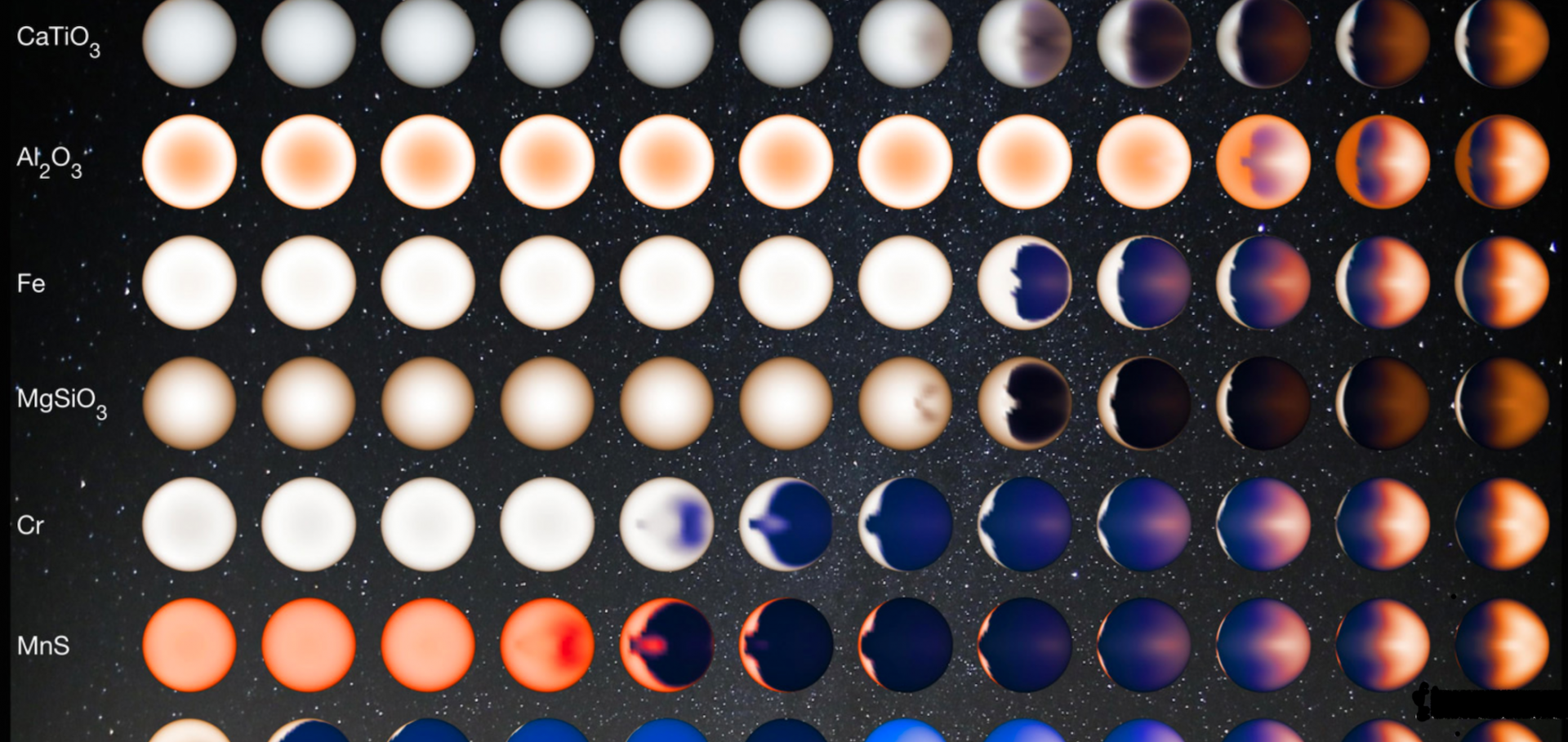
Patchy nightside clouds on ultra-hot Jupiters: General Circulation Model simulations with radiatively active cloud tracers
(2022)