VLT/CRIRES Science Verification Observations: A hint of C18O in the Young Brown Dwarf 2M0355

Research Notes of the American Astronomical Society IOP Publishing 6:9 (2022) 194-194

Authors:

Yapeng Zhang, Ignas AG Snellen, Matteo Brogi, Jayne L Birkby

Abstract:

Stars and planetary system

Kiloparsec view of a typical star-forming galaxy when the Universe was ∼1 Gyr old

Astronomy & Astrophysics EDP Sciences 665 (2022) L8-L8

Authors:

R Herrera-Camus, NM Förster Schreiber, SH Price, H Übler, AD Bolatto, RL Davies, D Fisher, R Genzel, D Lutz, T Naab, A Nestor, T Shimizu, A Sternberg, L Tacconi, K Tadaki

Abstract:

We present a kinematic analysis of the main-sequence galaxy HZ4 at z = 5.5. Our study is based on deep, spatially resolved observations of the [C II] 158 μm transition obtained with the Atacama Large Millimeter/Submillimeter Array (ALMA). From the combined analysis of the disk morphology, the 2D velocity structure, and forward modeling of the 1D velocity and velocity dispersion profiles, we conclude that HZ4 has a regular rotating disk in place. The intrinsic velocity dispersion in HZ4 is high (σ0 = 65.8−3.3+2.9 km s−1), and the ratio between the rotational velocity and the intrinsic velocity dispersion is Vrot/σ0 = 2.2. These values are consistent with the expectations from the trends of increasing σ0 and decreasing Vrot/σ0 as a function of the redshift observed in main-sequence galaxies up to z ≈ 4. Galaxy evolution models suggest that the high level of turbulence observed in HZ4 can only be achieved if, in addition to stellar feedback, there is radial transport of gas within the disk. Finally, we find that HZ4 is baryon-dominated on galactic scales (≲2 × Re), with a dark-matter fraction at one effective radius of fDM(Re) = 0.41−0.22+0.25. This value is comparable to the dark-matter fractions found in lower redshift galaxies that could be the descendants of HZ4: massive (M⋆ ≈ 1011 M⊙), star-forming galaxies at z ∼ 2, and passive, early-type galaxies at z ≈ 0.

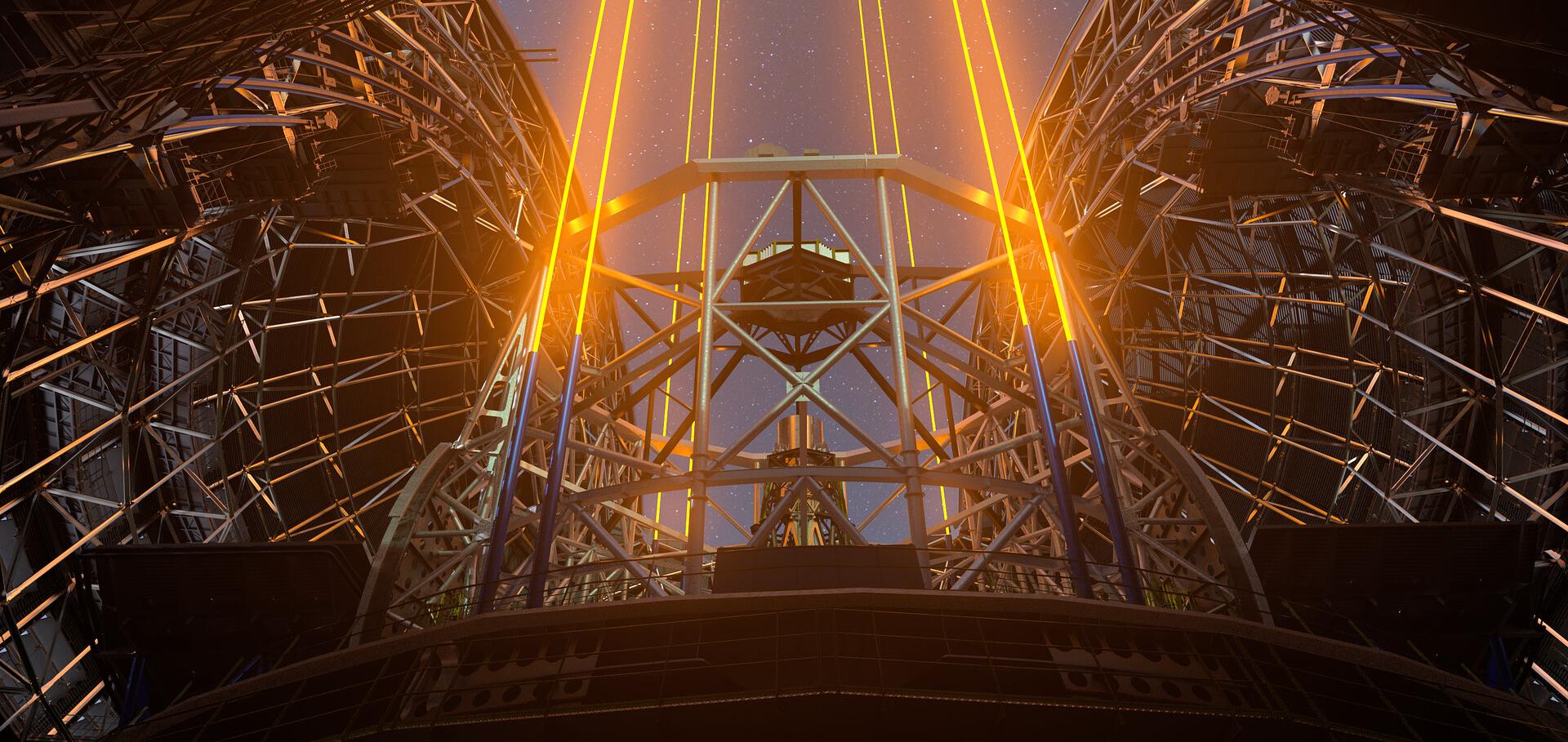
HARMONI at ELT: prototyping for Single-Conjugate AO Sensor subsystem

Proceedings of SPIE--the International Society for Optical Engineering SPIE, the international society for optics and photonics 12185 (2022) 121854y-121854y-11

Authors:

K El Hadi, JF Sauvage, K Dohlen, E Renault, W Bon, P Vola, T Crauchet, L Guemerle, F Madec, D Le Mignant, B Neichel, T Fusco, F Clarke, D Melotte, M Tecza, N Thatte, J Amiaux, J Paufique

WALOP-South: a four-camera one-shot imaging polarimeter for PASIPHAE survey. Paper II – polarimetric modeling and calibration

Journal of Astronomical Telescopes, Instruments, and Systems SPIE-Intl Soc Optical Eng 8:03 (2022)

Authors:

Siddharth Maharana, Ramya M Anche, Anamparambu N Ramaprakash, Bhushan Joshi, Artem Basyrov, Dmitry Blinov, Carolina Casadio, Kishan Deka, Hans Kristian Eriksen, Tuhin Ghosh, Eirik Gjerløw, John A Kypriotakis, Sebastian Kiehlmann, Nikolaos Mandarakas, Georgia V Panopoulou, Katerina Papadaki, Vasiliki Pavlidou, Timothy J Pearson, Vincent Pelgrims, Stephen B Potter, Anthony CS Readhead, Raphael Skalidis, Trygve Leithe Svalheim, Konstantinos Tassis, Ingunn K Wehus

WISDOM Project -- XIII. Feeding molecular gas to the supermassive black hole in the starburst AGN-host galaxy Fairall 49

Monthly Notices of the Royal Astronomical Society Oxford University Press 516:3 (2022) 4066-4083

Authors:

Federico Lelli, Timothy A Davis, Martin Bureau, Michele Cappellari, Lijie Liu, Ilaria Ruffa, Mark D Smith, Thomas G Williams

Abstract:

The mm-Wave Interferometric Survey of Dark Object Masses (WISDOM) is probing supermassive black holes (SMBHs) in galaxies across the Hubble sequence via molecular gas dynamics. We present the first WISDOM study of a luminous infrared galaxy with an active galactic nuclei (AGN): Fairall 49. We use new ALMA observations of the CO(2-1) line with a spatial resolution of about 80 pc together with ancillary HST imaging. We reach the following results: (1) The CO kinematics are well described by a regularly rotating gas disk with a radial inflow motion, suggesting weak feedback on the cold gas from both AGN and starburst activity; (2) The dynamically inferred SMBH mass is 1.6 +/- 0.4 (rnd) +/- 0.8 (sys) x 10^8 Msun, assuming that we have accurately subtracted the AGN and starburst light contributions, which have a luminosity of about 10^9 Lsun; (3) The SMBH mass agrees with the SMBH-stellar mass relation but is about 50 times higher than previous estimates from X-ray variability; (4) The dynamically inferred molecular gas mass is 30 times smaller than that inferred from adopting the Galactic CO-to-H_2 conversion factor (X_CO) for thermalised gas, suggesting low values of X_CO; (5) the molecular gas inflow rate increases steadily with radius and may be as high as 5 Msun/yr. This work highlights the potential of using high-resolution CO data to estimate, in addition to SMBH masses, the X_CO factor and gas inflow rates in nearby galaxies.