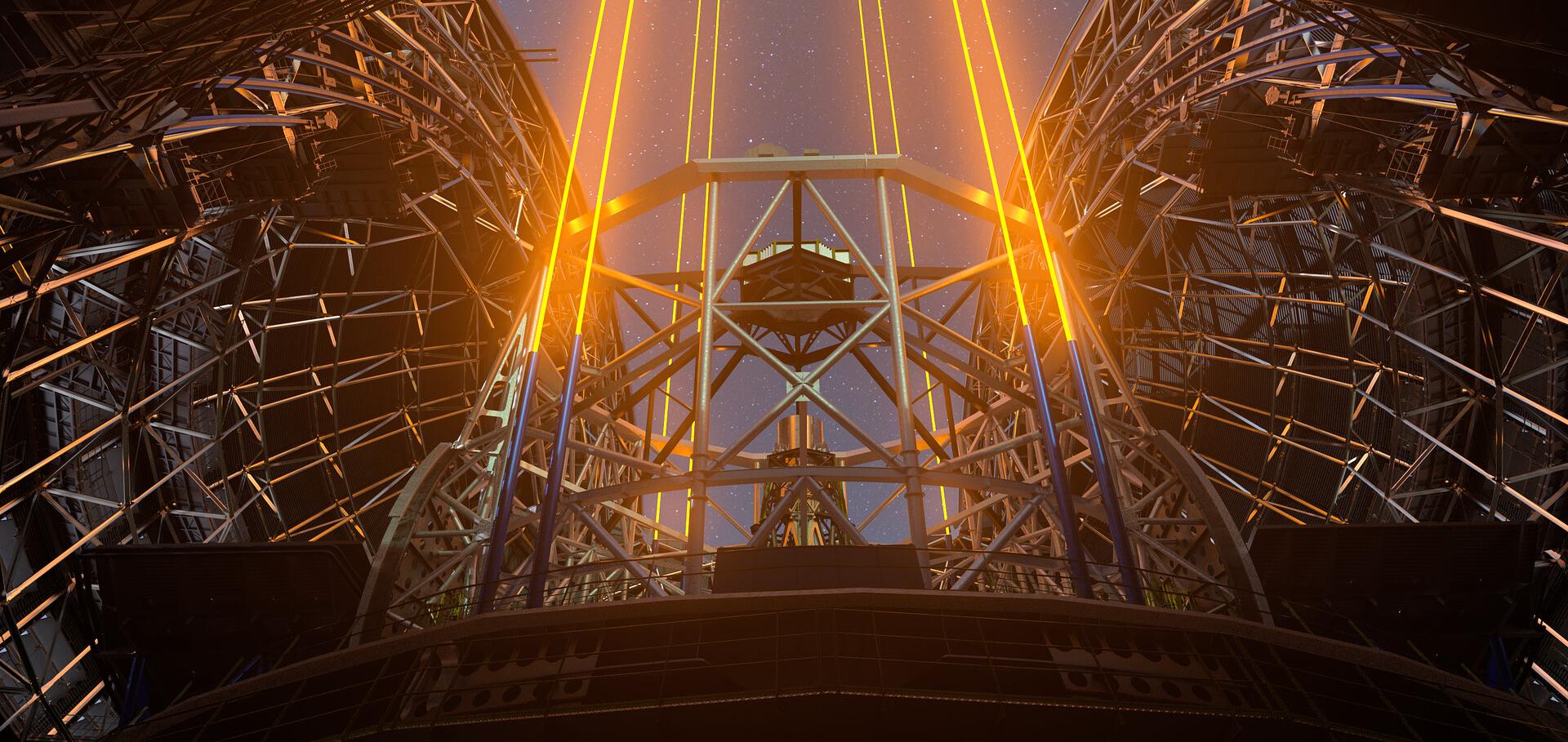
EAS 2022 takes positive steps forward for sustainable astronomy

Nature Astronomy Springer Nature 6:7 (2022) 765-765

Authors:

Antoaneta Antonova, Maarten Baes, Andreas Burkert, Roger L Davies, Inma Dominguez, Lex Kaper, Nick D Kylafis, Sara Lucatello, Georges Meylan, Agata Różańska

Water observed in the atmosphere of τ Boötis Ab with CARMENES/CAHA

Monthly Notices of the Royal Astronomical Society Oxford University Press (OUP) 514:3 (2022) 4160-4172

Authors:

Rebecca K Webb, Siddharth Gandhi, Matteo Brogi, Jayne L Birkby, Ernst de Mooij, Ignas Snellen, Yapeng Zhang

First light for GRAVITY Wide

Astronomy & Astrophysics EDP Sciences 665 (2022) A75-A75

Authors:

R Abuter, F Allouche, A Amorim, C Bailet, M Bauböck, J-P Berger, P Berio, A Bigioli, O Boebion, ML Bolzer, H Bonnet, G Bourdarot, P Bourget, W Brandner, Y Clénet, B Courtney-Barrer, Y Dallilar, R Davies, D Defrère, A Delboulbé, F Delplancke, R Dembet, PT de Zeeuw, A Drescher, A Eckart

Abstract:

More than a century ago, Albert Einstein presented his general theory of gravitation (GR) to the Prussian Academy of Sciences. One of the predictions of the theory is that not only particles and objects with mass, but also the quanta of light, photons, are tied to the curvature of space-time, and thus to gravity. There must be a critical compactness, above which photons cannot escape. These are black holes (henceforth BH). It took fifty years after the theory was announced before possible candidate objects were identified by observational astronomy. And another fifty years have passed, until we finally have in hand detailed and credible experimental evidence that BHs of 10 to 10^10 times the mass of the Sun exist in the Universe. Three very different experimental techniques, but all based on Michelson interferometry or Fourier-inversion spatial interferometry have enabled the critical experimental breakthroughs. It has now become possible to investigate the space-time structure in the vicinity of the event horizons of BHs. We briefly summarize these interferometric techniques, and discuss the spectacular recent improvements achieved with all three techniques. Finally, we sketch where the path of exploration and inquiry may go on in the next decades.Comment: 50 pages, accepted to The Astronomy and Astrophysics Revie

The Spectroscopy and H-band Imaging of Virgo cluster galaxies (SHIVir) Survey: Data Catalogue and Kinematic Profiles

(2022)

Authors:

Nathalie N-Q Ouellette, Stéphane Courteau, Jon A Holtzman, Michael McDonald, Michele Cappellari, Joel C Roediger, Patrick Côté, Julianne J Dalcanton, Elena Dalla Bontà, Laura Ferrarese, R Brent Tully, Connor Stone, Eric W Peng

The spectroscopy and H-band imaging of Virgo cluster galaxies (SHIVir) survey: data catalogue and kinematic profiles

Monthly Notices of the Royal Astronomical Society Oxford University Press 514:2 (2022) 2356-2375

Authors:

Nathalie N-Q Ouellette, Stephane Courteau, Jon A Holtzman, Michael McDonald, Michele Cappellari, Joel C Roediger, Patrick Cote, Julianne J Dalcanton, Elena Dalla Bonta, Laura Ferrarese, R Brent Tully, Connor Stone, Eric W Peng

Abstract:

The 'Spectroscopy and H-band Imaging of Virgo cluster galaxies' (SHIVir) survey is an optical and near-infrared survey which combines SDSS photometry, deep H-band photometry, and long-slit optical spectroscopy for 190 Virgo cluster galaxies covering all morphological types over the stellar mass range log (M∗/M·) = 7.8-11.5. We present the spectroscopic sample selection, data reduction, and analysis for this SHIVir sample. We have used and optimized the pPXF routine to extract stellar kinematics from our data. Ultimately, resolved kinematic profiles (rotation curves and velocity dispersion profiles) are available for 133 SHIVir galaxies. A comprehensive data base of photometric and kinematic parameters for the SHIVir sample is presented with grizH magnitudes, effective surface brightnesses, effective and isophotal radii, rotational velocities, velocity dispersions, and stellar and dynamical masses. Parameter distributions highlight some bimodal distributions and possible sample biases. A qualitative study of resolved extended velocity dispersion profiles suggests a link between the so-called 'sigma-drop' kinematic profile and the presence of rings in lenticular S0 galaxies. Rising dispersion profiles are linked to early-type spirals or dwarf ellipticals for which a rotational component is significant, whereas peaked profiles are tied to featureless giant ellipticals.