

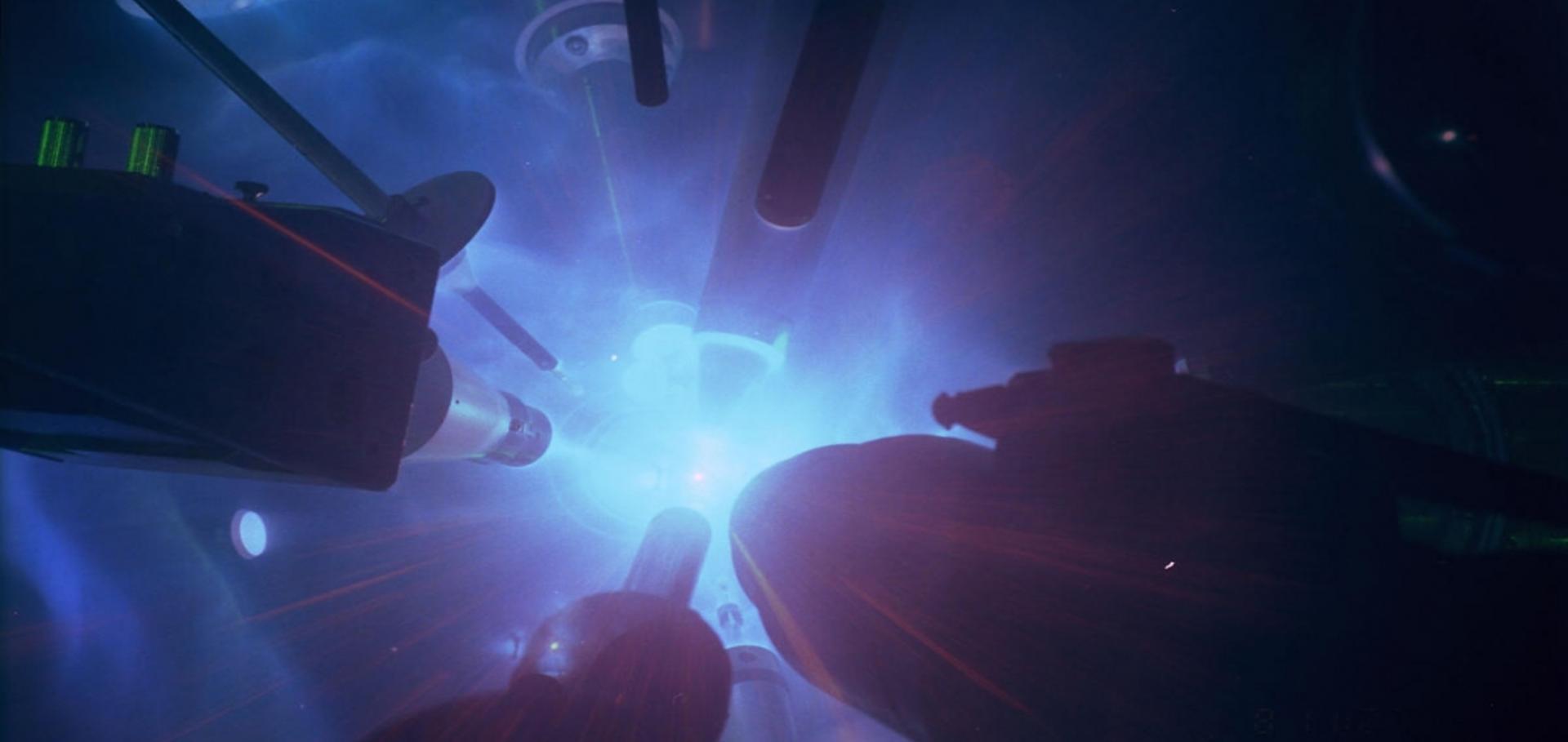
Setup for meV-resolution inelastic X-ray scattering measurements and X-ray diffraction at the Matter in Extreme Conditions endstation at the Linac Coherent Light Source
Review of Scientific Instruments AIP Publishing 89:10 (2018) 10F104
Abstract:
We describe a setup for performing inelastic X-ray scattering and X-ray diffraction measurements at the Matter in Extreme Conditions (MEC) endstation of the Linac Coherent Light Source. This technique is capable of performing high-, meV-resolution measurements of dynamic ion features in both crystalline and non-crystalline materials. A four-bounce silicon (533) monochromator was used in conjunction with three silicon (533) diced crystal analyzers to provide an energy resolution of ∼50 meV over a range of ∼500 meV in single shot measurements. In addition to the instrument resolution function, we demonstrate the measurement of longitudinal acoustic phonon modes in polycrystalline diamond. Furthermore, this setup may be combined with the high intensity laser drivers available at MEC to create warm dense matter and subsequently measure ion acoustic modes.Analytical estimates of proton acceleration in laser-produced turbulent plasmas
(2018)
Turbulent hydrodynamics experiments in high energy density plasmas: scientific case and preliminary results of the TurboHEDP project
HIGH POWER LASER SCIENCE AND ENGINEERING 6 (2018) ARTN e44
Experimental platform for the investigation of magnetized-reverse-shock dynamics in the context of POLAR
High Power Laser Science and Engineering Cambridge University Press 6 (2018) e43
Abstract:
The influence of a strong external magnetic field on the collimation of a high Mach number plasma flow and its collision with a solid obstacle is investigated experimentally and numerically. The laser irradiation (I ∼ 2 × 10¹⁴ W · cm−2 ) of a multilayer target generates a shock wave that produces a rear side plasma expanding flow. Immersed in a homogeneous 10 T external magnetic field, this plasma flow propagates in vacuum and impacts an obstacle located a few mm from the main target. A reverse shock is then formed with typical velocities of the order of 15–20 ± 5 km/s. The experimental results are compared with 2D radiative magnetohydrodynamic simulations using the FLASH code. This platform allows investigating the dynamics of reverse shock, mimicking the processes occurring in a cataclysmic variable of polar type.Axion driven cosmic magneto-genesis prior to the QCD crossover
Physical Review Letters American Physical Society (2018)