

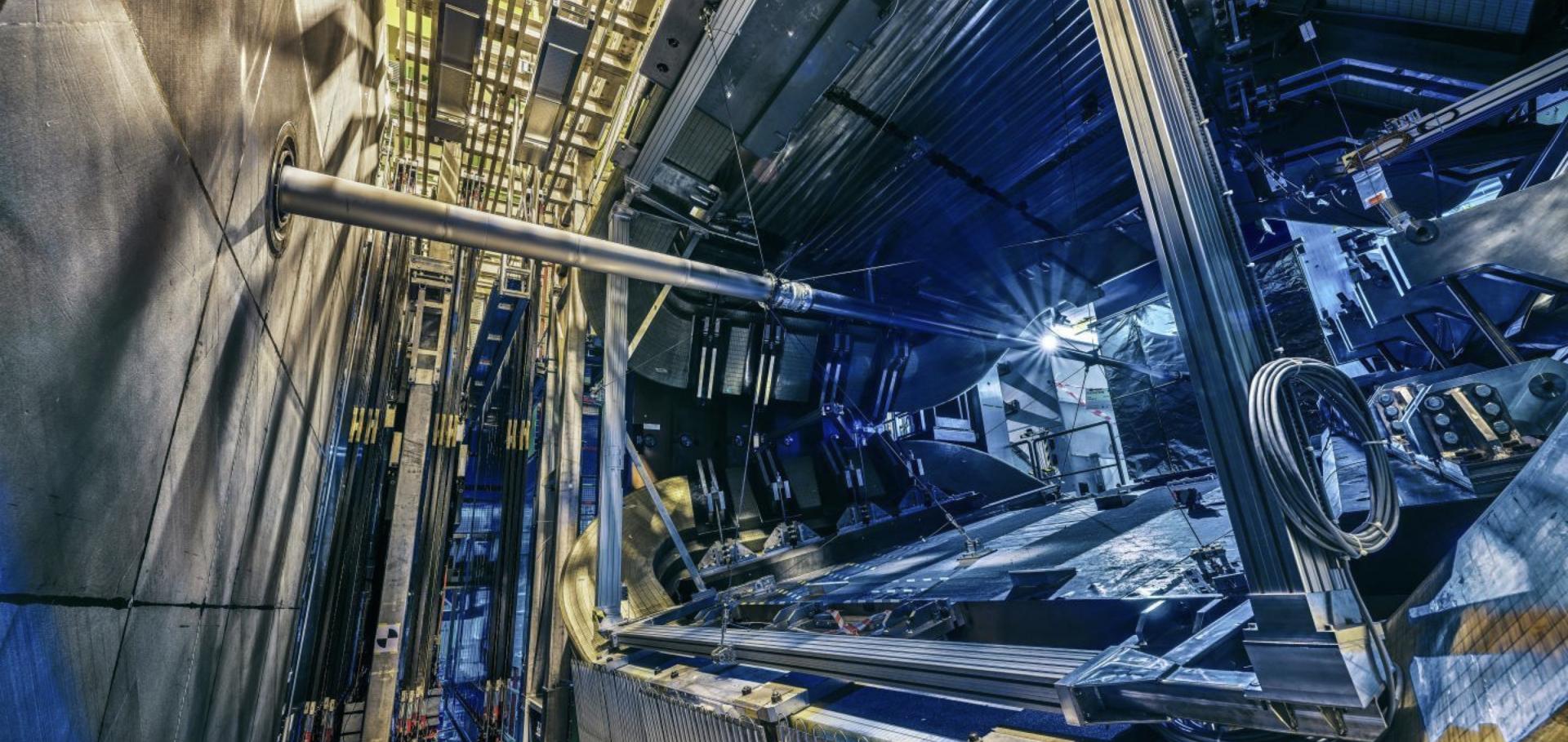
Design, assembly and beam validation of a full-scale TORCH module
Nuclear Instruments and Methods in Physics Research Section A Accelerators Spectrometers Detectors and Associated Equipment Elsevier (2026) 171542
Abstract:
The TORCH time-of-flight detector is part of a proposed upgrade of the LHCb experiment, foreseen for the high-luminosity phase of the LHC. The TORCH detector provides particle identification of hadrons in the sub-10 GeV/c momentum range, exploiting the prompt production of Cherenkov photons in an array of fused-silica plates. Photons are propagated to the periphery of the detector via total internal reflection, where they are focused by a cylindrical mirror onto an array of fast-timing MCP-PMT photon detectors. In order to achieve the design goals of TORCH, individual photons must be timed to 70ps precision or better. The development of the MCP-PMTs, the mechanical design and assembly strategy of a full-scale TORCH detector module, plus its system-level validation in a test beam are described. A validation of timing references, the optical integrity across glue joints and the readout integration are presented.Search for heavy neutral leptons in B-meson decays
Journal of High Energy Physics Springer 2026:3 (2026) 178
Abstract:
A search for long-lived heavy neutral leptons produced in B-meson decays and decaying to a μ±π∓ final state is performed with data collected by the LHCb experiment in proton-proton collisions at a centre-of-mass energy of 13 TeV, corresponding to an integrated luminosity of 5 fb−1. The results are interpreted in both lepton-number-conserving and lepton-number-violating scenarios. No significant excess is observed. Constraints are placed on the squared mixing element |UμN|2 to the active muon neutrino, under the assumption that couplings to other lepton flavours are negligible, in the mass range of 1.6–5.5 GeV.Measurement of the W → μν cross-sections as a function of the muon transverse momentum in pp collisions at 5.02 TeV
Journal of High Energy Physics Springer 2026:3 (2026) 148
Abstract:
The pp → W±(→ μ±νμ)X cross-sections are measured at a proton-proton centre-of-mass energy s=5.02 TeV using a dataset corresponding to an integrated luminosity of 100 pb−1 recorded by the LHCb experiment. Considering muons in the pseudorapidity range 2.2 < η < 4.4, the cross-sections are measured differentially in twelve intervals of muon transverse momentum between 28 < pT< 52 GeV. Integrated over pT, the measured cross-sections areσW+→μ+νμ=300.9±2.4±3.8±6.0pb, σW−→μ−ν¯μ=236.9±2.1±2.7±4.7pb, where the first uncertainties are statistical, the second are systematic, and the third are associated with the luminosity calibration. These integrated results are consistent with theoretical predictions. This analysis introduces a new method to determine the W-boson mass using the measured differential cross-sections corrected for detector effects. The measurement is performed on this statistically limited dataset as a proof of principle and yieldsmW=80369±130±33MeV, where the first uncertainty is experimental and the second is theoretical.Measurement of CP asymmetry in D 0 → K S 0 K S 0 decays with Run 3 data
Journal of High Energy Physics Springer 2026:2 (2026) 253