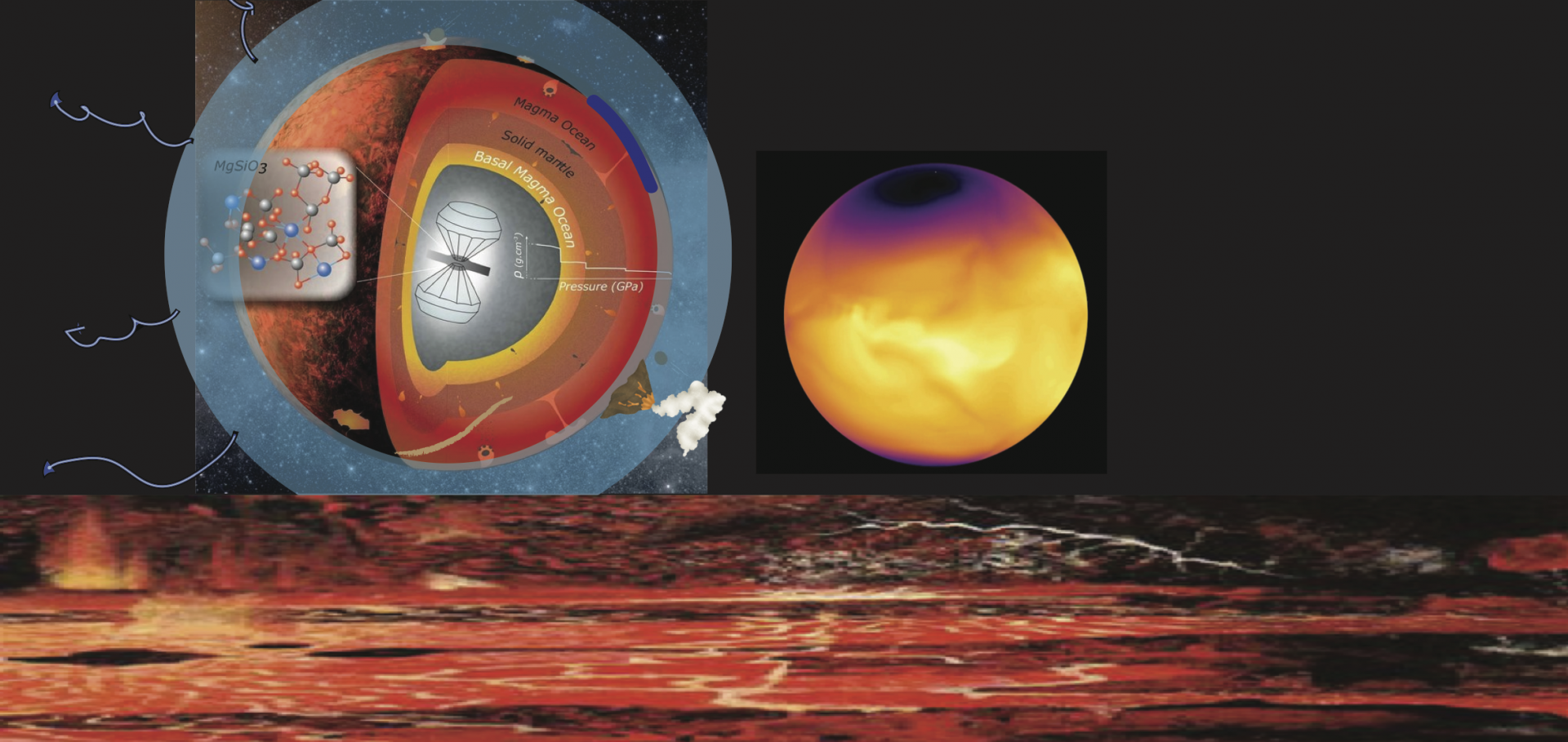
Mapping the pressure-dependent day-night temperature contrast of a strongly irradiated atmosphere with HST spectroscopic phase curve

Astronomical Journal IOP Publishing 163:1 (2021) 8

Authors:

Ben WP Lew, Daniel Apai, Yifan Zhou, Mark Marley, Lc Mayorga, Xianyu Tan, Vivien Parmentier, Sarah Casewell, Siyi Xu

Abstract:

Many brown dwarfs are on ultrashort-period and tidally locked orbits around white dwarf hosts. Because of these small orbital separations, the brown dwarfs are irradiated at levels similar to hot Jupiters. Yet, they are easier to observe than hot Jupiters because white dwarfs are fainter than main-sequence stars at near-infrared wavelengths. Irradiated brown dwarfs are, therefore, ideal hot Jupiter analogs for studying the atmospheric response under strong irradiation and fast rotation. We present the 1.1–1.67 μm spectroscopic phase curve of the irradiated brown dwarf (SDSS1411-B) in the SDSS J141126.20 + 200911.1 brown dwarf–white dwarf binary with the near-infrared G141 grism of the Hubble Space Telescope Wide Field Camera 3. SDSS1411-B is a 50MJup brown dwarf with an irradiation temperature of 1300 K and has an orbital period of 2.02864 hr. Our best-fit model suggests a phase-curve amplitude of 1.4% and places an upper limit of 11° for the phase offset from the secondary eclipse. After fitting the white dwarf spectrum, we extract the phase-resolved brown dwarf emission spectra. We report a highly wavelength-dependent day–night spectral variation, with a water-band flux variation of about 360% ± 70% and a comparatively small J-band flux variation of 37% ± 2%. By combining the atmospheric modeling results and the day–night brightness temperature variations, we derive a pressure-dependent temperature contrast. We discuss the difference in the spectral features of SDSS1411-B and hot Jupiter WASP-43b, as well as the lower-than-predicted day–night temperature contrast of J4111-BD. Our study provides the high-precision observational constraints on the atmospheric structures of an irradiated brown dwarf at different orbital phases.

Modeling Polarization Signals from Cloudy Brown Dwarfs Luhman 16 A and B in Three Dimensions

The Astrophysical Journal American Astronomical Society 923:1 (2021) 113

Authors:

Sagnick Mukherjee, Jonathan J Fortney, Rebecca Jensen-Clem, Xianyu Tan, Mark S Marley, Natasha E Batalha

TOI-2109: An Ultrahot Gas Giant on a 16 hr Orbit

The Astronomical Journal American Astronomical Society 162:6 (2021) 256

Authors:

Ian Wong, Avi Shporer, George Zhou, Daniel Kitzmann, Thaddeus D Komacek, Xianyu Tan, René Tronsgaard, Lars A Buchhave, Shreyas Vissapragada, Michael Greklek-McKeon, Joseph E Rodriguez, John P Ahlers, Samuel N Quinn, Elise Furlan, Steve B Howell, Allyson Bieryla, Kevin Heng, Heather A Knutson, Karen A Collins, Kim K McLeod, Perry Berlind, Peyton Brown, Michael L Calkins, Jerome P de Leon, Emma Esparza-Borges, Gilbert A Esquerdo, Akihiko Fukui, Tianjun Gan, Eric Girardin, Crystal L Gnilka, Masahiro Ikoma, Eric LN Jensen, John Kielkopf, Takanori Kodama, Seiya Kurita, Kathryn V Lester, Pablo Lewin, Giuseppe Marino, Felipe Murgas, Norio Narita, Enric Pallé, Richard P Schwarz, Keivan G Stassun, Motohide Tamura, Noriharu Watanabe, Björn Benneke, George R Ricker, David W Latham, Roland Vanderspek, Sara Seager, Joshua N Winn, Jon M Jenkins, Douglas A Caldwell, William Fong, Chelsea X Huang, Ismael Mireles, Joshua E Schlieder, Bernie Shiao, Jesus Noel Villaseñor

Convection modeling of pure-steam atmospheres

ArXiv 2111.15265 (2021)

Authors:

Xianyu Tan, Maxence Lefevre, Raymond Pierrehumbert

Inferring shallow surfaces on sub-neptune exoplanets with JWST

The Astrophysical Journal Letters IOP Publishing 922:2 (2021) L27

Authors:

Shang-Min Tsai, Hamish Innes, Tim Lichtenberg, Jake Taylor, Matej Malik, Katy Chubb, Raymond Pierrehumbert

Abstract:

Planets smaller than Neptune and larger than Earth make up the majority of the discovered exoplanets. Those with H2-rich atmospheres are prime targets for atmospheric characterization. The transition between the two main classes, super-Earths and sub-Neptunes, is not clearly understood as the rocky surface is likely not accessible to observations. Tracking several trace gases (specifically the loss of ammonia (NH3) and hydrogen cyanide (HCN)) has been proposed as a proxy for the presence of a shallow surface. In this work, we revisit the proposed mechanism of nitrogen conversion in detail and find its timescale on the order of a million years. NH3 exhibits dual paths converting to N2 or HCN, depending on the UV radiation of the star and the stage of the system. In addition, methanol (CH3OH) is identified as a robust and complementary proxy for a shallow surface. We follow the fiducial example of K2-18b with a 2D photochemical model on an equatorial plane. We find a fairly uniform composition distribution below 0.1 mbar controlled by the dayside, as a result of slow chemical evolution. NH3 and CH3OH are concluded to be the most unambiguous proxies to infer surfaces on sub-Neptunes in the era of the James Webb Space Telescope.