

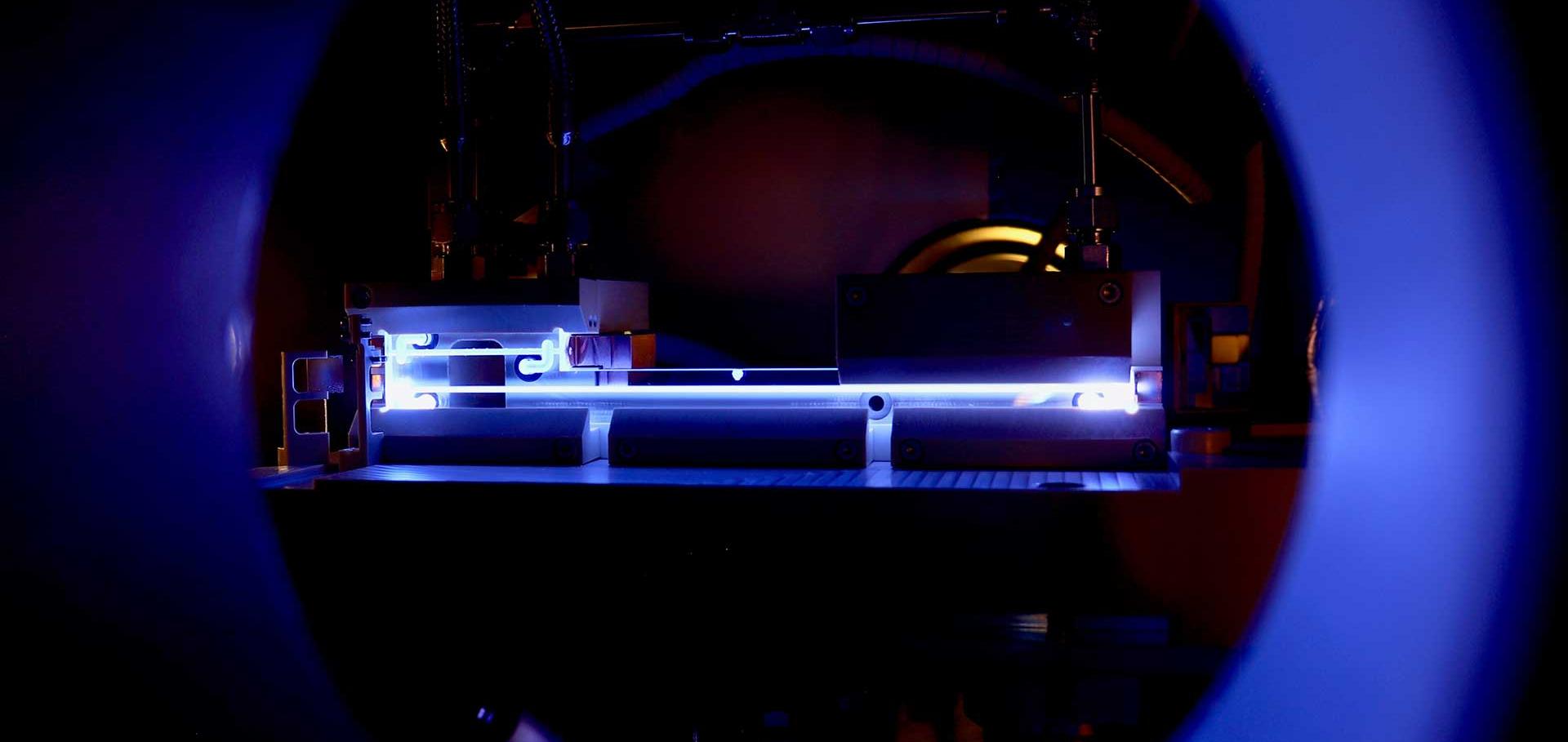
Long-term evolution of conditions within plasma capillary discharge devices, with application to plasma accelerators
48th EPS Conference on Plasma Physics, EPS 2022 (2022)
Abstract:
This work represents the first long-term (µs+) simulations of capillary discharge devices, made feasible by the computationally inexpensive QUEST algorithm [4]. We have demonstrated that QUEST gives comparable results to full plasma fluid simulations both during and long after the discharge has terminated. Using QUEST, the heat flow through the plasma-wall interface was simulated for discharge current conditions relevant to the FLASHForward experiment [2], operated at kHz-MHz repetition rates. The model showed that 1 kHz and 10 kHz repetition rates could be sustained indefinitely, but that 100 kHz and MHz rates quickly exceeded the sapphire capillary melting point. By reducing the pulse length and amplitude, MHz repetition rates can feasibly be sustained while providing plasma conditions suitable for accelerator applications.Azimuthal correlations in photoproduction and deep inelastic ep scattering at HERA
JOURNAL OF HIGH ENERGY PHYSICS (2021) ARTN 102
Stable witness-beam formation in a beam-driven plasma cathode
Physical Review Accelerators and Beams American Physical Society 24:10 (2021) 101302
Abstract:
Electron beams to be accelerated in beam-driven plasma wakes are commonly formed by a photocathode and externally injected into the wakefield of a preceding bunch. Alternatively, using the plasma itself as a cathode offers the possibility of generating ultrashort, low-emittance beams by trapping and accelerating electrons from the ambient plasma background. Here, we present a beam-driven plasma cathode realized via laser-triggered density-downramp injection, showing stable beam formation over more than a thousand consecutive events with an injection probability of 95%. The plasma cathode is highly tunable, resulting in the injection of electron bunches of tens of pC of charge, energies of up to 79 MeV, and relative energy spreads as low as a few percent. The stability of the injected beams was sufficiently high to experimentally determine their normalized emittance of 9.3 μm rms with a multishot method.Free electron lasers driven by plasma accelerators: status and near-term prospects
High Power Laser Science and Engineering Cambridge University Press 9 (2021) e57
Abstract:
Radiation reaction is the recoil of a charge upon emitting radiation. This effect is expected to play a significant role in the dynamics of charges, particularly electrons, and the radiation they produce in strong-field environments. Of particular interest are environments in which the electric field strength approaches the Schwinger field, E_sch=(m_e^2 c^3)/eℏ=1.38×10^16 Vcm^-1 defined as the field strength which can induce electron-positron pair production from vacuum. Electric field strengths approaching the Schwinger field may be generated by astrophysical bodies, such as pulsars and quasars. In such environments, classical theories of radiation reaction are expected to break down. Thus, a quantum description of radiation reaction is needed to accurately model radiation generation and other related processes such as pair production in these environments. The subject of this thesis is an experiment, conducted at the Central Laser Facility in 2021, the aim of which was to measure radiation reaction. The experiment utilised an all-optical set-up in which an energetic electron beam (peak energy ≈1 GeV) generated by a wakefield accelerator collided with a tightly focussed, counter-propagating laser pulse. In this thesis, I introduce and discuss a Bayesian analysis procedure which I have developed. This allows the post-collision electron spectrum and the spectrum of gamma radiation emitted during the col- lision to be used to quantitatively compare different models of radiation reaction, whilst also retrieving information concerning the collision conditions which could not be measured during the experiment. We find evidence of radiation reaction to 8σ, the highest degree of significance of any all-optical experi- ment to date. Using the Bayesian framework, we find that a quantum model of radiation reaction is more consistent with the spectrum of emitted radiation and the electron energy loss measured experimentally than a classical or a semiclassical model.Open AccesReduced model of plasma evolution in hydrogen discharge capillary plasmas
Physical Review E American Physical Society 104:1 (2021) 15211