

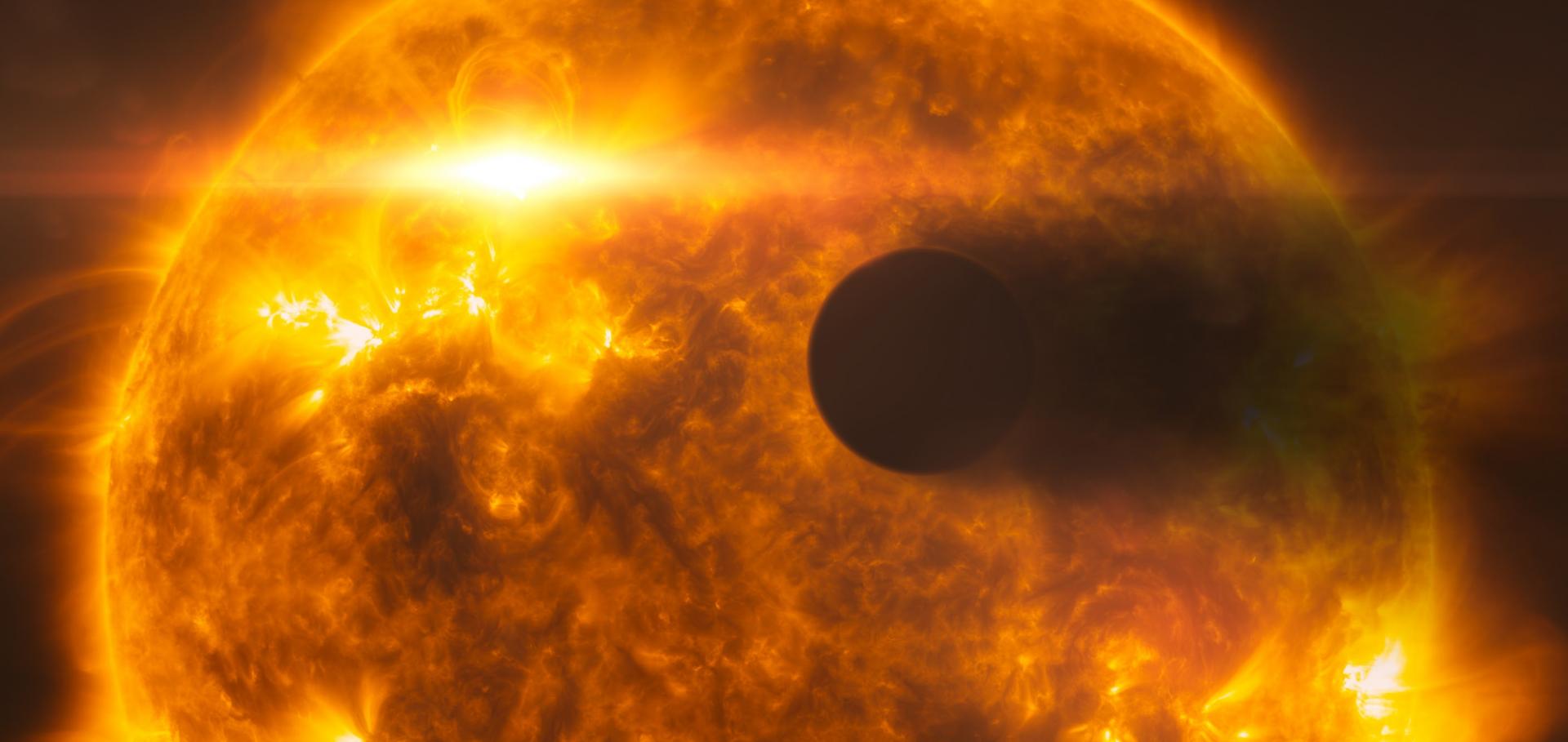

Atmospheric characterization of HIP 67522 b with VLT/CRIRES+. VLT/CRIRES+ suggests a heavier planet and hints at deuterium fractionation
(2026)
Mass estimates of the young TOI-451 transiting planets: multidimensional Gaussian Process on stellar spectroscopic and photometric signals
Monthly Notices of the Royal Astronomical Society Oxford University Press 546:2 (2026) stag087
Abstract:
The young TOI-451 planetary system, aged 125 Myr, provides a unique opportunity to test theories of planetary internal structures and atmospheric mass-loss through examination of its three transiting planets. We present an exhaustive photometric and spectroscopic follow-up to determine the orbital and physical properties of the system. We perform multidimensional Gaussian Process regression with the code pyaneti on spectroscopic time-series and NGTS/LCO light curves to disentangle the stellar and planetary signal in ESPRESSO radial velocities. We show how contemporaneous photometry serves as an activity indicator to inform RV modelling within a multidimensional Gaussian Processes framework. We argue that this can be exploited when spectroscopic observations are adversely affected by low signal-to-noise and/or poor sampling. We estimate the Doppler semi-amplitudes of , , and . This translates in 2 mass estimates for TOI-451 b and d of and ; as well as a mass upper limit for TOI-451 c of . The derived planetary properties suggest that planets c and d contain significant hydrogen-rich envelopes. The inferred parameters of TOI-451 b are consistent with either a rocky world that still retains a small hydrogen envelope or a water world. These insights make the TOI-451 system an ideal laboratory for future follow-up studies aimed at measuring atmospheric compositions, detecting atmospheric mass-loss signatures, and further exploring planetary formation and evolution processes.Mass estimates of the young TOI-451 transiting planets: Multidimensional Gaussian Process on stellar spectroscopic and photometric signals
(2026)
Detecting and characterising exoplanets with HARPS-N
Proceedings of the International Astronomical Union Cambridge University Press 20:S393 (2026) 150-155
Abstract:
Exoplanet follow-up with JWST requires precise masses and radii. HARPS-N is a high-resolution spectrograph on the Telescopio Nazionale Galileo (TNG), predominantly used to detect and characterize exoplanets using the radial velocity (RV) method. The HARPS-N Collaboration has been characterising exoplanets with HARPS-N for over a decade. In this short paper we highlight the contributions that the HARPS-N Collaboration has made to the characterisation of small exoplanets.Transformational astrophysics and exoplanet science with Habitable Worlds Observatory's High Resolution Imager
(2025)