Home
Department Of Physics text logo
  • Research
    • Our research
    • Our research groups
    • Our research in action
    • Research funding support
    • Summer internships for undergraduates
  • Study
    • Undergraduates
    • Postgraduates
  • Engage
    • For alumni
    • For business
    • For schools
    • For the public
  • Support
Menu
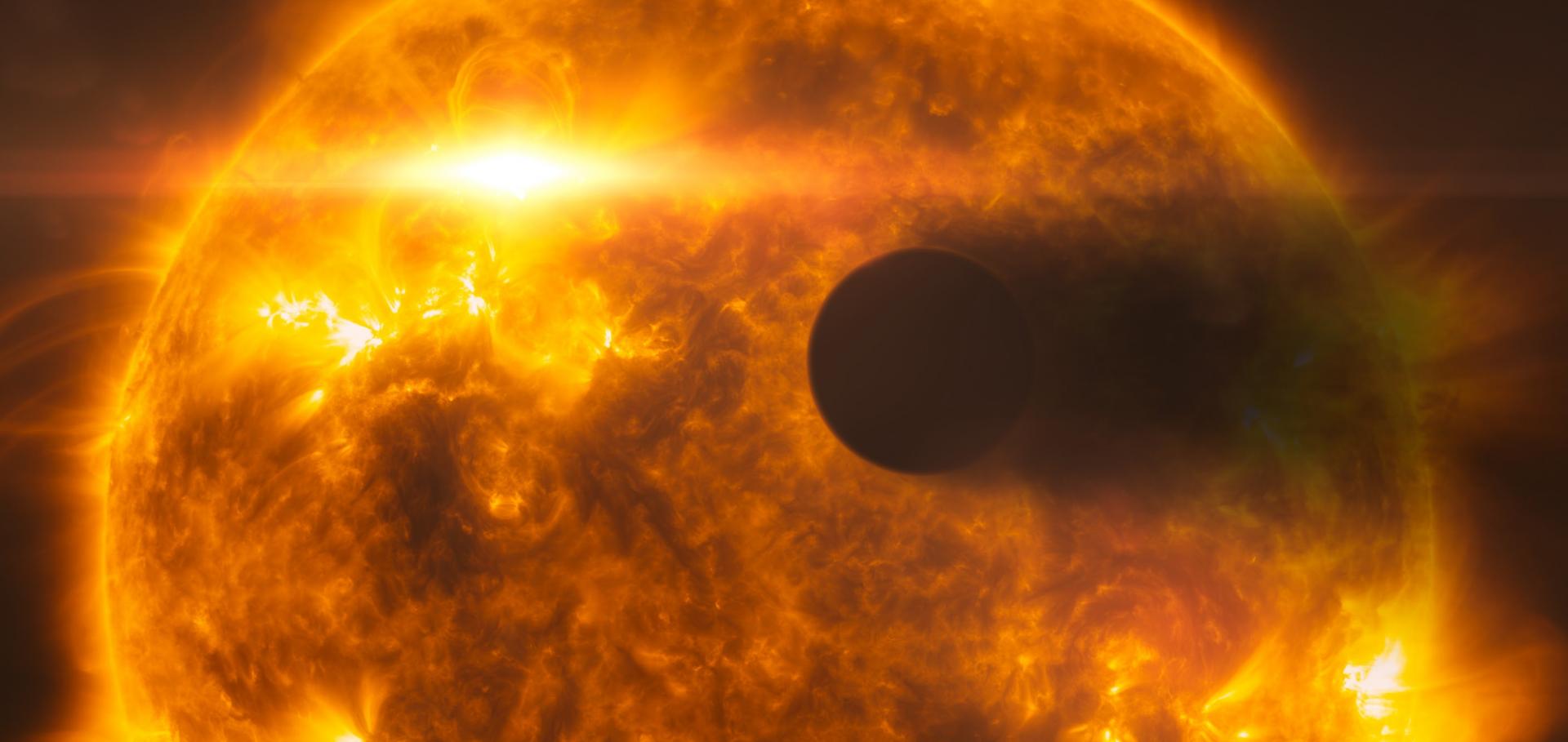
Stellar_flare_hits_HD_189733_b_(artist's_impression)

This artist's impression shows the hot Jupiter HD 189733b, as it passes in front of its parent star, as the latter is flaring, driving material away from the planet. The escaping atmosphere is seen silhouetted against the starlight. The surface of the star, which is around 80% the mass of the Sun, is based on observations of the Sun from NASA's Solar Dynamics Observatory.

Credit: NASA, ESA, L. Calçada, Solar Dynamics Observatory

Prof Suzanne Aigrain

Professor of Astrophysics

Research theme

  • Astronomy and astrophysics
  • Exoplanets and planetary physics

Sub department

  • Astrophysics

Research groups

  • Exoplanets and Stellar Physics
Suzanne.Aigrain@physics.ox.ac.uk
Telephone: 01865 (2)73339
Denys Wilkinson Building, room 762
Stars & Planets @ Oxford research group website
  • About
  • Publications

Granulation on a quiet K dwarf: HD 166620 I. Spectral signatures as a function of line-formation temperature

Monthly Notices of the Royal Astronomical Society Oxford University Press 543:3 (2025) 1974-1994

Authors:

A Anna John, K Al Moulla, NK O’Sullivan, J Fitzpatrick, A Collier Cameron, BS Lakeland, M Cretignier, A Mortier, Tim Naylor, Joe Llama, S Aigrain, C Hartogh, S Dalal, HM Cegla, CA Watson, X Dumusque, AF Martínez Fiorenzano

Abstract:

As radial velocity (RV) spectrographs reach unprecedented precision and stability below 1 m s, the challenge of granulation in the context of exoplanet detection has intensified. Despite promising advancements in post-processing tools, granulation remains a significant concern for the EPRV (extremely precise radial velocity) community. We present a pilot study to detect and characterize granulation using the High-Accuracy Radial-velocity Planet Searcher for the Northern hemisphere (HARPS-N) spectrograph. We observed HD 166620, a K2 star in the Maunder Minimum phase, intensely for two successive nights, expecting granulation to be the dominant nightly noise source in the absence of strong magnetic activity. After correcting for a newly identified instrumental signature, originating from CCD illumination variations under optimal seeing conditions, we detected the granulation signal using structure-function (SF) analysis and a single-component Gaussian process (GP) model. The granulation signal has a characteristic time-scale of min, within 1, and a standard deviation of cm s, within 3 of the predicted value. By examining spectra and RVs as a function of line formation temperature, we investigated the sensitivity of granulation-induced RV variations across different photospheric layers. We extracted RVs from various photospheric depths using both the line-by-line and cross-correlation function methods to mitigate any extraction method biases. Our findings indicate that granulation variability is detectable in both temperature bins, with the cooler bins, corresponding to the shallower layers of the photosphere, aligning more closely with predicted values.
More details from the publisher
Details from ORA
More details

ATREIDES

Astronomy & Astrophysics EDP Sciences 701 (2025) A190-A190

Authors:

V Bourrier, M Steiner, A Castro-González, DJ Armstrong, M Attia, S Gill, M Timmermans, J Fernandez, F Hawthorn, AHMJ Triaud, F Murgas, E Palle, H Chakraborty, K Poppenhaeger, M Lendl, DR Anderson, EM Bryant, E Friden, JV Seidel, MR Zapatero Osorio, F Eeles-Nolle, M Lafarga, IS Lockley, J Serrano Bell, R Allart, A Meech, A Osborn, RF Díaz, MA Fetzner Keniger, G Frame, A Heitzmann, A Ringham, P Eggenberger, Y Alibert, JM Almenara, A Leleu, SG Sousa, SJ Mercier, V Adibekyan, MP Battley, E Delgado Mena, W Dethier, JA Egger, K Barkaoui, D Bayliss, AY Burdanov, E Ducrot, M Ghachoui, M Gillon, Y Gómez Maqueo Chew

Abstract:

Thedistribution of close-in exoplanets is shaped by a complex interplay betweenatmospheric and dynamical processes. The Desert, Ridge, and Savanna(respectively a lack, overoccurence, and mild deficit of Neptunes withincreasing periods) illustrate the sensitivity of these worlds to suchprocesses, making them ideal targets to disentangle their roles. Determininghow many Neptunes are brought close-in by early disk-driven migration (DDM;expected to maintain primordial spin-orbit alignment) or late high-eccentricitytidal migration (HEM; expected to generate large misalignments) is essential tounderstanding how much atmosphere they lost. In this paper, we propose aunified view of the exo-Neptunian landscape to guide its exploration andspeculate that the Ridge is a hot spot for evolutionary processes. Low-densityNeptunes would mainly undergo DDM, becoming fully eroded at shorter periodsthan the Ridge. This is in contrast to denser Neptunes, which would be broughtto the Ridge and Desert by HEM. We embark on this exploration via the ATREIDES(Ancestry, Traits, and Relations of Exoplanets Inhabiting the Desert Edges andSavanna) collaboration, which relies on spectroscopic and photometricobservations of ~60 close-in Neptunes, their reduction with robust pipelines,and their interpretation through internal structure, atmospheric, andevolutionary models. We carried out a systematic Rossiter-McLaughlin censuswith VLT/ESPRESSO to measure the distribution of 3D spin-orbit angles,correlate its shape with the system properties (orbit, density, evaporation),and thus relate the fraction of aligned-misaligned Neptunian systems to DDM,HEM, and atmospheric erosion. The first ATREIDES target, TOI-421 c, lies in theSavanna with a neighboring sub-Neptune TOI-421 b. We measured for the firsttime their 3D spin-orbit angles (ψb = 57−15+11∘; ψc = 44.9−4.1+4.4∘). Together with the eccentricity and possibly large mutualinclination of their orbits, this hints at a chaotic dynamical origin thatcould result from DDM followed by HEM. Our program will provide the communitywith a wealth of constraints for formation and evolution models, and we welcomecollaborations that will contribute to pushing our understanding of theexo-Neptunian landscape forward.
More details from the publisher
Details from ORA
More details

Granulation on a quiet K dwarf: HD 166620 I. Spectral signatures as a function of line-formation temperature

(2025)

Authors:

Ancy Anna John, Khaled Al Moulla, Niamh KO Sullivan, Jay Fitzpatrick, Andrew Collier Cameron, Ben S Lakeland, Michael Cretignier, Annelies Mortier, Tim Naylor, Joe Llama, Suzanne Aigrain, Christian Hartogh, Shweta Dalal, Heather M Cegla, Christopher A Watson, Xavier Dumusque, Aldo F Martinez Fiorenzano

Using Doppler Imaging to model stellar activity and search for planets around Sun-like stars

(2025)

Authors:

Baptiste Klein, Suzanne Aigrain, Michael Cretignier, Xavier Dumusque, Khaled Al Moulla, Jean-Franà ois Donati, Niamh K O'Sullivan, Haochuan Yu, Andrew Collier Cameron, Oscar Barragán, Annelies Mortier, Alessandro Sozzetti
More details from the publisher

Using Doppler Imaging to model stellar activity and search for planets around Sun-like stars

Monthly Notices of the Royal Astronomical Society Oxford University Press (OUP) (2025) staf1337

Authors:

Baptiste Klein, Suzanne Aigrain, Michael Cretignier, Xavier Dumusque, Khaled Al Moulla, Jean-François Donati, Niamh K O’Sullivan, Haochuan Yu, Andrew Collier Cameron, Oscar Barragán, Annelies Mortier, Alessandro Sozzetti

Abstract:

Abstract Doppler Imaging (DI) is a well-established technique to map a physical field at a stellar surface from a time series of high-resolution spectra. In this proof-of-concept study, we aim to show that traditional DI algorithms, originally designed for rapidly-rotating stars, have also the ability to model the activity of Sun-like stars, when observed with new-generation highly-stable spectrographs, and search for low-mass planets around them. We used DI to retrieve the relative brightness distribution at the surface of the Sun from radial velocity (RV) observations collected by HARPS-N between 2022 and 2024. The brightness maps obtained with DI have a typical angular resolution of ~36○ and are a good match to low-resolution disc-resolved Dopplergrams of the Sun at epochs when the absolute, disc-integrated RV exceeds ~2 m s−1. The RV residuals after DI correction exhibit a dispersion of about 0.6 m s−1, comparable with existing state-of-the-art activity correction techniques. Using planet injection-recovery tests, we also show that DI can be a powerful tool for blind planet searches, so long as the orbital period is larger than ~100 days (i.e. 3 to 4 stellar rotation periods), and that it yields planetary mass estimates with an accuracy comparable to, for example, multi-dimensional Gaussian process regression. Finally, we highlight some limitations of traditional DI algorithms, which should be addressed to make DI a reliable alternative to state-of-the-art RV-based planet search techniques.
More details from the publisher
More details

Pagination

  • First page First
  • Previous page Prev
  • Page 1
  • Page 2
  • Page 3
  • Current page 4
  • Page 5
  • Page 6
  • Page 7
  • Page 8
  • Page 9
  • …
  • Next page Next
  • Last page Last

Footer Menu

  • Contact us
  • Giving to the Dept of Physics
  • Work with us
  • Media

User account menu

  • Log in

Follow us

FIND US

Clarendon Laboratory,

Parks Road,

Oxford,

OX1 3PU

CONTACT US

Tel: +44(0)1865272200

University of Oxfrod logo Department Of Physics text logo
IOP Juno Champion logo Athena Swan Silver Award logo

© University of Oxford - Department of Physics

Cookies | Privacy policy | Accessibility statement

Built by: Versantus

  • Home
  • Research
  • Study
  • Engage
  • Our people
  • News & Comment
  • Events
  • Our facilities & services
  • About us
  • Giving to Physics
  • Current students
  • Staff intranet