Home
Department Of Physics text logo
  • Research
    • Our research
    • Our research groups
    • Our research in action
    • Research funding support
    • Summer internships for undergraduates
  • Study
    • Undergraduates
    • Postgraduates
  • Engage
    • For young people
    • For teachers
    • For the public
    • For alumni
    • For business
  • Support
Menu
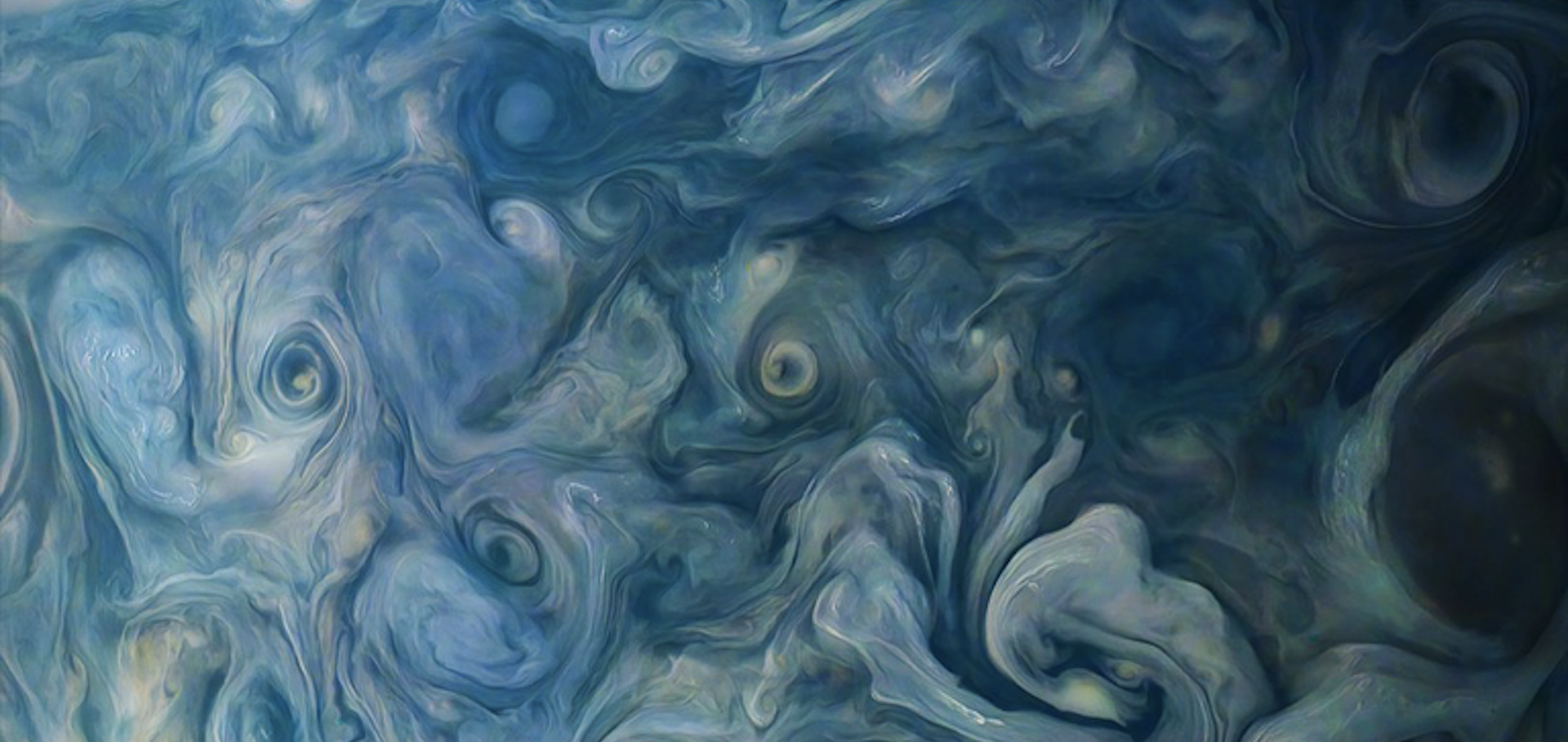
Jupiter's atmosphere

The incredible and intricate details of Jupiter's atmosphere, showing storms and clouds, that we one day hope to image on other worlds beyond our Solar System. Image: Seán Doran Flickr https://www.flickr.com/photos/seandoran

Credit: NASA / SwRI / MSSS / Gerald Eichstädt / Seán Doran

Prof Jayne Birkby

Professor of Astrophysics

Research theme

  • Astronomy and astrophysics
  • Instrumentation
  • Exoplanets and planetary physics

Sub department

  • Astrophysics

Research groups

  • Astronomical instrumentation
  • Exoplanet atmospheres
  • Exoplanets and Stellar Physics
  • Planet formation and dynamics
  • Planetary surfaces
  • Extremely Large Telescope
jayne.birkby@physics.ox.ac.uk
Denys Wilkinson Building, room 761
Personal research page
  • About
  • Books
  • Publications

Chasing rainbows and ocean glints: Inner working angle constraints for the Habitable Worlds Observatory

(2023)

Authors:

Sophia R Vaughan, Timothy D Gebhard, Kimberly Bott, Sarah L Casewell, Nicolas B Cowan, David S Doelman, Matthew Kenworthy, Johan Mazoyer, Maxwell A Millar-Blanchaer, Victor JH Trees, Daphne M Stam, Olivier Absil, Lisa Altinier, Pierre Baudoz, Ruslan Belikov, Alexis Bidot, Jayne L Birkby, Markus J Bonse, Bernhard Brandl, Alexis Carlotti, Elodie Choquet, Dirk van Dam, Niyati Desai, Kevin Fogarty, J Fowler, Kyle van Gorkom, Yann Gutierrez, Olivier Guyon, Sebastiaan Y Haffert, Olivier Herscovici-Schiller, Adrien Hours, Roser Juanola-Parramon, Evangelia Kleisioti, Lorenzo König, Maaike van Kooten, Mariya Krasteva, Iva Laginja, Rico Landman, Lucie Leboulleux, David Mouillet, Mamadou N'Diaye, Emiel H Por, Laurent Pueyo, Frans Snik
More details from the publisher

A Spectroscopic Thermometer: Individual Vibrational Band Spectroscopy with the Example of OH in the Atmosphere of WASP-33b

The Astronomical Journal IOP Publishing 166:2 (2023) 41-41

Authors:

Sam OM Wright, Stevanus K Nugroho, Matteo Brogi, Neale P Gibson, Ernst JW de Mooij, Ingo Waldmann, Jonathan Tennyson, Hajime Kawahara, Masayuki Kuzuhara, Teruyuki Hirano, Takayuki Kotani, Yui Kawashima, Kento Masuda, Jayne L Birkby, Chris A Watson, Motohide Tamura, Konstanze Zwintz, Hiroki Harakawa, Tomoyuki Kudo, Klaus Hodapp, Shane Jacobson, Mihoko Konishi, Takashi Kurokawa, Jun Nishikawa, Masashi Omiya

Abstract:

The ExoMol database (www.exomol.com) provides molecular data for spectroscopic studies of hot atmospheres. These data are widely used to model atmospheres of exoplanets, cool stars and other astronomical objects, as well as a variety of terrestrial applications. The 2024 data release reports the current status of the database which contains recommended line lists for 91 molecules and 224 isotopologues giving a total of almost 10$^{12}$ individual transitions. New features of the database include extensive "MARVELization" of line lists to allow them to be used for high resolutions studies, extension of several line lists to ultraviolet wavelengths, provision of photodissociation cross sections and extended provision of broadening parameters. Some of the in-house data specifications have been rewritten in JSON and moved to conformity with other international standards. Data products, including specific heats, a database of lifetimes for plasma studies, and the ExoMolHR web app which allows exclusively high resolution data to be extracted, are discussed
More details from the publisher
Details from ORA
More details

A spectroscopic thermometer: individual vibrational band spectroscopy with the example of OH in the atmosphere of WASP-33b

(2023)

Authors:

Sam OM Wright, Stevanus K Nugroho, Matteo Brogi, Neale P Gibson, Ernst JW de Mooij, Ingo Waldmann, Jonathan Tennyson, Hajime Kawahara, Masayuki Kuzuhara, Teruyuki Hirano, Takayuki Kotani, Yui Kawashima, Kento Masuda, Jayne L Birkby, Chris A Watson, Motohide Tamura, Konstanze Zwintz, Hiroki Harakawa, Tomoyuki Kudo, Klaus Hodapp, Shane Jacobson, Mihoko Konishi, Takashi Kurokawa, Jun Nishikawa, Masashi Omiya, Takuma Serizawa, Akitoshi Ueda, Sébastien Vievard, Sergei N Yurchenko
More details from the publisher

Applying a temporal systematics model to vector Apodizing Phase Plate coronagraphic data: TRAP4vAPP

(2023)

Authors:

Pengyu Liu, Alexander J Bohn, David S Doelman, Ben J Sutlieff, Matthias Samland, Matthew A Kenworthy, Frans Snik, Jayne L Birkby, Beth A Biller, Jared R Males, Katie M Morzinski, Laird M Close, Gilles PPL Otten
More details from the publisher

Applying a temporal systematics model to vector Apodizing Phase Plate coronagraphic data: TRAP4vAPP

Astronomy & Astrophysics EDP Sciences 674 (2023) A115-A115

Authors:

Pengyu Liu, Alexander J Bohn, David S Doelman, Ben J Sutlieff, Matthias Samland, Matthew A Kenworthy, Frans Snik, Jayne L Birkby, Beth A Biller, Jared R Males, Katie M Morzinski, Laird M Close, Gilles PPL Otten

Abstract:

The vector Apodizing Phase Plate (vAPP) is a pupil plane coronagraph that suppresses starlight by forming a dark hole in its point spread function (PSF). The unconventional and non-axisymmetrical PSF arising from the phase modification applied by this coronagraph presents a special challenge to post-processing techniques. We aim to implement a recently developed post-processing algorithm, temporal reference analysis of planets (TRAP) on vAPP coronagraphic data. The property of TRAP that uses non-local training pixels, combined with the unconventional PSF of vAPP, allows for more flexibility than previous spatial algorithms in selecting reference pixels to model systematic noise. Datasets from two types of vAPPs are analysed: a double grating-vAPP (dgvAPP360) that produces a single symmetric PSF and a grating-vAPP (gvAPP180) that produces two D-shaped PSFs. We explore how to choose reference pixels to build temporal systematic noise models in TRAP for them. We then compare the performance of TRAP with previously implemented algorithms that produced the best signal-to-noise ratio (S/N) in companion detections in these datasets. We find that the systematic noise between the two D-shaped PSFs is not as temporally associated as expected. Conversely, there is still a significant number of systematic noise sources that are shared by the dark hole and the bright side in the same PSF. We should choose reference pixels from the same PSF when reducing the dgvAPP360 dataset or the gvAPP180 dataset with TRAP. In these datasets, TRAP achieves results consistent with previous best detections, with an improved S/N for the gvAPP180 dataset.Comment: 15 pages, 10 figures, accepted to A&
More details from the publisher
Details from ORA
More details

Pagination

  • First page First
  • Previous page Prev
  • …
  • Page 6
  • Page 7
  • Page 8
  • Page 9
  • Current page 10
  • Page 11
  • Page 12
  • Page 13
  • Page 14
  • …
  • Next page Next
  • Last page Last

Footer Menu

  • Contact us
  • Giving to the Dept of Physics
  • Work with us
  • Media

User account menu

  • Log in

Follow us

FIND US

Clarendon Laboratory,

Parks Road,

Oxford,

OX1 3PU

CONTACT US

Tel: +44(0)1865272200

University of Oxfrod logo Department Of Physics text logo
IOP Juno Champion logo Athena Swan Silver Award logo

© University of Oxford - Department of Physics

Cookies | Privacy policy | Accessibility statement

Built by: Versantus

  • Home
  • Research
  • Study
  • Engage
  • Our people
  • News & Comment
  • Events
  • Our facilities & services
  • About us
  • Giving to Physics
  • Current students
  • Staff intranet