Home
Department Of Physics text logo
  • Research
    • Our research
    • Our research groups
    • Our research in action
    • Research funding support
    • Summer internships for undergraduates
  • Study
    • Undergraduates
    • Postgraduates
  • Engage
    • For alumni
    • For business
    • For schools
    • For the public
  • Support
Menu
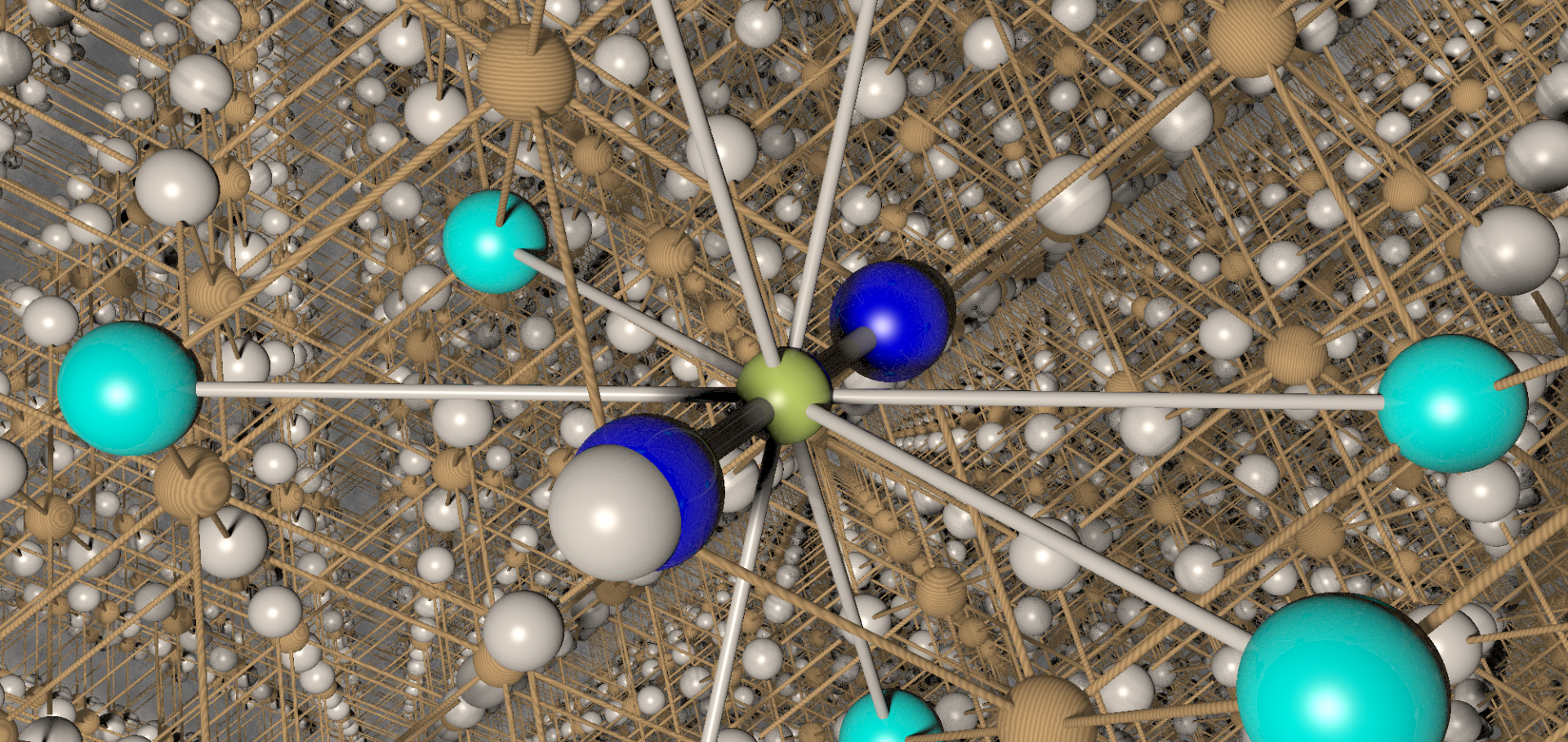
Crystal structure inside calcium fluoride with an implanted muon
Credit: SJB

Professor Stephen Blundell

Professor of Physics

Research theme

  • Quantum materials

Sub department

  • Condensed Matter Physics

Research groups

  • Muons and magnets
Stephen.Blundell@physics.ox.ac.uk
Telephone: 01865 (2)72347
Clarendon Laboratory, room 108
  • About
  • Books
  • Teaching
  • Research
  • Publications

Magnetism in geometrically frustrated YMnO_3 under hydrostatic pressure studied with muon spin relaxation

Physical Review Letters 98 (2007) 197203 4pp

Authors:

T Lancaster, S. J. Blundell, D. Andreica, M. Janoschek
More details from the publisher
More details

Magnetism in the high-Tc analogue Cs2AgF4 studied with muon-spin relaxation

(2007)

Authors:

T Lancaster, SJ Blundell, PJ Baker, W Hayes, SR Giblin, SE McLain, FL Pratt, Z Salman, EA Jacobs, JFC Turner, T Barnes
More details from the publisher

Separation of energy scales in the kagome antiferromagnet TmAgGe: A magnetic-field-orientation study up to 55 T

Physical Review B - Condensed Matter and Materials Physics 75:9 (2007)

Authors:

PA Goddard, J Singleton, AL Lima Sharma, E Morosan, SJ Blundell, SL Bud'ko, PC Canfield

Abstract:

TmAgGe is an antiferromagnet in which the spins are confined to distorted kagome-like planes at low temperatures. We report angle-dependent measurements of the magnetization M in fields of up to 55 T that show that there are two distinct and separate energy scales present in TmAgGe, each responsible for a set of step-like metamagnetic transitions: weak exchange interactions and strong crystalline-electric-field (CEF) interactions. Simulations of M using a three-dimensional, free-energy minimization technique allow us to specify the physical origin of the metamagnetic transitions in low, in-plane fields. We also show that the transitions observed with the field perpendicular to the kagome planes are associated with the CEF-split multiplet of Tm. © 2007 The American Physical Society.
More details from the publisher
More details

Magnetic order in the S= 2 two-dimensional molecular antiferromagnet copper pyrazine perchlorate Cu (Pz)2 (Cl O4) 2

Physical Review B - Condensed Matter and Materials Physics 75:9 (2007)

Authors:

T Lancaster, SJ Blundell, ML Brooks, PJ Baker, FL Pratt, JL Manson, MM Conner, F Xiao, CP Landee, FA Chaves, S Soriano, MA Novak, TP Papageorgiou, AD Bianchi, T Herrmannsdörfer, J Wosnitza, JA Schlueter

Abstract:

We present an investigation of magnetic ordering in the two-dimensional S= 2 quantum magnet Cu (Pz)2 (Cl O4) 2 using specific heat and zero-field muon-spin relaxation (μ+ SR). The magnetic contribution to the specific heat is consistent with an exchange strength of 17.7 (3) K. We find unambiguous evidence for a transition to a state of three-dimensional long-range order below a critical temperature TN =4.21 (1) K using μ+ SR even though there is no feature in the specific heat at that temperature. The absence of a specific heat anomaly at TN is consistent with recent theoretical predictions. The ratio of TN J=0.24 corresponds to a ratio of intralayer to interlayer exchange constants of J′ J=6.8× 10⁻⁴, indicative of excellent two-dimensional isolation. The scaled magnetic specific heat of [Cu (Pz)2 (H F2)] B F4, a compound with an analogous structure, is very similar to that of Cu (Pz)2 (Cl O4) 2 although both differ slightly from the predicted value for an ideal 2D S= 2 Heisenberg antiferromagnet. © 2007 The American Physical Society.
More details from the publisher
More details

Muon-spin relaxation measurements on the dimerized spin- 1/2 chains NaTi Si2 O6 and TiOCl

Physical Review B Condensed Matter and Materials Physics 75:9 (2007)

Authors:

PJ Baker, SJ Blundell, FL Pratt, T Lancaster, ML Brooks, W Hayes, M Isobe, Y Ueda, M Hoinkis, M Sing, M Klemm, S Horn, R Claessen

Abstract:

We report muon spin relaxation (μSR) and magnetic susceptibility investigations of two Ti3+ (S=1/2) chain compounds, NaTi Si2 O6 and TiOCl, each of which exhibits a spin gap at low temperature. From these we conclude that the spin gap in NaTi Si2 O6, which arises from orbital ordering at TOO =210 K, is temperature independent below TOO, with a value of 2Δ=700 (100) K. In TiOCl, we find thermally activated spin fluctuations corresponding to a spin gap 2Δ=440 (60) K below Tc1 =67 K. We can describe both the μSR and susceptibility data in terms of a model based on the dimerization of the Ti3+ chains. We also compare the methods used to extract the spin gap and the concentration of free spins within the samples from μSR and magnetic susceptibility data. © 2007 The American Physical Society.
More details from the publisher
More details

Pagination

  • First page First
  • Previous page Prev
  • …
  • Page 123
  • Page 124
  • Page 125
  • Page 126
  • Current page 127
  • Page 128
  • Page 129
  • Page 130
  • Page 131
  • …
  • Next page Next
  • Last page Last

Footer Menu

  • Contact us
  • Giving to the Dept of Physics
  • Work with us
  • Media

User account menu

  • Log in

Follow us

FIND US

Clarendon Laboratory,

Parks Road,

Oxford,

OX1 3PU

CONTACT US

Tel: +44(0)1865272200

University of Oxfrod logo Department Of Physics text logo
IOP Juno Champion logo Athena Swan Silver Award logo

© University of Oxford - Department of Physics

Cookies | Privacy policy | Accessibility statement

Built by: Versantus

  • Home
  • Research
  • Study
  • Engage
  • Our people
  • News & Comment
  • Events
  • Our facilities & services
  • About us
  • Giving to Physics
  • Current students
  • Staff intranet