Home
Department Of Physics text logo
  • Research
    • Our research
    • Our research groups
    • Our research in action
    • Research funding support
    • Summer internships for undergraduates
  • Study
    • Undergraduates
    • Postgraduates
  • Engage
    • For alumni
    • For business
    • For schools
    • For the public
  • Support
Menu
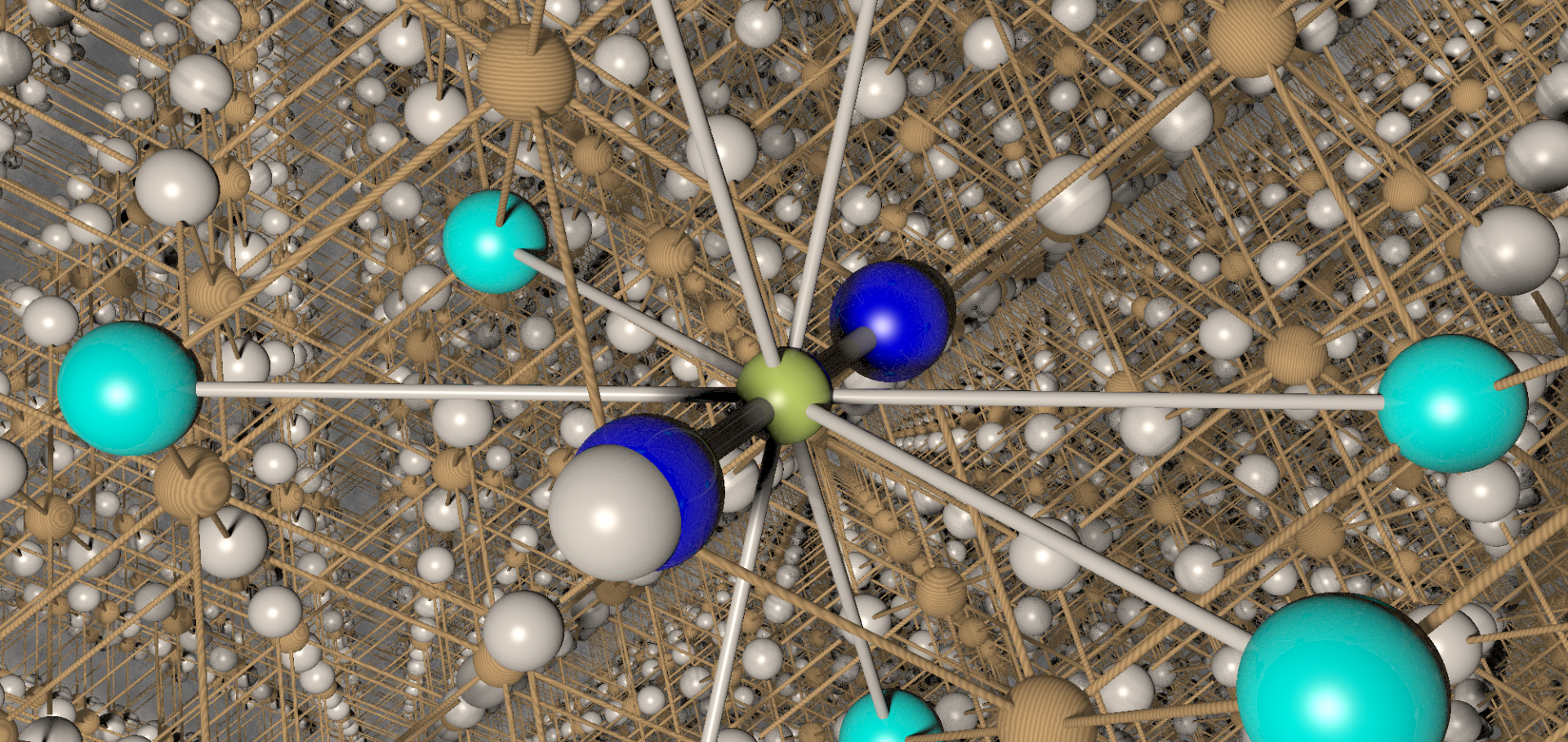
Crystal structure inside calcium fluoride with an implanted muon
Credit: SJB

Professor Stephen Blundell

Professor of Physics

Research theme

  • Quantum materials

Sub department

  • Condensed Matter Physics

Research groups

  • Muons and magnets
Stephen.Blundell@physics.ox.ac.uk
Telephone: 01865 (2)72347
Clarendon Laboratory, room 108
  • About
  • Books
  • Teaching
  • Research
  • Publications

Muon-spin relaxation study of charge carrier dynamics in the conducting polymer PPV

SYNTHETIC MET 119:1-3 (2001) 205-206

Authors:

SJ Blundell, FL Pratt, IM Marshall, A Husmann, W Hayes, RE Martin, AB Holmes

Abstract:

Muon-spin relaxation (mu SR) experiments on the conducting polymer poly(2,3-dibutoxy-1,4-phenylene vinylene) (DB-PPV) probe the dynamics of the highly mobile polarons created by the muon-implantation process in which muonium reacts with the polymer forming a radical state. The fluctuating spin density induced by the electronic spin defect rapidly diffusing up and down the chain leads to a characteristic relaxation, the temperature and field dependence of which permit the extraction of on-chain and inter-chain diffusion rates. These results provide information concerning: the charge-transport mechanism in DB-PPV.
More details from the publisher

Numerical simulation of angle dependent magnetoresistances oscillations in alpha-(BEDT-TTF)(2)KHg(SCN)(4)

SYNTHETIC MET 120:1-3 (2001) 983-984

Authors:

MS Nam, A Ardavan, SJ Blundell, J Singleton

Abstract:

We present a numerical simulation of angle dependent magnetoresistances oscillations(AMROs) in alpha-(BEDT-TTF)(2)KHg(SCN)(4). The nesting vector of the density wave and the magnetic breakdowngap in the low-temperature, low-magnetic-field state (LTLF) are constrained by simulations of quasi-one-dimensional (Q1D) AMRO. Quasi-two-dimensional (Q2D) AMRO simulations for the high-temperature, high-magnetic-field state (HTHF) allow the precise derivation of an ellipticity of the Q2D Fermi surface. Simulations of the field dependent AMRO demonstrate the gradual evolution of the FS from LTLF to HTHF states toward the kink transition at 23 T.
More details from the publisher

Numerical simulation of angle dependent magnetoresistances oscillations in α-(BEDT-TTF)2KHg(SCN)4

Synthetic Metals 120:1-3 (2001) 983-984

Authors:

MS Nam, A Ardavan, SJ Blundell, J Singleton

Abstract:

We present a numerical simulation of angle dependent magnetoresistances oscillations (AMROs) in α-(BEDT-TTF)2KHg(SCN)4. The nesting vector of the density wave and the magnetic breakdowngap in the low-temperature, low-magnetic-field state (LTLF) are constrained by simulations of quasi-one-dimensional (Q1D) AMRO. Quasi-two-dimensional (Q2D) AMRO simulations for the high-temperature, high-magnetic-field state (HTHF) allow the precise derivation of an ellipticity of the Q2D Fermi surface. Simulations of the field dependent AMRO demonstrate the gradual evolution of the FS from LTLF to HTHF states toward the kink transition at 23 T.
More details from the publisher

The mapping of the quasi-two-dimensional Fermi surface sections of organic conductors

SYNTHETIC MET 120:1-3 (2001) 989-990

Authors:

W Hayes, MS Nam, JA Symington, SJ Blundell, A Ardavan, J Singleton

Abstract:

We have developed a model for parameterizing the shape of the quasi-two-dimensional (Q2D) Fermi surface (FS) sections found in many organic molecular metals. Using this model, we show that it is possible to extract more detail about the Q2D pocket shape from angle-dependent magnetoresistance oscillations than in the traditional approximation which assumes an elliptical FS shape. We also consider the implications for cyclotron resonance experiments.
More details from the publisher

The mapping of the quasi-two-dimensional Fermi surface sections of organic conductors

Synthetic Metals 120:1-3 (2001) 989-990

Authors:

W Hayes, MS Nam, JA Symington, SJ Blundell, A Ardavan, J Singleton

Abstract:

We have developed a model for parameterizing the shape of the quasi-two-dimensional (Q2D) Fermi surface (FS) sections found in many organic molecular metals. Using this model, we show that it is possible to extract more detail about the Q2D pocket shape from angle-dependent magnetoresistance oscillations than in the traditional approximation which assumes an elliptical FS shape. We also consider the implications for cyclotron resonance experiments.
More details from the publisher

Pagination

  • First page First
  • Previous page Prev
  • …
  • Page 153
  • Page 154
  • Page 155
  • Page 156
  • Current page 157
  • Page 158
  • Page 159
  • Page 160
  • Page 161
  • …
  • Next page Next
  • Last page Last

Footer Menu

  • Contact us
  • Giving to the Dept of Physics
  • Work with us
  • Media

User account menu

  • Log in

Follow us

FIND US

Clarendon Laboratory,

Parks Road,

Oxford,

OX1 3PU

CONTACT US

Tel: +44(0)1865272200

University of Oxfrod logo Department Of Physics text logo
IOP Juno Champion logo Athena Swan Silver Award logo

© University of Oxford - Department of Physics

Cookies | Privacy policy | Accessibility statement

Built by: Versantus

  • Home
  • Research
  • Study
  • Engage
  • Our people
  • News & Comment
  • Events
  • Our facilities & services
  • About us
  • Giving to Physics
  • Current students
  • Staff intranet