

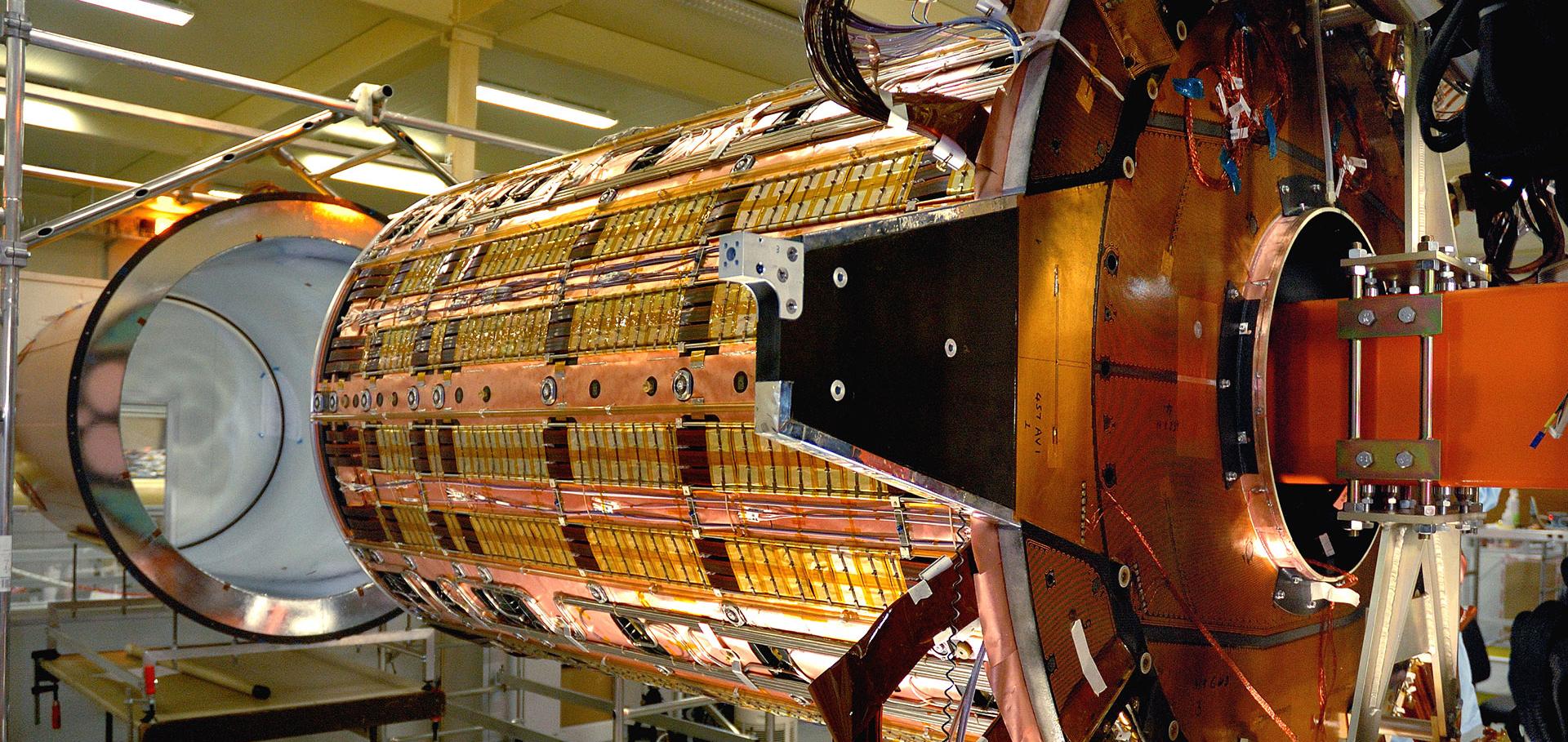

The Compact Linear e+e− Collider (CLIC): Accelerator and Detector
Cern European Organization for Nuclear Research -Reports- Cern (2018)
The Compact Linear e+e− Collider (CLIC): Physics Potential
Cern European Organization for Nuclear Research -Reports- Cern CERN (2018)
Abstract:
The Compact Linear Collider, CLIC, is a proposed e+e− collider at the TeV scale whose physics potential ranges from high-precision measurements to extensive direct sensitivity to physics beyond the Standard Model. This document summarises the physics potential of CLIC, obtained in detailed studies, many based on full simulation of the CLIC detector. CLIC covers one order of magnitude of centre-of-mass energies from 350 GeV to 3 TeV, giving access to large event samples for a variety of SM processes, many of them for the first time in e+e− collisions or for the first time at all. The high collision energy combined with the large luminosity and clean environment of the e+e− collisions enables the measurement of the properties of Standard Model particles, such as the Higgs boson and the top quark, with unparalleled precision. CLIC might also discover indirect effects of very heavy new physics by probing the parameters of the Standard Model Effective Field Theory with an unprecedented level of precision. The direct and indirect reach of CLIC to physics beyond the Standard Model significantly exceeds that of the HL-LHC. This includes new particles detected in challenging non-standard signatures. With this physics programme, CLIC will decisively advance our knowledge relating to the open questions of particle physics.Design and operation of a prototype interaction point beam collision feedback system for the International Linear Collider
PHYSICAL REVIEW ACCELERATORS AND BEAMS 21:12 (2018) ARTN 122802
The Compact Linear e+e− Collider (CLIC) - 2018 Summary Report
CERN Yellow Reports: Monographs CERN (2018)
Abstract:
The Compact Linear Collider (CLIC) is a TeV-scale high-luminosity linear e+e- collider under development at CERN. Following the CLIC conceptual design published in 2012, this report provides an overview of the CLIC project, its current status, and future developments. It presents the CLIC physics potential and reports on design, technology, and implementation aspects of the accelerator and the detector. For an optimal exploitation of its physics potential, CLIC is foreseen to be built and operated in stages, at centre-of-mass energies of 380 GeV, 1.5 TeV and 3 TeV, respectively, for a site length ranging from 11 km to 50 km. CLIC uses a two-beam acceleration scheme, in which normal-conducting highgradient 12 GHz accelerating structures are powered via a high-current drive beam. For the first stage, an alternative with X-band klystron powering is also considered. CLIC accelerator optimisation, technical developments and system tests have resulted in significant progress in recent years. Moreover, this has led to an increased energy efficiency (power around 170MW) for the 380 GeV stage, together with a reduced cost estimate at the level of 6 billion CHF. The detector concept, which matches the physics performance requirements and the CLIC experimental conditions, has been refined using improved software tools for simulation and reconstruction. Significant progress has been made on detector technology developments for the tracking and calorimetry systems. A wide range of CLIC physics studies has been conducted, both through full detector simulations with overlay of beaminduced backgrounds, and through parametric studies, together providing a broad overview of the CLIC physics potential. Each of the three energy stages adds cornerstones of the full CLIC physics programme, such as Higgs width and couplings, top-quark properties, Higgs self-coupling, direct searches, and many precision electroweak measurements. The interpretation of the combined results gives crucial and accurate insight into new physics, largely complementary to LHC and HL-LHC. The construction of the first CLIC energy stage could start by 2026. First beams would be available by 2035, marking the beginning of a broad CLIC physics programme spanning 25–30 years.Higgs physics at the CLIC electron-positron linear collider
European Physical Journal C Springer Nature 475:77 (2018)