Home
Department Of Physics text logo
  • Research
    • Our research
    • Our research groups
    • Our research in action
    • Research funding support
    • Summer internships for undergraduates
  • Study
    • Undergraduates
    • Postgraduates
  • Engage
    • For alumni
    • For business
    • For schools
    • For the public
  • Support
Menu
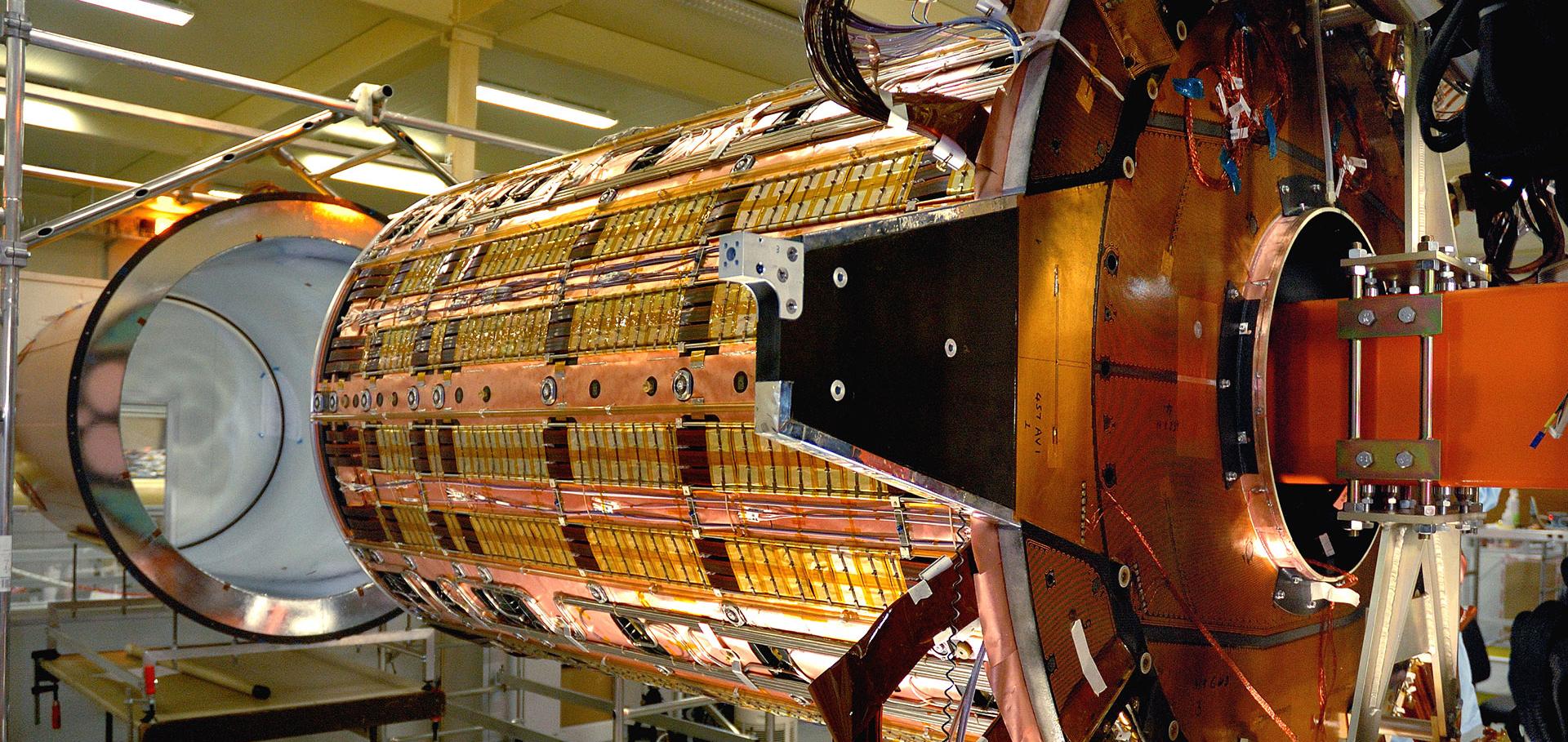
Insertion of STC into TRT at the Department of Physics, Oxford
Credit: CERN

Philip Burrows

Professor of Physics

Sub department

  • Particle Physics
Philip.Burrows@physics.ox.ac.uk
Telephone: 01865 (2)73451
Denys Wilkinson Building, room 615a
  • About
  • Publications

Optimisation of a high-resolution, low-latency stripline beam position monitor system for use in intra-train feedback

IPAC 2017 - Proceedings of the 8th International Particle Accelerator Conference (2017) 1979-1982

Authors:

NB Kraljevic, RM Bodenstein, T Bromwich, PN Burrows, GB Christian, C Perry, R Ramjiawan, DR Bett

Abstract:

A high-resolution, low-latency beam position monitor (BPM) system has been developed for use in feedback systems at particle accelerators and beamlines that operate with trains of particle bunches with bunch separations as low as several tens of nanoseconds, such as future linear electron-positron colliders and free-electron lasers. The system was tested with electron beams in the extraction line of the Accelerator Test Facility at the High Energy Accelerator Research Organization (KEK) in Japan. The fast analogue front-end signal processor is based on a single-stage RF down-mixer, with a measured latency of 15.6 ± 0.1 ns. The processor has been optimised, doubling the maximum operating beam intensity up to 1.6 nC, and the signal processing in the custom digital acquisition board has been upgraded in order to improve the resolution beyond the 300 nm level measured previously. The latest results, demonstrating a position resolution of order 150 nm with single-pass beam, will be presented.

Progress towards nanometre-level beam stabilisation using a cavity BPM system at ATF2

IPAC 2017 - Proceedings of the 8th International Particle Accelerator Conference (2017) 1986-1988

Authors:

T Bromwich, NB Kraljevic, RM Bodenstein, PN Burrows, GB Christian, C Perry, R Ramjiawan

Abstract:

A lowlatency feedback system has been designed and tested to achieve interbunch position stabilisation at the final focus of the Accelerator Test Facility (ATF2) at KEK. This system has now been enhanced through the use of position information from two cavity beam position monitors (BPMs) to enable beam stabilisation at a third, intermediate location where a witness BPM measures the correction. LowQ cavity BPMs were used, along with custom signal processing electronics designed for low latency and optimal position resolution. A custom stripline kicker, power amplifier and digital feedback board were used to provide beam correction and feedback control. The system was tested in singlepass, multibunch mode with the aim of providing interbunch beam stabilisation on electron bunches of charge ~1 nC separated in time by 280 ns. In 2015 a single BPM feedback system demonstrated beam stabilisation to below 75 nm. To date the two BPM input feedback system has demonstrated beam stabilisation to 83 ± 6 nm. This performance is limited by the current understanding of the cavity BPM resolution. Work will be described with the aim of improving this result.

Tuning simulations for the CLIC traditional beam delivery system

IPAC 2017 - Proceedings of the 8th International Particle Accelerator Conference (2017) 788-790

Authors:

RM Bodenstein, PN Burrows, E Marin, F Plassard, R Tomás

Abstract:

As the design of the CLIC beam delivery system (BDS) evolves, tuning simulations must be performed on each of the proposed lattice designs to see which system achieves the highest luminosity in the most realistic manner. This work will focus on the tuning simulations performed on the so-called Traditional lattice design for the center-of-mass energy of 3 TeV. The lattice modifications required to target the most important aberrations and the latest tuning results will be presented.

Quantitative shadowgraphy and proton radiography for large intensity modulations

Physical Review E - Statistical Physics, Plasmas, Fluids, and Related Interdisciplinary Topics American Physical Society (2017)

Authors:

Muhammad Kasim, Luke Ceurvorst, Naren Ratan, James Sadler, Nicholas Chen, Alexander Savert, Raoul Trines, Robert Bingham, Philip N Burrows, Malte C Kaluza, Peter Norreys

Abstract:

Shadowgraphy is a technique widely used to diagnose objects or systems in various fields in physics and engineering. In shadowgraphy, an optical beam is deflected by the object and then the intensity modulation is captured on a screen placed some distance away. However, retrieving quantitative information from the shadowgrams themselves is a challenging task because of the non-linear nature of the process. Here, a novel method to retrieve quantitative information from shadowgrams, based on computational geometry, is presented for the first time. This process can also be applied to proton radiography for electric and magnetic field diagnosis in high-energy-density plasmas and has been benchmarked using a toroidal magnetic field as the object, among others. It is shown that the method can accurately retrieve quantitative parameters with error bars less than 10%, even when caustics are present. The method is also shown to be robust enough to process real experimental results with simple pre- and post-processing techniques. This adds a powerful new tool for research in various fields in engineering and physics for both techniques.
More details from the publisher
Details from ORA
More details
More details

A fast, custom FPGA-based signal processor and its applications to intra-train beam stabilisation

Proc. of International Workshop on Personal Computers and Particle Accelerator Controls (PCaPAC'16), Campinas, Brazil, October 25-28, 2016 JACoW (2017) 137-140

Authors:

Glenn B Christian, Neven Blaskovic Kraljevic, Ryan M Bodenstein, T Bromwich, Philip N Burrows, Colin Perry, RL Ramjaiwan, J Roberts

Abstract:

A custom 9-channel feedback controller has been developed for low-latency applications in beam-based stabilisation. Fast 14-bit ADCs and DACs are used for highresolution signal conversion and a Xilinx Virtex-5 FPGA is used for core high-bandwidth digital computation. The sampling, and fast digital logic, can be clocked in the range 200 to 400MHz, derived from an external or internal source. A custom data acquisition system, based around LabVIEW, has been developed for real-time control and monitoring at up to 460 kbps transfer rates, and is capable of writing and reading from EPICS data records. Details of the hardware, signal processing, and data acquisition will be presented. Two examples of applications will also be presented: a position and angle bunch-by-bunch feedback system using strip-line beam position monitors to stabilise intra-train positional jitter to below the micron level with a latency less than 154 ns; and a phase feedforward system using RF cavity-based phase monitors to stabilise the downstream rms phase jitter to below 50 fs with a total latency less than the 380 ns beam time-of-flight.
More details from the publisher
Details from ORA

Pagination

  • First page First
  • Previous page Prev
  • …
  • Page 24
  • Page 25
  • Page 26
  • Page 27
  • Current page 28
  • Page 29
  • Page 30
  • Page 31
  • Page 32
  • …
  • Next page Next
  • Last page Last

Footer Menu

  • Contact us
  • Giving to the Dept of Physics
  • Work with us
  • Media

User account menu

  • Log in

Follow us

FIND US

Clarendon Laboratory,

Parks Road,

Oxford,

OX1 3PU

CONTACT US

Tel: +44(0)1865272200

University of Oxfrod logo Department Of Physics text logo
IOP Juno Champion logo Athena Swan Silver Award logo

© University of Oxford - Department of Physics

Cookies | Privacy policy | Accessibility statement

Built by: Versantus

  • Home
  • Research
  • Study
  • Engage
  • Our people
  • News & Comment
  • Events
  • Our facilities & services
  • About us
  • Giving to Physics
  • Current students
  • Staff intranet