

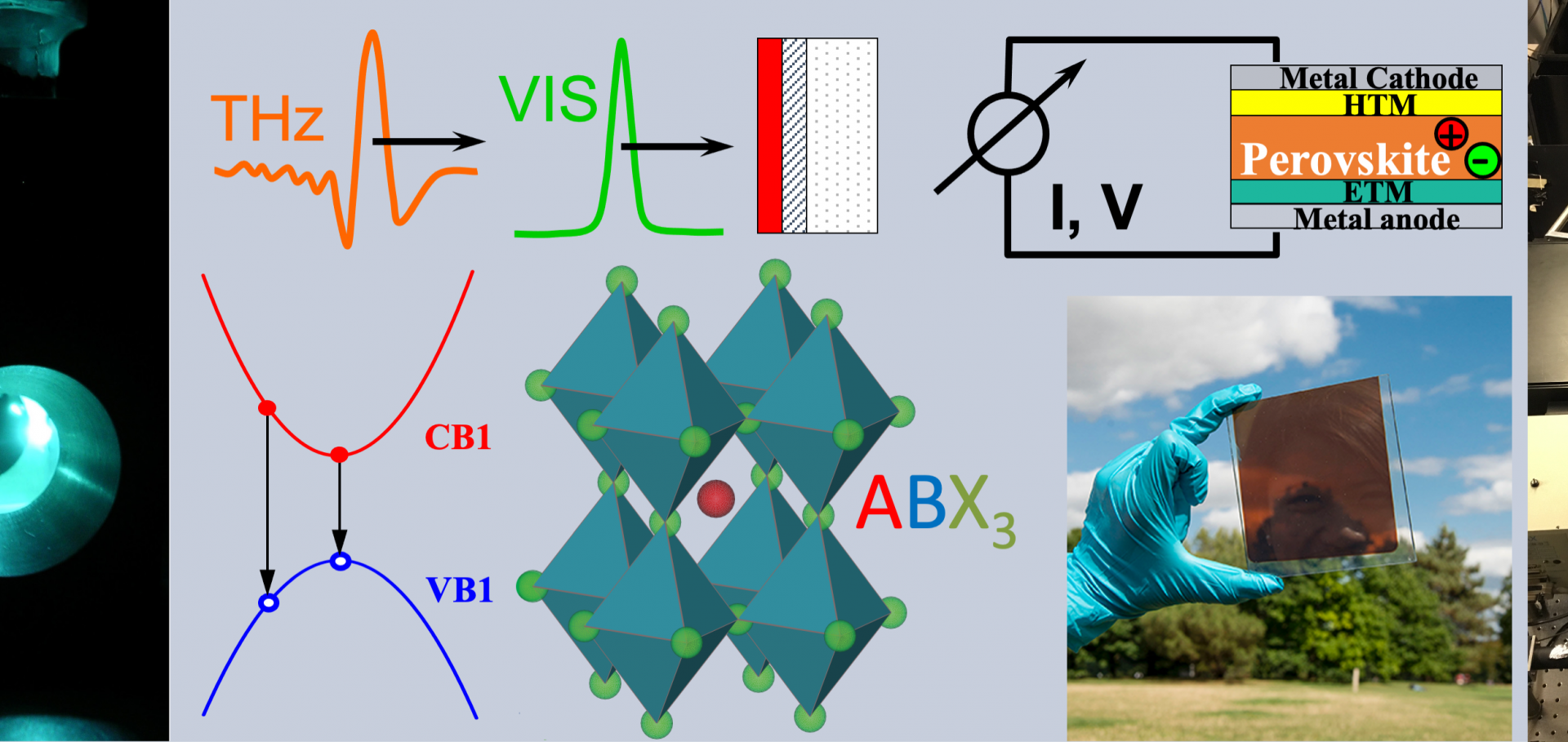

Carrier lifetime and mobility enhancement in nearly defect-free core-shell nanowires measured using time-resolved terahertz spectroscopy.
Nano Lett 9:9 (2009) 3349-3353
Abstract:
We have used transient terahertz photoconductivity measurements to assess the efficacy of two-temperature growth and core-shell encapsulation techniques on the electronic properties of GaAs nanowires. We demonstrate that two-temperature growth of the GaAs core leads to an almost doubling in charge-carrier mobility and a tripling of carrier lifetime. In addition, overcoating the GaAs core with a larger-bandgap material is shown to reduce the density of surface traps by 82%, thereby enhancing the charge conductivity.Conductivity of Nanoporous InP Membranes Investigated Using Terahertz Spectroscopy
Institute of Electrical and Electronics Engineers (IEEE) (2008) 707-708
Conductivity of nanoporous InP membranes investigated using terahertz spectroscopy.
Nanotechnology 19:39 (2008) 395704
Abstract:
We have investigated the terahertz conductivity of extrinsic and photoexcited electrons in nanoporous indium phosphide (InP) at different pore densities and orientations. The form of electronic transport in the film was found to differ significantly from that for bulk InP. While photo-generated electrons showed Drude-like transport, the behaviour for extrinsic electrons deviated significantly from the Drude model. Time-resolved photoconductivity measurements found that carrier recombination was slow, with lifetimes exceeding 1 ns for all porosities and orientations. When considered together, these findings suggest that the surfaces created by the nanopores strongly alter the dynamics of both extrinsic and photoexcited electrons.Efficient generation of charges via below-gap photoexcitation of polymer-fullerene blend films investigated by terahertz spectroscopy
Physical Review B Condensed Matter and Materials Physics 78:11 (2008)
Abstract:
Using optical-pump terahertz-probe spectroscopy, we have investigated the time-resolved conductivity dynamics of photoexcited polymer-fullerene bulk heterojunction blends for two model polymers: poly[3-hexylthiophene] (P3HT) and poly[2-methoxy-5- (3,7 -dimethyloctyloxy)-1,4-phenylenevinylene] (MDMO-PPV) blended with [6,6]-phenyl-CMesoscopic order and the dimensionality of long-range resonance energy transfer in supramolecular semiconductors.
J Chem Phys 129:10 (2008) 104701