



Multi-messenger Observations of a Binary Neutron Star Merger
Astrophysical Journal Letters American Astronomical Society 848 (2017) L12-L12
Abstract:
On 2017 August 17 a binary neutron star coalescence candidate (later designated GW170817) with merger time 12:41:04 UTC was observed through gravitational waves by the Advanced LIGO and Advanced Virgo detectors. The Fermi Gamma-ray Burst Monitor independently detected a gamma-ray burst (GRB 170817A) with a time delay of ∼1.7s with respect to the merger time. From the gravitational-wave signal, the source was initially localized to a sky region of 31 deg(2) at a luminosity distance of 40+8−8 Mpc and with component masses consistent with neutron stars. The component masses were later measured to be in the range 0.86 to 2.26 M⊙. An extensive observing campaign was launched across the electromagnetic spectrum leading to the discovery of a bright optical transient (SSS17a, now with the IAU identification of AT 2017gfo) in NGC 4993 (at ∼40Mpc) less than 11 hours after the merger by the One-Meter, Two Hemisphere (1M2H) team using the 1 m Swope Telescope. The optical transient was independently detected by multiple teams within an hour. Subsequent observations targeted the object and its environment. Early ultraviolet observations revealed a blue transient that faded within 48 hours. Optical and infrared observations showed a redward evolution over ∼10 days. Following early non-detections, X-ray and radio emission were discovered at the transient’s position ∼9 and ∼16 days, respectively, after the merger. Both the X-ray and radio emission likely arise from a physical process that is distinct from the one that generates the UV/optical/near-infrared emission. No ultra-high-energy gamma-rays and no neutrino candidates consistent with the source were found in follow-up searches. These observations support the hypothesis that GW170817 was produced by the merger of two neutron stars in NGC 4993 followed by a short gamma-ray burst (GRB 170817A) and a kilonova/macronova powered by the radioactive decay of r-process nuclei synthesized in the ejecta.Measurement of the νμ energy spectrum with IceCube-79: IceCube Collaboration
European Physical Journal C 77:10 (2017)
Abstract:
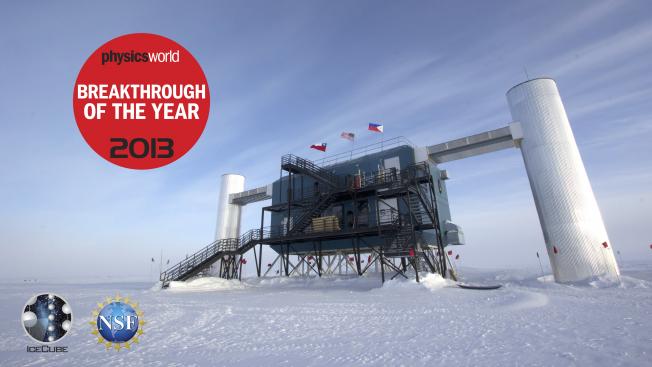
IceCube is a neutrino observatory deployed in the glacial ice at the geographic South Pole. The νAstrophysical neutrinos: IceCube highlights
Nuclear and Particle Physics Proceedings Elsevier 291 (2017) 167-174
Atmospheric neutrino results from IceCube-DeepCore and plans for PINGU
Journal of Physics: Conference Series 888:1 (2017)
Abstract:
© Published under licence by IOP Publishing Ltd. The IceCube neutrino observatory at the South Pole is the largest operating neutrino detector in the world and spans a wide range of science topics, from astronomy at the PeV-scale to particle physics at the GeV-scale. We present results from the search for a light, O(1) eV 2 , sterile neutrino using the large IceCube array and, separately, using the lower energy extension DeepCore sub-array. Additionally, we review the atmospheric neutrino results and expected sensitivities related to oscillation physics (ν μ disappearance and ν τ appearance) as well as new limits on non-standard interactions. Continuing the success of the IceCube-DeepCore physics program, a proposed next generation in-fill detector with increased sensitivity to neutrinos of O(1) GeV will be covered.Search for neutrinos from dark matter self-annihilations in the center of the Milky Way with 3 years of IceCube/DeepCore
European Physical Journal C: Particles and Fields Springer Verlag 77:9 (2017) ARTN 627