



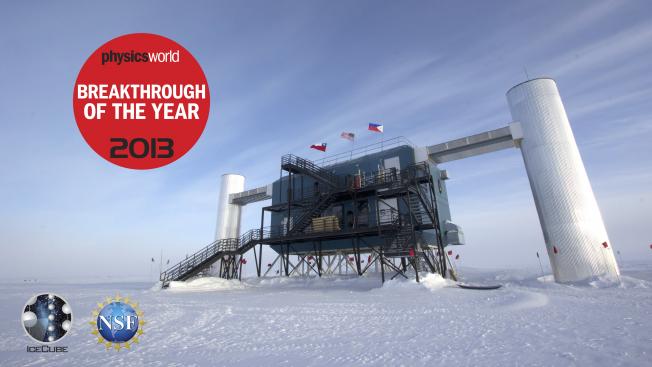
The IceCube Neutrino Observatory - Contributions to ICRC 2015 Part V: Neutrino Oscillations and Supernova Searches
34th International Cosmic Ray Conference Proceedings of Science 2015:1096-1112 (2015)
Abstract:
Papers on neutrino oscillations and supernova searches submitted to the 34th International Cosmic Ray Conference (ICRC 2015, The Hague) by the IceCube Collaboration.Search for features in the spectrum of primordial perturbations using Planck and other datasets
(2015)
Search for dark matter annihilation in the Galactic Center with IceCube-79
European Physical Journal C Springer Berlin Heidelberg 75:10 (2015) 492
Abstract:
The Milky Way is expected to be embedded in a halo of dark matter particles, with the highest density in the central region, and decreasing density with the halo-centric radius. Dark matter might be indirectly detectable at Earth through a flux of stable particles generated in dark matter annihilations and peaked in the direction of the Galactic Center. We present a search for an excess flux of muon (anti-) neutrinos from dark matter annihilation in the Galactic Center using the cubic-kilometer-sized IceCube neutrino detector at the South Pole. There, the Galactic Center is always seen above the horizon. Thus, new and dedicated veto techniques against atmospheric muons are required to make the southern hemisphere accessible for IceCube. We used 319.7 live-days of data from IceCube operating in its 79-string configuration during 2010 and 2011. No neutrino excess was found and the final result is compatible with the background. We present upper limits on the self-annihilation cross-section, (Formula presented.), for WIMP masses ranging from 30 GeV up to 10 TeV, assuming cuspy (NFW) and flat-cored (Burkert) dark matter halo profiles, reaching down to ≃4·10-24 cm3 s-1, and ≃2.6·10-23 cm3 s-1 for the νν¯ channel, respectively.The detection of a SN IIn in optical follow-up observations of IceCube neutrino events
Astrophysical Journal American Astronomical Society 811:1 (2015) 1-17