

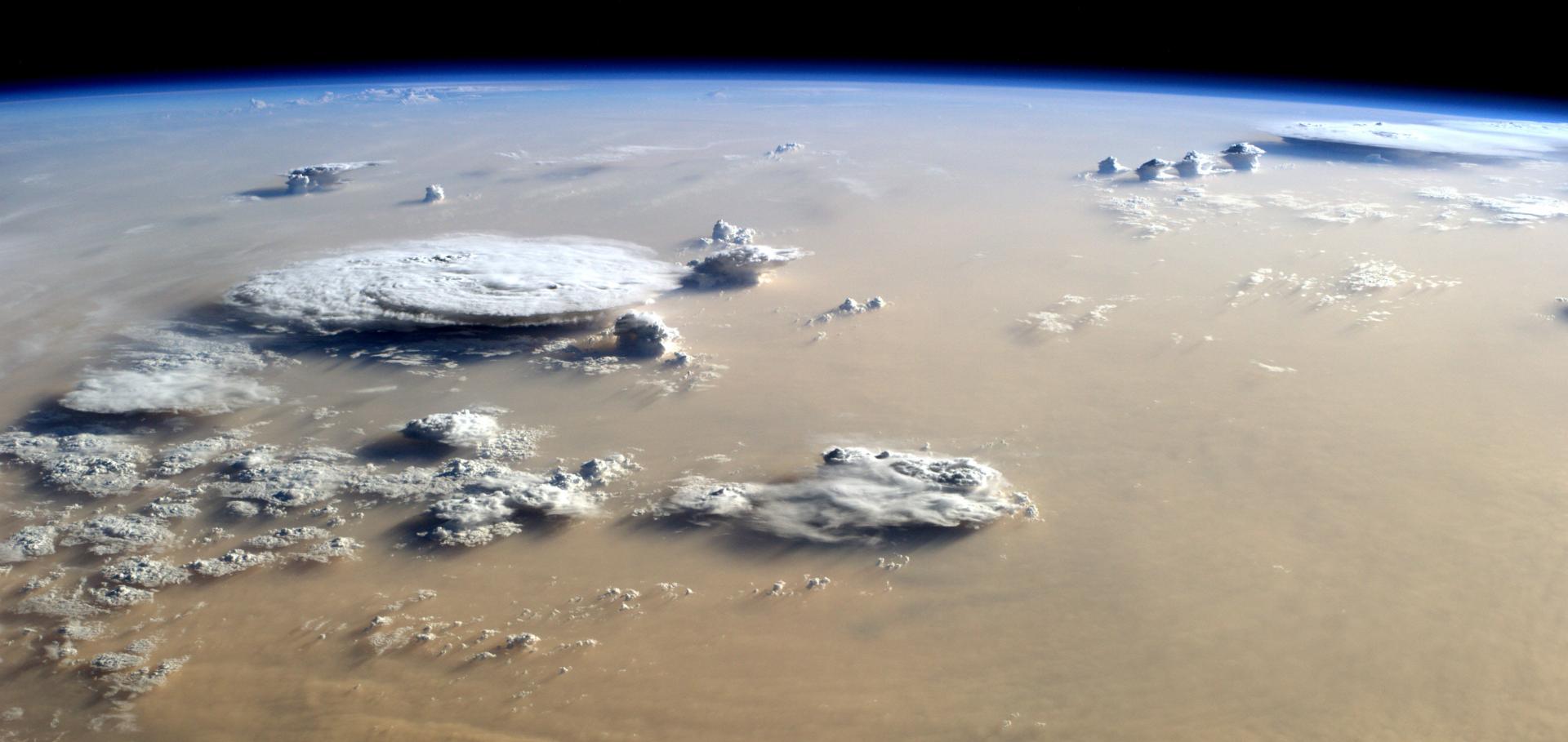
Satellite Observations of Smoke-Cloud-Radiation Interactions Over the Amazon Rainforest
Atmospheric Chemistry and Physics Discussions European Geosciences Union (2022)
Supplementary material to "Satellite Observations of Smoke-Cloud-Radiation Interactions Over the Amazon Rainforest"
(2022)
ClimateBench v1.0: a benchmark for data-driven climate projections
Journal of Advances in Modeling Earth Systems American Geophysical Union 14:10 (2022) e2021MS002954
Abstract:
Many different emission pathways exist that are compatible with the Paris climate agreement, and many more are possible that miss that target. While some of the most complex Earth System Models have simulated a small selection of Shared Socioeconomic Pathways, it is impractical to use these expensive models to fully explore the space of possibilities. Such explorations therefore mostly rely on one-dimensional impulse response models, or simple pattern scaling approaches to approximate the physical climate response to a given scenario. Here we present ClimateBench—the first benchmarking framework based on a suite of Coupled Model Intercomparison Project, AerChemMIP and Detection-Attribution Model Intercomparison Project simulations performed by a full complexity Earth System Model, and a set of baseline machine learning models that emulate its response to a variety of forcers. These emulators can predict annual mean global distributions of temperature, diurnal temperature range and precipitation (including extreme precipitation) given a wide range of emissions and concentrations of carbon dioxide, methane and aerosols, allowing them to efficiently probe previously unexplored scenarios. We discuss the accuracy and interpretability of these emulators and consider their robustness to physical constraints such as total energy conservation. Future opportunities incorporating such physical constraints directly in the machine learning models and using the emulators for detection and attribution studies are also discussed. This opens a wide range of opportunities to improve prediction, robustness and mathematical tractability. We hope that by laying out the principles of climate model emulation with clear examples and metrics we encourage engagement from statisticians and machine learning specialists keen to tackle this important and demanding challenge.Invisible ship tracks show large cloud sensitivity to aerosol
Nature Springer Nature 610:7930 (2022) 101-106
Abstract:
Cloud reflectivity is sensitive to atmospheric aerosol concentrations because aerosols provide the condensation nuclei on which water condenses1. Increased aerosol concentrations due to human activity affect droplet number concentration, liquid water and cloud fraction2, but these changes are subject to large uncertainties3. Ship tracks, long lines of polluted clouds that are visible in satellite images, are one of the main tools for quantifying aerosol–cloud interactions4. However, only a small fraction of the clouds polluted by shipping show ship tracks5,6. Here we show that even when no ship tracks are visible in satellite images, aerosol emissions change cloud properties substantially. We develop a new method to quantify the effect of shipping on all clouds, showing a cloud droplet number increase and a more positive liquid water response when there are no visible tracks. We directly detect shipping-induced cloud property changes in the trade cumulus regions of the Atlantic, which are known to display almost no visible tracks. Our results indicate that previous studies of ship tracks were suffering from selection biases by focusing only on visible tracks from satellite imagery. The strong liquid water path response we find translates to a larger aerosol cooling effect on the climate, potentially masking a higher climate sensitivity than observed temperature trends would otherwise suggest.Invisible ship tracks show large cloud sensitivity to aerosol
Nature Springer Nature 610:7930 (2022) 101-106