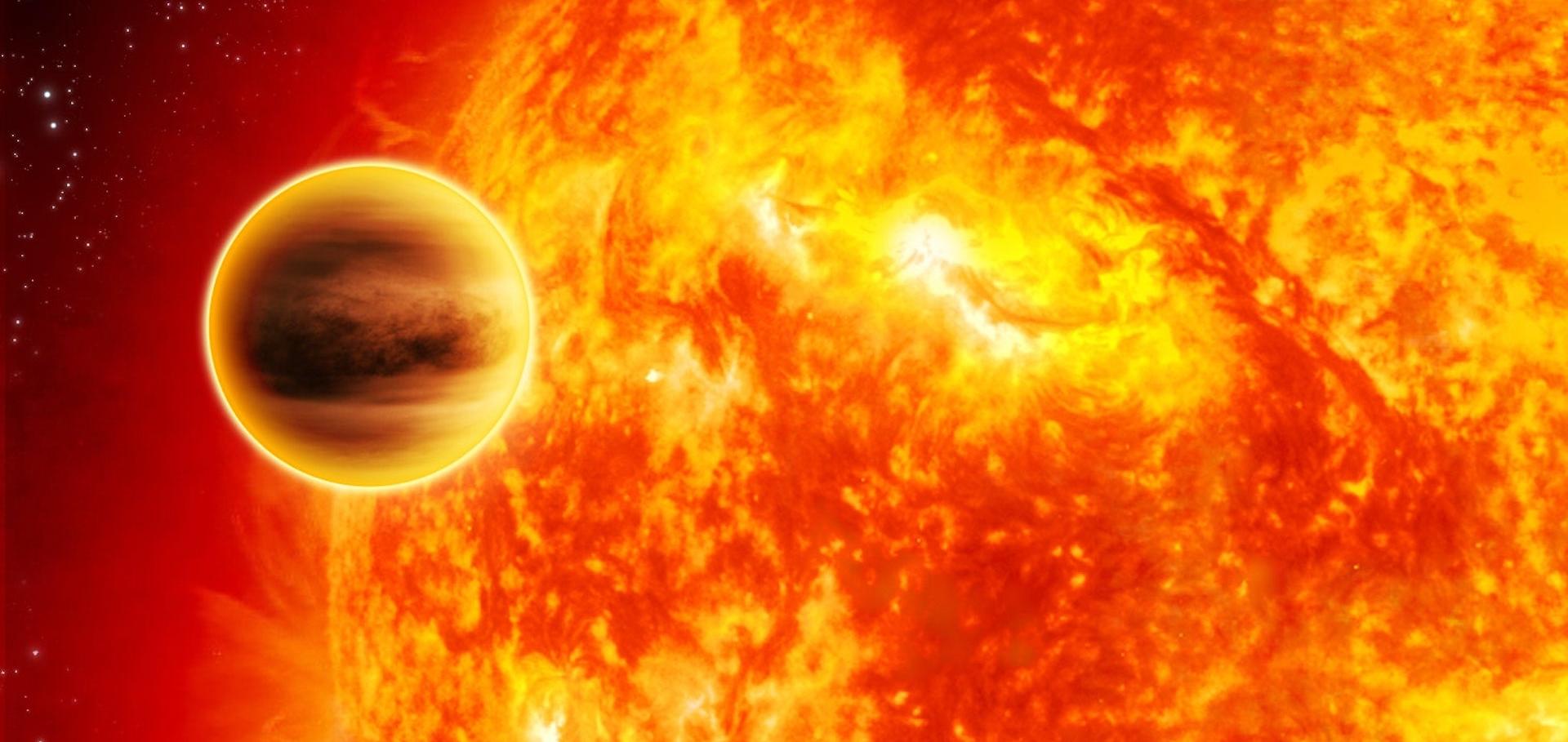
Planet Hunters TESS I: TOI 813, a subgiant hosting a transiting Saturn-sized planet on an 84-day orbit

Authors:

NL Eisner, O Barragán, S Aigrain, C Lintott, G Miller, N Zicher, TS Boyajian, C Briceño, EM Bryant, JL Christiansen, AD Feinstein, LM Flor-Torres, M Fridlund, D Gandolfi, J Gilbert, N Guerrero, JM Jenkins, K Jones, MH Kristiansen, A Vanderburg, N Law, AR López-Sánchez, AW Mann, EJ Safron, ME Schwamb, KG Stassun, HP Osborn, J Wang, A Zic, C Ziegler, F Barnet, SJ Bean, DM Bundy, Z Chetnik, JL Dawson, J Garstone, AG Stenner, M Huten, S Larish, LD Melanson, T Mitchell, C Moore, K Peltsch, DJ Rogers, C Schuster, DS Smith, DJ Simister, C Tanner, I Terentev, A Tsymbal

Abstract:

We report on the discovery and validation of TOI 813b (TIC 55525572 b), a transiting exoplanet identified by citizen scientists in data from NASA's Transiting Exoplanet Survey Satellite (TESS) and the first planet discovered by the Planet Hunters TESS project. The host star is a bright (V = 10.3 mag) subgiant ($R_\star=1.94\,R_\odot$, $M_\star=1.32\,M_\odot$). It was observed almost continuously by TESS during its first year of operations, during which time four individual transit events were detected. The candidate passed all the standard light curve-based vetting checks, and ground-based follow-up spectroscopy and speckle imaging enabled us to place an upper limit of $2 M_{Jup}$ (99 % confidence) on the mass of the companion, and to statistically validate its planetary nature. Detailed modelling of the transits yields a period of $83.8911_{ - 0.0031 } ^ { + 0.0027 }$ days, a planet radius of $6.71 \pm 0.38$ $R_{\oplus}$, and a semi major axis of $0.423_{ - 0.037 } ^ { + 0.031 }$ AU. The planet's orbital period combined with the evolved nature of the host star places this object in a relatively under-explored region of parameter space. We estimate that TOI-813b induces a reflex motion in its host star with a semi-amplitude of $\sim6$ ms$^{-1}$, making this system a promising target to measure the mass of a relatively long-period transiting planet.

The Kepler Smear Campaign: Light curves for 102 Very Bright Stars

Astrophysical Journal Supplement American Astronomical Society

Authors:

Benjamin JS Pope, Guy R Davies, Keith Hawkins, Timothy R White, Amalie Stokholm, Allyson Bieryla, David W Latham, Madeline Lucey, Conny Aerts, Suzanne Aigrain, Victoria Antoci, Timothy R Bedding, Dominic M Bowman, Douglas A Caldwell, Ashley Chontos, Gilbert A Esquerdo, Daniel Huber, Paula Jofre, Simon J Murphy, Timothy van Reeth, Victor Silva Aguirre, Jie Yu

Abstract:

We present the first data release of the Kepler Smear Campaign, using collateral 'smear' data obtained in the Kepler four-year mission to reconstruct light curves of 102 stars too bright to have been otherwise targeted. We describe the pipeline developed to extract and calibrate these light curves, and show that we attain photometric precision comparable to stars analyzed by the standard pipeline in the nominal Kepler mission. In this paper, aside from publishing the light curves of these stars, we focus on 66 red giants for which we detect solar-like oscillations, characterizing 33 of these in detail with spectroscopic chemical abundances and asteroseismic masses as benchmark stars. We also classify the whole sample, finding nearly all to be variable, with classical pulsations and binary effects. All source code, light curves, TRES spectra, and asteroseismic and stellar parameters are publicly available as a Kepler legacy sample.

The Search for Living Worlds and the Connection to Our Cosmic Origins

Authors:

MA Barstow, SUZANNE Aigrain, J Barstow, M Barthelemy, B Biller, A Bonanos, L Buchhave, S Casewell, C Charbonnel, S Charlot, R Davies, N Devaney, C Evans, M Ferrari, L Fossatti, B Gaensicke, M Garcia, AGD Castro, T Henning, C Lintott, C Knigge, C Neiner, L Rossi, C Snodgrass, D Stam, E Tolstoy, M Tosi

Abstract:

One of the most exciting scientific challenges is to detect Earth-like planets in the habitable zones of other stars in the galaxy and search for evidence of life. The ability to observe and characterise dozens of potentially Earth-like planets now lies within the realm of possibility due to rapid advances in key space and imaging technologies. The associated challenge of directly imaging very faint planets in orbit around nearby very bright stars is now well understood, with the key instrumentation also being perfected and developed. Such advances will allow us to develop large transformative telescopes, covering a broad UV-optical-IR spectral range, which can carry out the detailed research programmes designed to answer the questions we wish to answer: Carry out high contrast imaging surveys of nearby stars to search for planets within their habitable zones. Characterise the planets detected to determine masses and radii from photometric measurements. Through spectroscopic studies of their atmospheres and surfaces, search for habitability indicators and for signs of an environment that has been modified by the presence of life. Active studies of potential missions have been underway for a number of years. The latest of these is the Large UV Optical IR space telescope (LUVOIR), one of four flagship mission studies commissioned by NASA in support of the 2020 US Decadal Survey. LUVOIR, if selected, will be of interest to a wide scientific community and will be the only telescope capable of searching for and characterizing a sufficient number of exoEarths to provide a meaningful answer to the question - Are we alone?. This paper is a submission to the European Space Agency Voyage 2050 call for white papers outlining the case for an ESA contribution to a Large UVOIR telescope.

The TRAPPIST-1 system: Orbital evolution, tidal dissipation, formation and habitability

MNRAS

Authors:

JCB Papaloizou, E Szuszkiewicz, Caroline Terquem

The Transiting Exoplanet Community Early Release Science Program for JWST

Planetary and Space Science Elsevier

Authors:

Jacob L Bean, Kevin B Stevenson, Natalie M Batalha, Zachory Berta-Thompson, Laura Kreidberg, Nicolas Crouzet, Björn Benneke, Michael R Line, David K Sing, Hannah R Wakeford, Heather A Knutson, Eliza M-R Kempton, Jean-Michel Désert, Ian Crossfield, Natasha E Batalha, Julien de Wit, Vivien Parmentier, Joseph Harrington, Julianne I Moses, Mercedes Lopez-Morales, Munazza K Alam, Jasmina Blecic, Giovanni Bruno, Aarynn L Carter, John W Chapman, Leen Decin, Diana Dragomir, Thomas M Evans, Jonathan J Fortney, Jonathan D Fraine, Peter Gao, Antonio García Muñoz, Neale P Gibson, Jayesh M Goyal, Kevin Heng, Renyu Hu, Sarah Kendrew, Brian M Kilpatrick, Jessica Krick, Pierre-Olivier Lagage, Monika Lendl, Tom Louden, Nikku Madhusudhan, Avi M Mandell, Megan Mansfield, Erin M May, Giuseppe Morello, Caroline V Morley, Nikolay Nikolov, Seth Redfield, Jessica E Roberts, Everett Schlawin, Jessica J Spake, Kamen O Todorov, Angelos Tsiaras, Olivia Venot, William C Waalkes, Peter J Wheatley, Robert T Zellem, Daniel Angerhausen, David Barrado, Ludmila Carone, Sarah L Casewell, Patricio E Cubillos, Mario Damiano, Miguel de Val-Borro, Benjamin Drummond, Billy Edwards, Michael Endl, Nestor Espinoza, Kevin France, John E Gizis, Thomas P Greene, Thomas K Henning, Yucian Hong, James G Ingalls, Nicolas Iro, Patrick GJ Irwin, Tiffany Kataria, Fred Lahuis, Jérémy Leconte, Jorge Lillo-Box, Stefan Lines, Joshua D Lothringer, Luigi Mancini, Franck Marchis, Nathan Mayne, Enric Palle, Emily Rauscher, Gaël Roudier, Evgenya L Shkolnik, John Southworth, Mark R Swain, Jake Taylor, Johanna Teske, Giovanna Tinetti, Pascal Tremblin, Gregory S Tucker, Roy van Boekel, Ingo P Waldmann, Ian C Weaver, Tiziano Zingales

Abstract:

The James Webb Space Telescope (JWST) presents the opportunity to transform our understanding of planets and the origins of life by revealing the atmospheric compositions, structures, and dynamics of transiting exoplanets in unprecedented detail. However, the high-precision, time-series observations required for such investigations have unique technical challenges, and prior experience with other facilities indicates that there will be a steep learning curve when JWST becomes operational. In this paper we describe the science objectives and detailed plans of the Transiting Exoplanet Community Early Release Science (ERS) Program, which is a recently approved program for JWST observations early in Cycle 1. The goal of this project, for which the obtained data will have no exclusive access period, is to accelerate the acquisition and diffusion of technical expertise for transiting exoplanet observations with JWST, while also providing a compelling set of representative datasets that will enable immediate scientific breakthroughs. The Transiting Exoplanet Community ERS Program will exercise the time-series modes of all four JWST instruments that have been identified as the consensus highest priorities, observe the full suite of transiting planet characterization geometries (transits, eclipses, and phase curves), and target planets with host stars that span an illustrative range of brightnesses. The observations in this program were defined through an inclusive and transparent process that had participation from JWST instrument experts and international leaders in transiting exoplanet studies. Community engagement in the project will be centered on a two-phase Data Challenge that culminates with the delivery of planetary spectra, time-series instrument performance reports, and open-source data analysis toolkits in time to inform the agenda for Cycle 2 of the JWST mission.