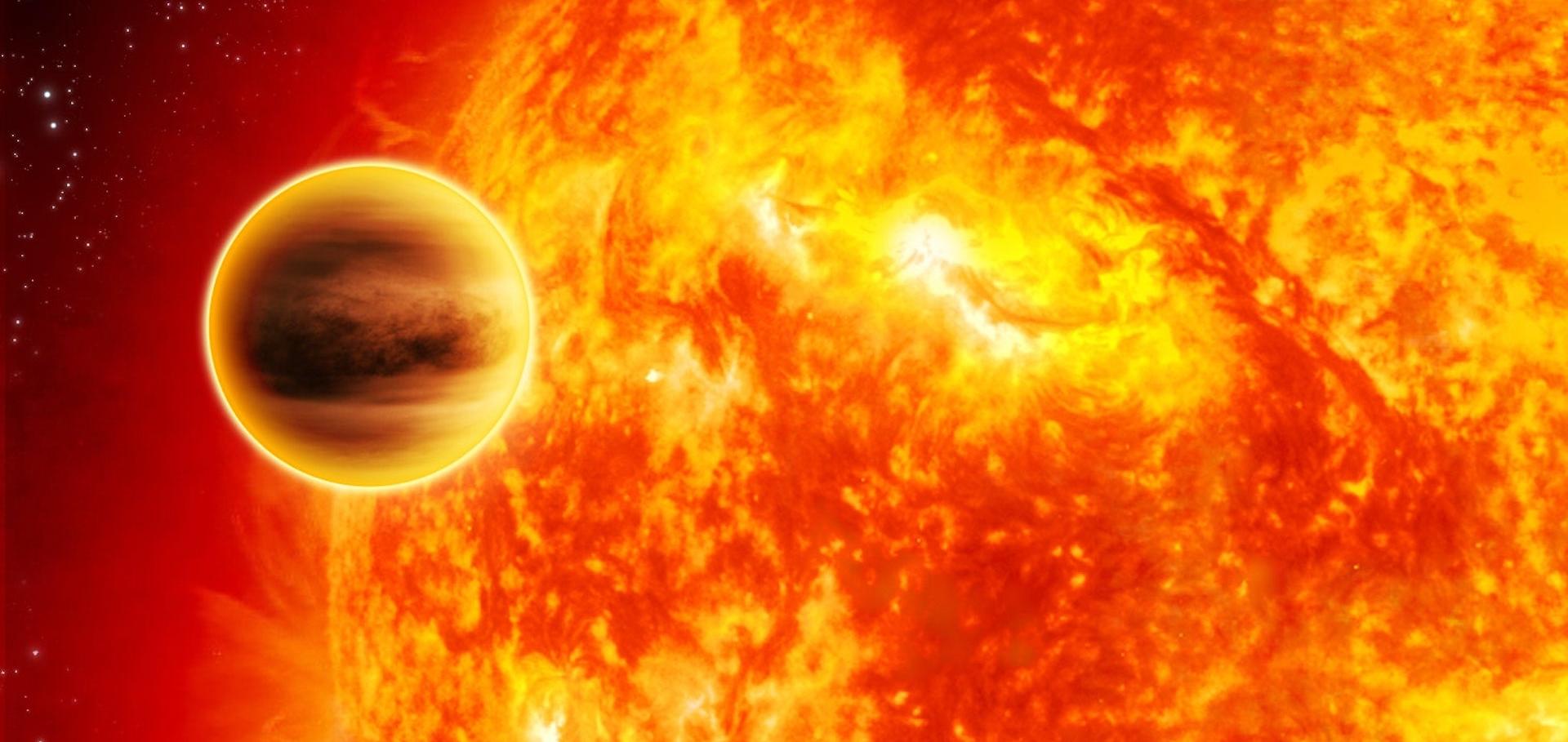
Heat Reveals What Clouds Conceal: Global Carbon and Longitudinally Asymmetric Chemistry on LTT 9779 b

Astronomical Journal 171:4 (2026)

Authors:

R Ashtari, S Collins, J Splinter, KB Stevenson, V Parmentier, J Brande, S Saha, S Stamer, IJM Crossfield, JS Jenkins, KA Kahle, JD Lothringer, N Mehta, NB Cowan, D Dragomir, L Kreidberg, M López-Morales, TM Evans-Soma, E Esparza-Borges, M Weiner Mansfield, H Beltz, T Daylan, O Venot, J Pero, X Zhang

Abstract:

LTT 9779 b is an ultra-hot Neptune (Rp ≈ 4.7 R⊕, Mp ≈ 29 M⊕) orbiting its Sun-like host star in just 19 hr, placing it deep within the “hot-Neptune desert,” where Neptunian planets are seldom found. We present new James Webb Space Telescope NIRSpec G395H phase curve observations that probe its atmospheric composition in unprecedented detail. At near-IR wavelengths, which penetrate the high-altitude clouds inferred from previous NIRISS/SOSS spectra, thermal emission reveals a carbon-rich atmosphere with opacity dominated by carbon monoxide (CO) and carbon dioxide (CO2). Evidence for both species is observed at all orbital phases (σ  11.6), with retrieved mixing ratios of ∼10−1 for CO and ∼10−4 for CO2, indicating a globally well-mixed reservoir of carbon-bearing gases. We also find moderate evidence of water vapor (H2O; σ  3.9) on the eastern dayside and dayside (orbital phases 120° and 180°, respectively), and tentatively detect sulfur dioxide (SO2; σ  2.5) on the western nightside (orbital phase 300°), providing insight into its chemistry and possible photochemical production under intense stellar irradiation. Our findings show that LTT 9779 b retains a carbon-rich atmosphere at a distance from its host star where hot-Neptune-class worlds are expected to evaporate. This makes LTT 9779 b a valuable laboratory for studying atmospheric escape and chemical processes under extreme conditions, offering new insight into the survival of planets in the hot-Neptune desert.

Redox processes of slightly-carbon-rich rocky planets

(2026)

Authors:

Claire Marie Guimond, Oliver Shorttle, Raymond Pierrehumbert

Abstract:

Whether a planet's volcanic gas is oxidising or reducing is inherited from redox conditions in the planet's mantle. It is often presumed that reactions between iron species control mantle oxygen fugacity. However, iron alone need not be the sole dictator of how oxidising the interior of a planet is. Carbon is a powerful redox element, with great potential to feed back upon the mantle redox state as it melts. Despite Earth being carbon-poor, it has been proposed that the oxygen fugacity of Earth's upper mantle is in part controlled by carbon (Holloway et al., 1992; Stagno et al., 2013); a slightly-higher volatile endowment could make carbon-powered geochemistry inescapable. Indeed, a number of known rocky exoplanets are predicted to have formed with carbon contents greater than Earth (Bergin et al., 2023). We offer a framework for how carbon is transported from solid planetary interior to atmosphere, tracking redox couplings between carbon and iron. We also incorporate a coupled 1D energy- and mass-balance model to provide first-order predictions of the rate of volcanism. We show that carbon-iron redox coupling would maintain interior oxygen fugacity in a narrow range: more reducing than Earth magma, but not reducing enough to prevent CO2 outgassing entirely.Bergin, E. A., Kempton, E. M.-R., Hirschmann, M., Bastelberger, S. T., Teal, D. J., Blake, G. A., Ciesla, F. J., & Li, J. (2023). Exoplanet Volatile Carbon Content as a Natural Pathway for Haze Formation. The Astrophysical Journal, 949, L17. Holloway, J. R., Pan, V., & Gudmundsson, G. (1992). High-pressure fluid-absent melting experiments in the presence of graphite: Oxygen fugacity, ferric/ferrous ratio and dissolved CO2. European Journal of Mineralogy, 4(1), 105–114. Stagno, V., Ojwang, D. O., McCammon, C. A., & Frost, D. J. (2013). The oxidation state of the mantle and the extraction of carbon from Earth’s interior. Nature, 493(7430).

GATOS N: The first direct kinematic evidence of dusty outflows from AGN via PAH kinematics of local Seyfert galaxies with JWST

(2026)

Authors:

Fergus R Donnan, Ismael García-Bernete, Dimitra Rigopoulou, Almudena Alonso-Herrero, Anelise Audibert, Enrica Bellocchi, Andrew Bunker, Steph Campbell, Françoise Combes, Richard Davies, Tanio Díaz-Santos, Juan A Fernández-Ontiveros, Poshak Gandhi, Santiago García-Burillo, O González-Martín, Erin KS Hicks, Laura Hermosa Muñoz, Sebastian F Hoenig, Masatoshi Imanishi, Alvaro Labiano, Nancy A Levenson, Miguel Pereira-Santaella, Cristina Ramos Almeida, Claudio Ricci, Rogemar A Riffel, Daniel Rouan, David Rosario, Karin Sandstrom, T Taro Shimizu, Marko Stalevski, Niranjan Thatte, Oscar Veenema, Lulu Zhang

The Key to Unlocking Exoplanet Biosignatures: a UK-led IR Spectrograph for the Habitable Worlds Observatory Coronagraph

(2026)

Authors:

Beth Biller, Dan Dicken, Olivier Absil, Raziye Artan, Jo Barstow, Jayne Birkby, Christophe Dumas, Sasha Hinkley, Tad Komacek, Katherine Morris, Lorenzo Pino, Sarah Rugheimer, Colin Snodgrass, Stephen Todd, Vinooja Thurairethinam, Amaury Triaud

Mantle Convection and Nightside Volcanism on Lava World K2-141 b

Monthly Notices of the Royal Astronomical Society Oxford University Press (OUP) (2026) stag390

Authors:

Tobias G Meier, Claire Marie Guimond, Raymond T Pierrehumbert, Jayne Birkby, Richard D Chatterjee, Chloe E Fisher, Gregor J Golabek, Mark Hammond, Thaddeus D Komacek, Tim Lichtenberg, Alex McGinty, Erik Meier Valdés, Harrison Nicholls, Luke T Parker, Rob J Spaargaren, Paul J Tackley

Abstract:

Abstract Ultra-short period lava worlds offer a unique window into the coupled evolution of planetary interior and atmospheres under extreme irradiation. In this study, we investigate the mantle dynamics, nightside volcanism, and volatile outgassing on lava world K2-141 b (1.54 R⊕, 5.31 M⊕) using two-dimensional convection models with tracer-based volatile tracking. Our simulations explore a range of interior configurations, including models with and without plastic yielding, basal versus mixed heating, core cooling, and melt intrusion. In models without plastic yielding (i.e. with a strong lithosphere), we find that mantle upwellings form at the substellar and antistellar points, while downwellings form near the day-night terminators at the boundary between the magma ocean and cold, solid nightside. These downwellings facilitate the recycling of crustal material, representing a form of asymmetric, single-lid tectonics. The resulting magma ocean thickness varies from 200 to 300 km depending on the model parameters, corresponding to about 2-3 % of the planet’s radius. Continuous nightside volcanism produces a basaltic crust and gradually depletes the mantle of volatiles. We find that over a billion years, volcanic eruptions can outgas tens of bars of CO2 and H2O. We show that even relatively large volcanic eruptions on the nightside produce thermal emission signals of no more than 1 ppm, remaining below the current detectability threshold in thermal phase curves. However, for most models, outgassing rates are increased near the day-night terminators and future studies should assess whether such localised outgassing could lead to atmospheric signatures in transmission spectroscopy.