Molecular gas inflows and outflows in ultraluminous infrared galaxies at z similar to 0.2 and one QSO at z=6.1

Astronomy and Astrophysics EDP Sciences 633 (2020) L4

Authors:

R Herrera-Camus, E Sturm, J Gracia-Carpio, S Veilleux, T Shimizu, D Lutz, M Stone, E Gonzalez-Alfonso, R Davies, J Fischer, R Genzel, R Maiolino, A Sternberg, L Tacconi, Aprajita Verma

Abstract:

Aims: Our aim is to search for and characterize inflows and outflows of molecular gas in four ultraluminous infrared galaxies (ULIRGs; LIR >  1012L⊙) at z ∼ 0.2−0.3 and one distant quasi-stellar object (QSO) at z = 6.13.

Methods: We used Herschel/PACS and ALMA Band 7 observations of the hydroxyl molecule (OH) line at rest-frame wavelength 119 μm, which in absorption can provide unambiguous evidence of inflows or outflows of molecular gas in nuclear regions of galaxies. Our study contributes to doubling the number of OH 119 μm observations of luminous systems at z ∼ 0.2−0.3, and pushes the search for molecular outflows based on the OH 119 μm transition to z ∼ 6.

Results: We detect OH 119 μm high-velocity absorption wings in three of the four ULIRGs. In two cases, IRAS F20036−1547 and IRAS F13352+6402, the blueshifted absorption profiles indicate the presence of powerful and fast (∼200−500 km s−1) molecular gas outflows. Consistent with an inside-out quenching scenario, these outflows are depleting the central reservoir of star-forming molecular gas at a rate similar to that of intense star formation activity. For the starburst-dominated system IRAS 10091+4704, we detect an inverted P Cygni profile that is unique among ULIRGs and indicates the presence of a fast (∼400 km s−1) inflow of molecular gas at a rate of ∼100 M⊙ yr−1 towards the central region. Finally, we tentatively detect (∼3σ) the OH 119 μm doublet in absorption in the z = 6.13 QSO ULAS J131911+095051. The OH 119 μm feature is blueshifted with a median velocity that suggests the presence of a molecular outflow, although characterized by a modest molecular mass loss rate of ∼200 M⊙ yr−1. This value is comparable to the small mass outflow rates found in the stacking of the [C II] spectra of other z ∼ 6 QSOs and suggests that ejective feedback in this phase of the evolution of ULAS J131911+095051 has subsided.

Stratified disc wind models for the AGN broad-line region: ultraviolet, optical and X-ray properties

ArXiv 2001.03625 (2020)

Authors:

James H Matthews, Christian Knigge, Nick Higginbottom, Knox S Long, Stuart A Sim, Samuel W Mangham, Edward J Parkinson, Henrietta A Hewitt

FPGA architecture to search for accelerated pulsars with SKA

Institute of Electrical and Electronics Engineers (IEEE) 00 (2020) 1-5

Authors:

P Thiagaraj, B Stappers, A Ghalame, L Levin, A Karastergiou, J Roy, M Mickaliger, M Keith

MKT J170456.2-482100: the first transient discovered by MeerKAT

MONTHLY NOTICES OF THE ROYAL ASTRONOMICAL SOCIETY 491:1 (2020) 560-575

Authors:

Ln Driessen, I McDonald, Dah Buckley, M Caleb, Ej Kotze, Sb Potter, Km Rajwade, A Rowlinson, Bw Stappers, E Tremou, Pa Woudt, Rp Fender, R Armstrong, P Groot, I Heywood, A Horesh, Aj van der Horst, E Koerding, Va McBride, Jca Miller-Jones, Kp Mooley, Ramj Wijers

Abstract:

© 2019 The Author(s) We report the discovery of the first transient with MeerKAT, MKT J170456.2−482100, discovered in ThunderKAT images of the low-mass X-ray binary GX339−4. MKT J170456.2−482100 is variable in the radio, reaching a maximum flux density of 0.71 ± 0.11 mJy on 2019 October 12, and is undetected in 15 out of 48 ThunderKAT epochs. MKT J170456.2−482100 is coincident with the chromospherically active K-type sub-giant TYC 8332-2529-1, and ∼ 18 yr of archival optical photometry of the star shows that it varies with a period of 21.25 ± 0.04 d. The shape and phase of the optical light curve changes over time, and we detect both X-ray and UV emission at the position of MKT J170456.2−482100, which may indicate that TYC 8332-2529-1 has large star spots. Spectroscopic analysis shows that TYC 8332-2529-1 is in a binary, and has a line-of-sight radial velocity amplitude of 43 km s−1. We also observe a spectral feature in antiphase with the K-type sub-giant, with a line-of-sight radial velocity amplitude of ∼ 12 ± 10 km s−1, whose origins cannot currently be explained. Further observations and investigation are required to determine the nature of the MKT J170456.2−482100 system.

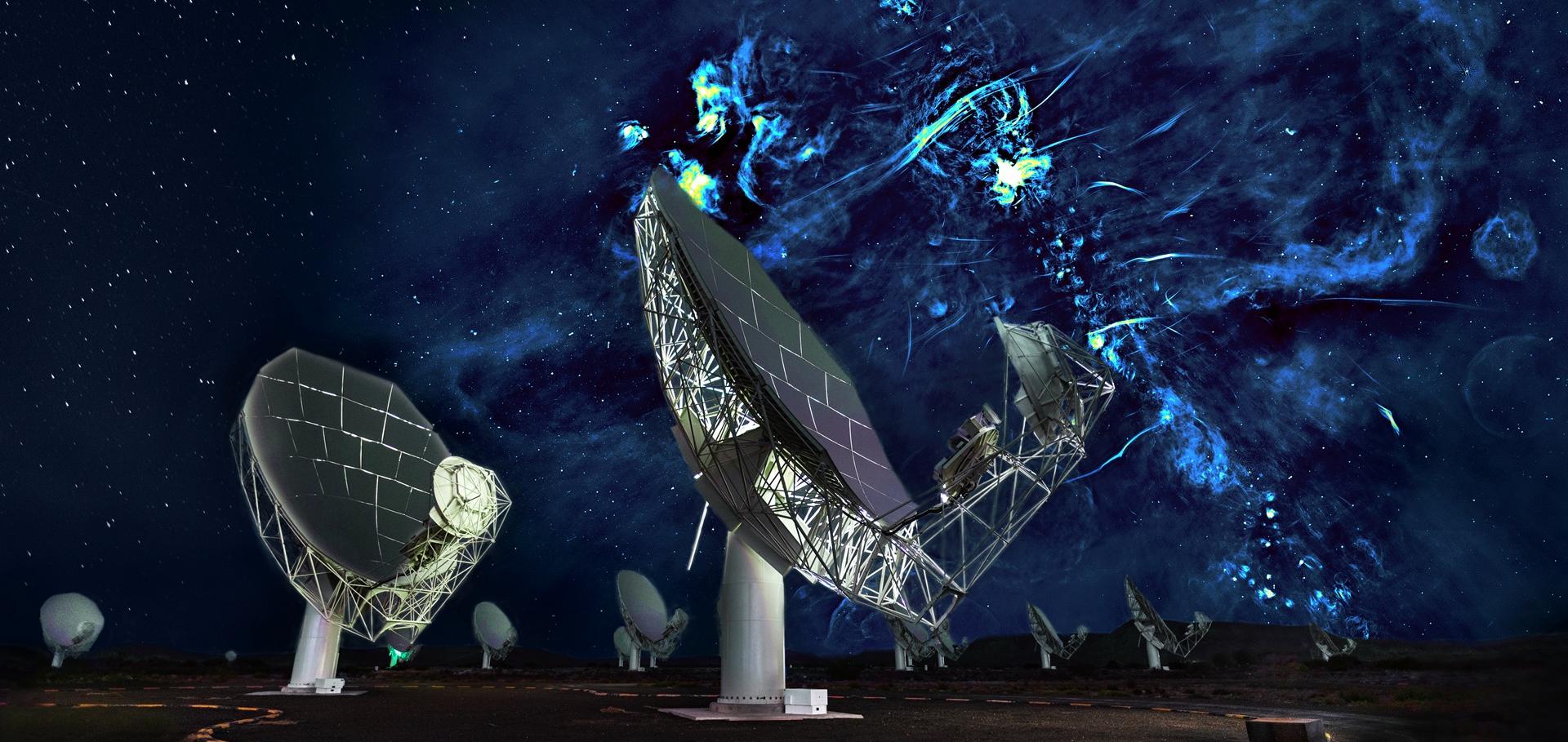
The MeerKAT telescope as a pulsar facility: System verification and early science results from MeerTime

Publications of the Astronomical Society of Australia Cambridge University Press 37 (2020) e028

Authors:

M Bailes, A Jameson, F Abbate, Ed Barr, Ndr Bhat, L Bondonneau, M Burgay, Sj Buchner, F Camilo, Dj Champion, I Cognard, Pb Demorest, Pcc Freire, T Gautam, M Geyer, Jm Griessmeier, L Guillemot, H Hu, F Jankowski, S Johnston, A Karastergiou, R Karuppusamy, D Kaur, Mj Keith, M Kramer, J Van Leeuwen, Me Lower, Y Maan, Ma McLaughlin, Bw Meyers, S Osłowski, Ls Oswald, A Parthasarathy, T Pennucci, B Posselt, A Possenti, Sm Ransom, Dj Reardon, A Ridolfi, Ctg Schollar, M Serylak, G Shaifullah, M Shamohammadi, Rm Shannon, C Sobey, X Song, R Spiewak, Ih Stairs, Bw Stappers, W Van Straten

Abstract:

We describe system verification tests and early science results from the pulsar processor (PTUSE) developed for the newly commissioned 64-dish SARAO MeerKAT radio telescope in South Africa. MeerKAT is a high-gain low-system temperature radio array that currently operates at 580-1 670 MHz and can produce tied-array beams suitable for pulsar observations. This paper presents results from the MeerTime Large Survey Project and commissioning tests with PTUSE. Highlights include observations of the double pulsar, pulse profiles from 34 millisecond pulsars (MSPs) from a single 2.5-h observation of the Globular cluster Terzan 5, the rotation measure of Ter5O, a 420-sigma giant pulse from the Large Magellanic Cloud pulsar PSR , and nulling identified in the slow pulsar PSR J0633-2015. One of the key design specifications for MeerKAT was absolute timing errors of less than 5 ns using their novel precise time system. Our timing of two bright MSPs confirm that MeerKAT delivers exceptional timing. PSR exhibits a jitter limit of whilst timing of PSR over almost 11 months yields an rms residual of 66 ns with only 4 min integrations. Our results confirm that the MeerKAT is an exceptional pulsar telescope. The array can be split into four separate sub-arrays to time over 1 000 pulsars per day and the future deployment of S-band (1 750-3 500 MHz) receivers will further enhance its capabilities.