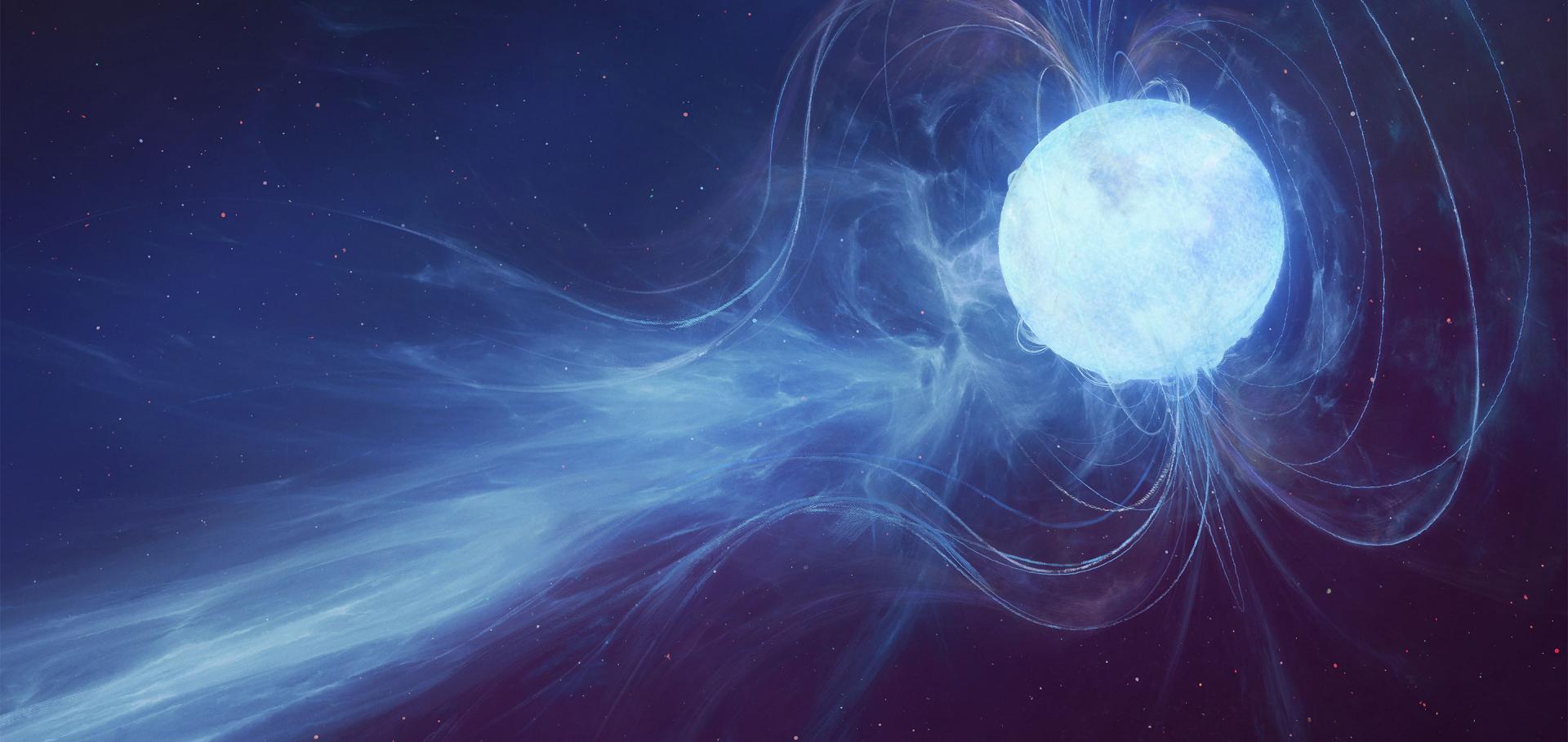
A HyperFlash and ÉCLAT view of the local environment and energetics of the repeating FRB 20240619D

Monthly Notices of the Royal Astronomical Society Oxford University Press 546:3 (2026) stag090

Authors:

OS Ould-Boukattine, AJ Cooper, JWT Hessels, DM Hewitt, SK Ocker, A Moroianu, K Nimmo, MP Snelders, I Cognard, TJ Dijkema, M Fine, MP Gawroński, W Herrmann, J Huang, F Kirsten, Z Pleunis, W Puchalska, S Ranguin, T Telkamp

Abstract:

Time-variable propagation effects provide a window into the local plasma environments of repeating fast radio burst (FRB) sources. Here we report high-cadence observations of FRB 20240619D, as part of the HyperFlash and ÉCLAT programmes. We observed for 500 h and detected 217 bursts, including 10 bursts with high fluence ( Jy ms) and implied energy. We track burst-to-burst variations in dispersion measure (DM) and rotation measure (RM), from which we constrain the parallel magnetic field strength in the source’s local environment: mG. Apparent DM variations between sub-bursts in a single bright event are interpreted as coming from plasma lensing or variable emission height. We also identify two distinct scintillation screens along the line of sight, one associated with the Milky Way and the other likely located in the FRB’s host galaxy or local environment. Together, these (time-variable) propagation effects reveal that FRB 20240619D is embedded in a dense, turbulent and highly magnetised plasma. The source’s environment is more dynamic than that measured for many other (repeating) FRB sources, but less extreme compared to several repeaters that are associated with a compact, persistent radio source. FRB 20240619D’s cumulative burst fluence distribution shows a power-law break, with a flat tail at high energies. Along with previous studies, this emphasises a common feature in the burst energy distribution of hyperactive repeaters. Using the break in the burst fluence distribution, we estimate a source redshift of . We discuss FRB 20240619D’s nature in the context of similar studies of other repeating FRBs.

Prompt Searches for Very-high-energy γ -Ray Counterparts to IceCube Astrophysical Neutrino Alerts

The Astrophysical Journal American Astronomical Society 997:2 (2026) 141

Authors:

J Abhir, A Biland, K Brand, T Bretz, D Dorner, L Eisenberger, D Elsaesser, P Günther, S Hasan, D Hildebrand, K Mannheim, M Linhoff, F Pfeifle, W Rhode, B Schleicher, V Sliusar, M Vorbrugg, R Walter, F Aharonian, F Ait Benkhali, J Aschersleben, H Ashkar, M Backes, A Brown, G Cotter

Abstract:

The search for sources of high-energy astrophysical neutrinos can be significantly advanced through a multimessenger approach, which seeks to detect the γ-rays that accompany neutrinos as they are produced at their sources. Multimessenger observations have so far provided the first evidence for a neutrino source, illustrated by the joint detection of the flaring blazar TXS 0506+056 in high-energy (E > 1 GeV) and very-high-energy (VHE; E > 100 GeV) γ-rays in coincidence with the high-energy neutrino IceCube-170922A, identified by IceCube. Imaging atmospheric Cherenkov telescopes (IACTs), namely FACT, H.E.S.S., MAGIC, and VERITAS, continue to conduct extensive neutrino target-of-opportunity follow-up programs. These programs have two components: follow-up observations of single astrophysical neutrino candidate events (such as IceCube-170922A), and observation of known γ-ray sources after the identification of a cluster of neutrino events by IceCube. Here we present a comprehensive analysis of follow-up observations of high-energy neutrino events observed by the four IACTs between 2017 September (after the IceCube-170922A event) and 2021 January. Our study found no associations between γ-ray sources and the observed neutrino events. We provide a detailed overview of each neutrino event and its potential counterparts. Furthermore, a joint analysis of all IACT data is included, yielding combined upper limits on the VHE γ-ray flux.

The odyssey of the black hole low mass X-ray binary GX339-4: Five years of dense multi-wavelength monitoring

(2026)

Authors:

E Tremou, S Corbel, R Fender, P Woudt, JCA Miller-Jones, I Heywood, F Carotenuto, S Motta, A Tzioumis, PJ Groot, DM Russell, J Crook-Mansour, P Saikia, W Yu, J van den Eijnden, AJ van der Horst, DRA Williams-Baldwin, X Zhang

Resonant locking between binary systems induced by gravitational waves

Physical Review D American Physical Society (APS) 113:2 (2026) 023040

Authors:

Charlie Sharpe, Yonadav Barry Ginat, Zeyuan Xuan, Bence Kocsis

Abstract:

The interaction of gravitational waves (GWs) with matter is thought to be typically negligible in the Universe. We identify an exception in the case of resonant interactions, where GWs emitted by a background binary system, such as an inspiraling supermassive black hole (SMBH) binary, cause a resonant response in a stellar-mass foreground binary and the frequencies of the two systems become, and remain, synchronized. We point out that this previously unexplored dynamical phenomenon is not only possible, but can lead to O ( 30 ) binary systems becoming resonantly locked in the host galaxy of merging SMBHs of mass 10 8.5 11 M , each of which has a significantly reduced merger time. We predict O ( 10 10 ) binary systems have been locked in the Universe’s history. Resonant locking could be detected through anomalous inspiral of binary systems.

Cosmic rays, γ -rays, and neutrinos from discrete black hole X-ray binary ejecta

Monthly Notices of the Royal Astronomical Society Oxford University Press 546:2 (2026) stag080

Authors:

Nicolas J Bacon, Alex J Cooper, Dimitrios Kantzas, James H Matthews, Rob Fender

Abstract:

The origin of cosmic rays (CRs) from outside the Solar system is unknown, as they are deflected by the interstellar magnetic field. Supernova remnants are the main candidate for CRs up to PeV energies but due to lack of evidence, they cannot be concluded as the sources of the most energetic Galactic CRs. We investigate discrete ejecta produced in state transitions of black hole X-ray binary systems as a potential source of CRs, motivated by recent TeV -ray detections by LHAASO. Starting from MAXI J1820+070, we examine the multi-wavelength observations and find that efficient particle acceleration may take place (i.e. into a robust power law), up to eV, where is the ratio of particle energy to magnetic energy. From these calculations, we estimate the global contribution of ejecta to the entire Galactic spectrum to be , with the CR contribution rising to at PeV energies, assuming roughly equal energy in non-thermal protons, non-thermal electrons, and magnetic fields. In addition, we calculate associated -ray and neutrino spectra of the MAXI J1820+070 ejecta to investigate new detection methods with CTAO, which provide strong constraints on initial ejecta size of order Schwarzschild radii ( pc) assuming a period of adiabatic expansion.