

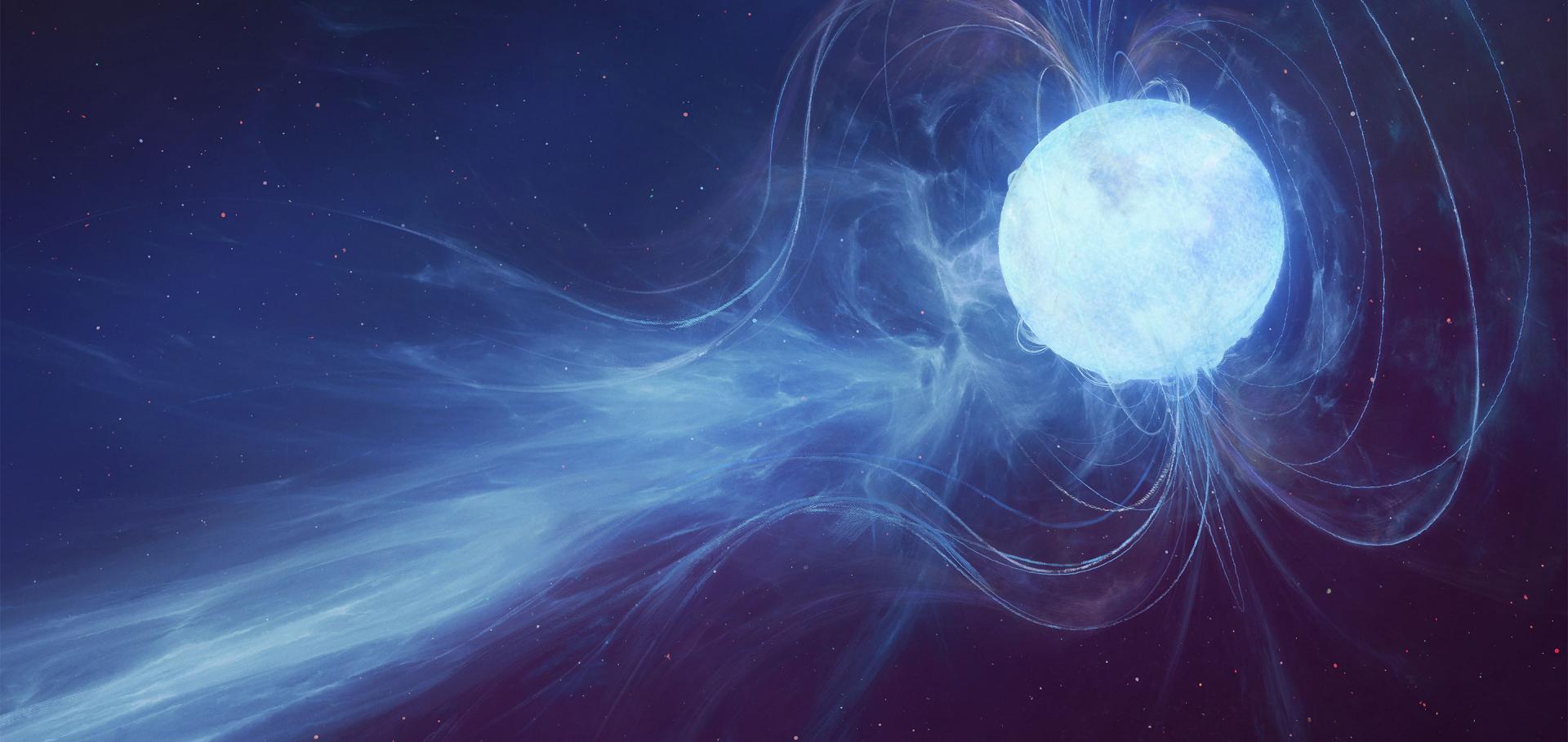
Observational Biases and Improved Modelling of Off-axis Relativistic Jets
Monthly Notices of the Royal Astronomical Society Oxford University Press (OUP) (2026) stag1187
Abstract:
Abstract Relativistic Doppler boosting significantly affects the observed emission of astrophysical jets resulting in observational biases. In this work we investigate the observational biases and modelling opportunities which arise due to relativistic boosting using two X-ray binary case studies. Using the one-sided jet ejecta from MAXI J1535-571, we demonstrate that incorporating non-detections of the receding jet ejecta into kinematic modelling can significantly improve parameter estimation, reducing posterior uncertainties by over $40{{\ \rm per\ cent}}$. For the bipolar jets of MAXI J1820+070, we recover the intrinsic jet rest-frame emission of both approaching and receding jet components, demonstrating that they follow a common powerlaw evolution. Using this rest-frame emission profile as a base model, we show that current observational strategies strongly bias against detecting ejecta with high initial Lorentz factors ≳ 5 and receding ejecta components across a broad region of parameter space. These results highlight the importance of observational strategy selection, particularly early-time and late-time observations, and leveraging non-detections in the modelling of relativistic jets. More generally, quantifying observational biases and maximising modelling capabilities by incorporating the non-detection of receding jets can be employed to enhance interpretation of future gravitational-wave/optically-triggered observations of off-axis, extragalactic jetted transients.The Transitional Type Ibn/IIn SN 2022pda, with Pre-explosion Outbursts and a Double-peaked Light Curve
The Astrophysical Journal Letters American Astronomical Society 1004:2 (2026) l37
Abstract:
We report the results of a photometric and spectroscopic follow-up campaign of the unusual interacting supernova (SN) 2022pda. Precursor variability lasting ∼100 days is observed before the explosion. The SN light curve has a double-peak shape. It reached a first maximum of Mr = −19.6 ± 0.2 mag, followed by an initial 2 month decline and a second, broad peak lasting about 6 months. The early spectra show a blue continuum with dominant H and He emission lines. A high-resolution pre-maximum spectrum shows that the profile of the He i λ 5876 line consists of a moderately narrow (∼1900 km s−1) P Cygni absorption superposed on a broader (∼3300 km s−1) component. In the blue region, several spectral features are identified, including C iii/N iii/O ii blends. Two broad bumps at 4600–5200 Å and 6400–6800 Å regions reveal a complex profile, which are likely due to blends of H, He, and other emission lines. Late-time spectra are still dominated by prominent and broad H and He lines in emission. Shock-driven model fits to the bolometric light curve suggest that the SN is powered by interaction with a massive CSM with enhanced mass-loss rates ∼5 M⊙yr−1, expelled during two events that occurred ∼1 and ∼0.2 yr before the explosion. The overall SN evolution indicates that SN 2022pda is a transitional event between an H-rich SN IIn (SN 2009ip-like) and an He-rich SN Ibn. Our findings suggest that the progenitor was likely a luminous blue variable transitioning towards a Wolf–Rayet stage.TITAN DR1: An Improved, Validated, and Systematically Controlled Recalibration of ATLAS Photometry toward Type Ia Supernova Cosmology
The Astrophysical Journal American Astronomical Society 1004:2 (2026) 173
Abstract:
ATLAS (Asteroid Terrestrial Last Alert System) is a time-domain survey using four telescopes, covering the entire sky. It has observed 8378 spectroscopically confirmed Type Ia supernovae (SNe Ia), with thousands of cosmology-grade light curves (to be released as TITAN DR1). To prepare this massive, low-redshift dataset for cosmology, we evaluate and cross-calibrate ATLAS forced photometry using tertiary stars from the DES (Dark Energy Survey) Y6 release. The 5000 deg2 DES footprint overlaps regions both in and out of the PS1 (Pan-STARRS DR1) footprint, allowing tests of the primary calibrator for the ATLAS Refcat2 catalog. Initial offsets are at the ∼40 mmag scale. To improve this, we determine Δ zero-point offsets for two cases: (1) pixel-to-pixel offsets within individual CCDs (reduced from ∼8 to ∼4 mmag rms) and (2) chip-to-chip offsets across the nine CCDs and filters (reduced from ∼17 to ∼3 mmag rms). We also identify the largest systematic uncertainty as a transmission-function color dependence, requiring shifts in the assumed ATLAS filters at the ∼30 mmag level if uncorrected. We validate our calibration using (a) CALSPEC standards, (b) an independent tertiary catalog, and (c) distance moduli of cross-matched SNe Ia, all showing improved consistency. Overall, we estimate combined calibration-related systematics at the ∼5–10 mmag level, supporting competitive cosmological constraints with the TITAN SN Ia dataset.Observational Biases and Improved Modelling of Off-axis Relativistic Jets
(2026)
Towards improved synchrotron self absorption energy estimates: accounting for inhomogeneous and non-spherical emitting regions
Monthly Notices of the Royal Astronomical Society Oxford University Press (OUP) (2026) stag1113