

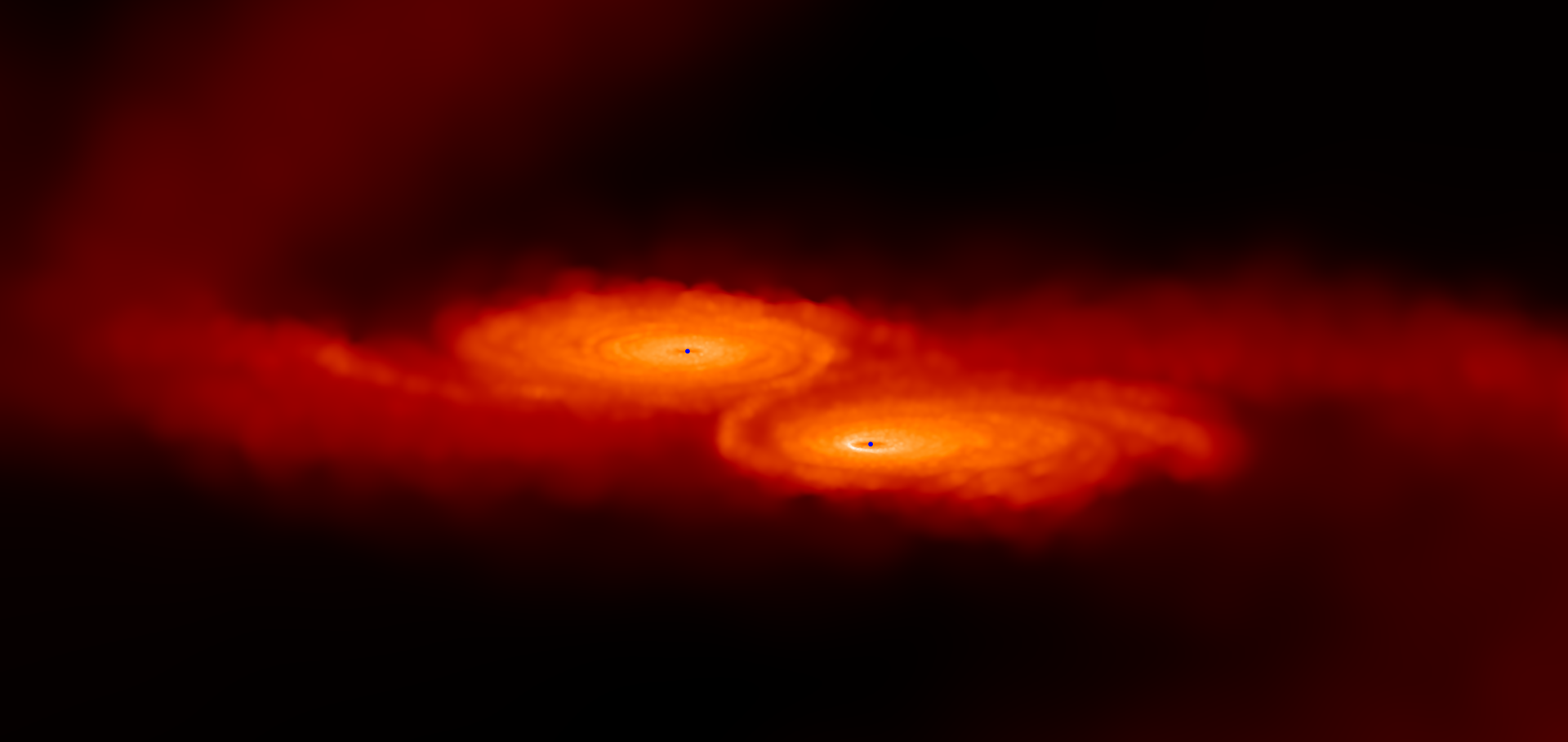
Black hole binary formation in AGN discs: from isolation to merger
Monthly Notices of the Royal Astronomical Society Oxford University Press 524:2 (2023) 2770-2796
Abstract:
Motivated by the increasing number of detections of merging black holes by LIGO-VIRGO-KAGRA, black hole (BH) binary mergers in the discs of active galactic nuclei (AGNs) is investigated as a possible merger channel. In this pathway, BH encounters in the gas disc form mutually bound BH binary systems through interaction with the gas in the disc and subsequently inspiral through gravitational torques induced by the local gas. To determine the feasibility of this merger pathway, we present the first three-dimensional global hydrodynamic simulations of the formation and evolution of a stellar-mass BH binaries AGN discs with three different AGN disc masses and five different initial radial separations. These 15 simulations show binary capture of prograde and retrograde binaries can be successful in a range of disc densities including cases well below that of a standard radiatively efficient alpha disc, identifying that the majority of these captured binaries are then subsequently hardened by the surrounding gas. The eccentricity evolution depends strongly on the orbital rotation where prograde binaries are governed by gravitational torques form their circumbinary mini disc, with eccentricities being damped, while for retrograde binaries the eccentricities are excited to >∼ 0.9 by accretion torques. In two cases, retrograde binaries ultimately undergo a close periapsis passage which results in a merger via gravitational waves after only a few thousand binary orbits. Thus, the merger time-scale can be far shorter than the AGN disc lifetime. These simulations support an efficient AGN disc merger pathway for BHs.Complete characterization of the orbital shapes of the noncircular Kerr geodesic solutions with circular orbit constants of motion
Physical Review D American Physical Society (APS) 107:12 (2023) 124058
Prevention of core particle depletion in stellarators by turbulence
Physical Review Research American Physical Society 5:2 (2023) L022053
Abstract:
In reactor-relevant plasmas, neoclassical transport drives an outward particle flux in the core of large stellarators and predicts strongly hollow density profiles. However, this theoretical prediction is contradicted by experiments. In particular, in Wendelstein 7-X, the first large optimized stellarator, flat or weakly peaked density profiles are generally measured, indicating that neoclassical theory is not sufficient and that an inward contribution to the particle flux is missing in the core. In this Research Letter, it is shown that the turbulent contribution to the particle flux can explain the difference between experimental measurements and neoclassical predictions. The results of this Research Letter also prove that theoretical and numerical tools are approaching the level of maturity needed for the prediction of equilibrium density profiles in stellarator plasmas, which is a fundamental requirement for the design of operation scenarios of present devices and future reactors.Secular spin–orbit resonances of black hole binaries in AGN disks
Astrophysical Journal American Astronomical Society 950:1 (2023) 48