

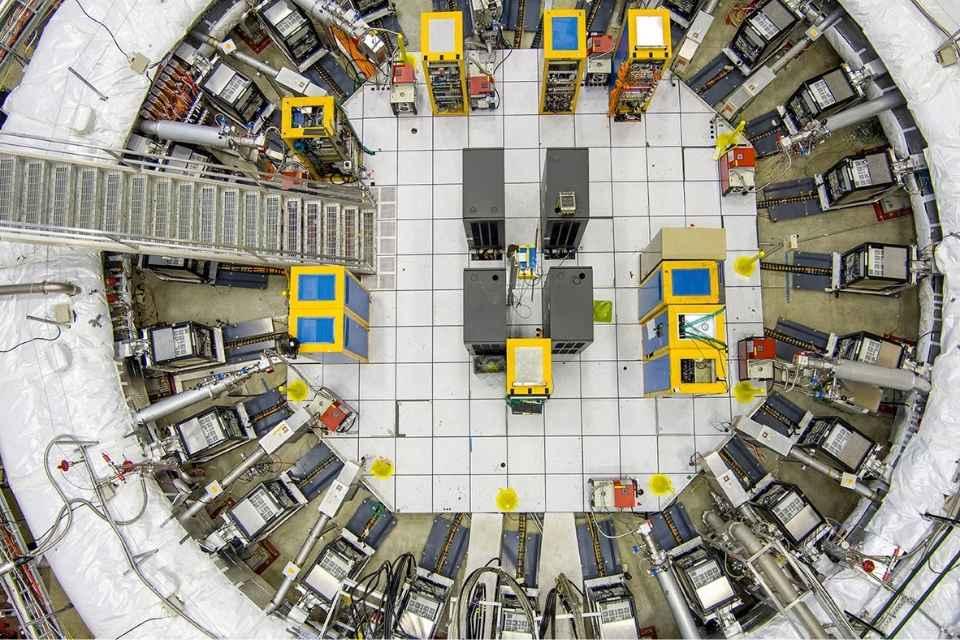
Three Oxford physicists were named recipients of the 2026 Breakthrough Prize in Fundamental Physics for their work with the Fermilab collaboration. Dr Babak Abi, Dr Farrukh Azfar and Dr Sam Henry have all been recognised for their work reporting the results from the measurement campaigns at Fermilab.
The prize was awarded to the Muon g-2 collaborations at CERN and Brookhaven National Laboratory as well as Fermilab. The award recognises the collaborations’ multi-decade, groundbreaking contributions to the measurement of the muon's anomalous magnetic moment that have pushed the boundaries of experimental precision and ignited a new era in the quest for physics beyond the Standard Model. The muon is a heavy, unstable cousin of the electron, and like the electron it can behave like a tiny magnet. The physicists are looking to capture how the muon’s magnetic strength is subtly affected by the “foam” of virtual particles constantly popping in and out of empty space around it. Measuring the muon’s magnetism and comparing it to theoretical predictions allows physicists to test whether any unknown particles or forces are hidden in this foam. In other words, to probe for new physics beyond the Standard Model, our most successful theory of particles and forces.
‘Oxford's contributions include extensive analysis of the test beam data at Fermilab and the development of a system to monitor the quality of the data for detector components, with particular attention to the trackers used to verify particle trajectories,’ explains Dr Azfar. Dr Henry continues, summarising his and Dr Abi’s work: ‘We started a programme to develop a new magnetometer to calibrate the magnetic sensors in the apparatus as the experiment requires a super-precise measurement of the magnetic field. The high-precision absolute magnetometer utilises nuclear spin-polarised Helium-3 gas to measure magnetic fields offering extremely high sensitivity and accuracy particularly in high-field environments. This work was completed by our American collaborators, and used to cross-check the measurement which is key to the result.’
‘We are thrilled and honoured to have contributed to this effort and it's great to see the prize reflect the huge collective effort of hundreds of physicists from around the world,’ concludes Dr Azfar. ‘This is a very important precision measurement testing the predictions of the Standard Model to high stringency with relatively small and low-cost experiments with a rich and fascinating history at CERN, Brookhaven and now Fermilab.’