

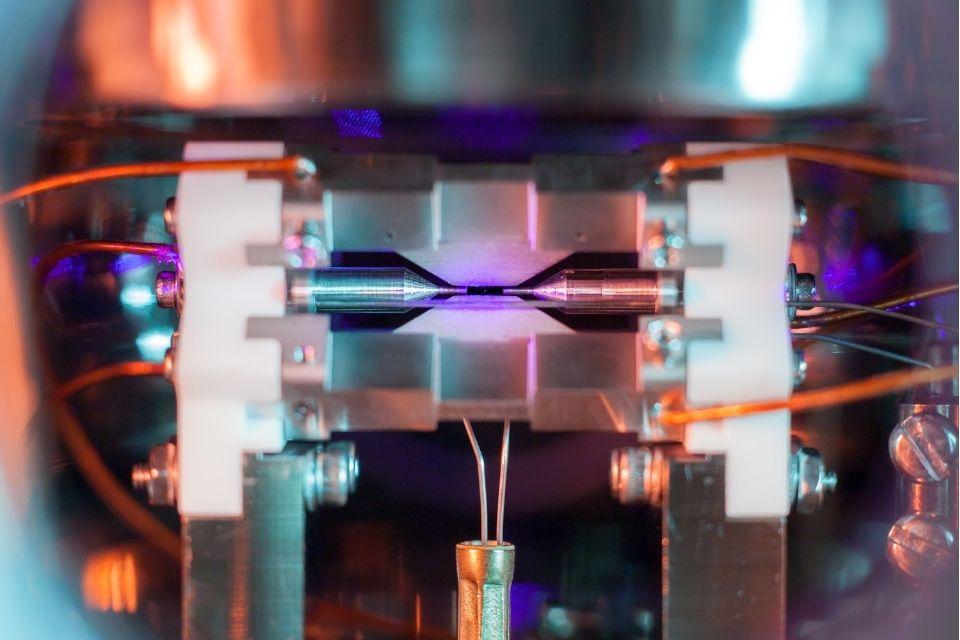
Experimental trapped-ion setup used to generate the family of squeezed states; the ion is confined between electrode structures and controlled using precisely tuned laser fields.
Researchers at the University of Oxford have demonstrated a new type of quantum interaction using a single trapped ion. By creating and controlling increasingly complex forms of 'squeezing' – including a fourth-order effect known as quadsqueezing – the team has, for the first time, made previously unreachable quantum effects experimentally accessible. The approach also provides a new way to engineer these interactions, with potential applications in quantum simulation, sensing, and computing. Their results have been published in Nature Physics.
Many systems in physics behave like tiny objects that vibrate or swing back and forth, like a spring or a pendulum. In quantum physics, these are known as quantum harmonic oscillators. Light waves, vibrations in molecules, and even the motion of a single trapped atom can all be described in this way. Controlling these systems is important for quantum technologies, from ultra-precise sensors to new kinds of quantum computers.
One of the best-known ways to control a quantum oscillator is called squeezing. Quantum mechanics sets a limit on how precisely certain pairs of properties, such as position and momentum, can be known at the same time. Squeezing reshapes this uncertainty: one property becomes more sharply defined, while the other becomes more uncertain. This is not just a curiosity; squeezed light is already used to improve the sensitivity of gravitational-wave detectors such as LIGO.
But ordinary squeezing is only part of a wider family of squeezing interactions. Physicists have long wanted to go further, creating stronger and more complex interactions known as trisqueezing and quadsqueezing. Until now, however, these interactions have been extremely difficult to realise in practice. In most systems, higher-order effects are naturally very weak, and they become weaker very quickly as the order increases. This means the desired quantum behaviour is often too weak to observe before it is lost to noise.
The group have now demonstrated a new way around this problem. Instead of trying to drive a weak higher-order interaction directly, the team combined two carefully controlled forces acting on a single trapped ion, following a theory proposed by Dr Raghavendra Srinivas and Dr Robert Tyler Sutherland (UTSA) in 2021. Each force on its own produces a simple, linear effect but when applied together, they produce a new interaction that is more than the sum of their parts. This arises from an effect known as non-commutativity, where the two forces influence each other’s action to generate a stronger interaction in the ion’s motion.
'In the lab, non-commuting interactions are often seen as a nuisance because they introduce unwanted dynamics,' comments lead author, Dr Oana Băzăvan from the Department of Physics at the University of Oxford. 'Here, we took the opposite approach and used that feature to generate stronger quantum interactions.'
Using the same experimental setup, the team could switch between different types of squeezing and generated squeezing, trisqueezing, and, for the first time on any platform, quadsqueezing, a fourth-order interaction. By changing the frequencies, phases, and strengths of the applied forces, they could select which interaction appeared while suppressing unwanted effects.
Dr Băzăvan continues: 'The result is more than the creation of a new quantum state. It is a demonstration of a new method for engineering interactions that were previously out of reach. The fourth-order quadsqueezing interaction was generated more than 100 times faster than expected using conventional approaches. This makes effects that were previously out of reach accessible in practice.'
The researchers confirmed the interactions by reconstructing the quantum states of motion of the trapped ion. These measurements revealed distinctive shapes associated with second-, third-, and fourth-order squeezing, providing a direct signature of the different interactions.
The method is now being extended to more complex systems with multiple modes of motion. Because it relies on ingredients available in a range of quantum platforms, it could provide a general route to new forms of quantum simulation, sensing, and computation. Already, in combination with mid-circuit measurements of the ion’s spin, the technique has been used to generate arbitrary superpositions of these squeezed states and to simulate a lattice gauge theory.
Study co-author Dr Srinivas also from the Department of Physics at the University of Oxford, who supervised the work, adds: 'Fundamentally, we have demonstrated a new type of interaction that lets us explore quantum physics in uncharted territory, and we are genuinely excited for the discoveries to come.'
Squeezing, trisqueezing and quadsqueezing in a hybrid oscillator-spin system, O Băzăvan et al, Nature Physics, 1 May 2026