

Researchers at the University of Oxford, Imperial College London and the Okinawa Institute of Science and Technology have demonstrated a new technique for measuring extremely small differences in the frequency of light, achieving a precision far beyond what conventional spectroscopy can reach. The findings have been published in Nature Sensors.
Precision frequency measurement underpins a wide range of modern science and technology, from atomic clocks and chemical spectroscopy to LiDAR systems that detect motion and distance. Identifying individual spectral features — the distinctive frequencies at which atoms and molecules absorb or emit light — is essential to many of these applications. But when two spectral features lie very close together, a fundamental obstacle arises: standard intensity-based measurement techniques lose the ability to tell them apart as the gap between them narrows. This phenomenon is known as Rayleigh's curse.
Quantum theory predicts that this limit is not truly fundamental. Rather than measuring the brightness of light directly, a more informative strategy is to first sort the incoming light into specific temporal shapes, called modes, that carry the most information about the frequency separation. In practice, this requires a mode filter that operates with very high fidelity — small imperfections quickly erase the advantage.
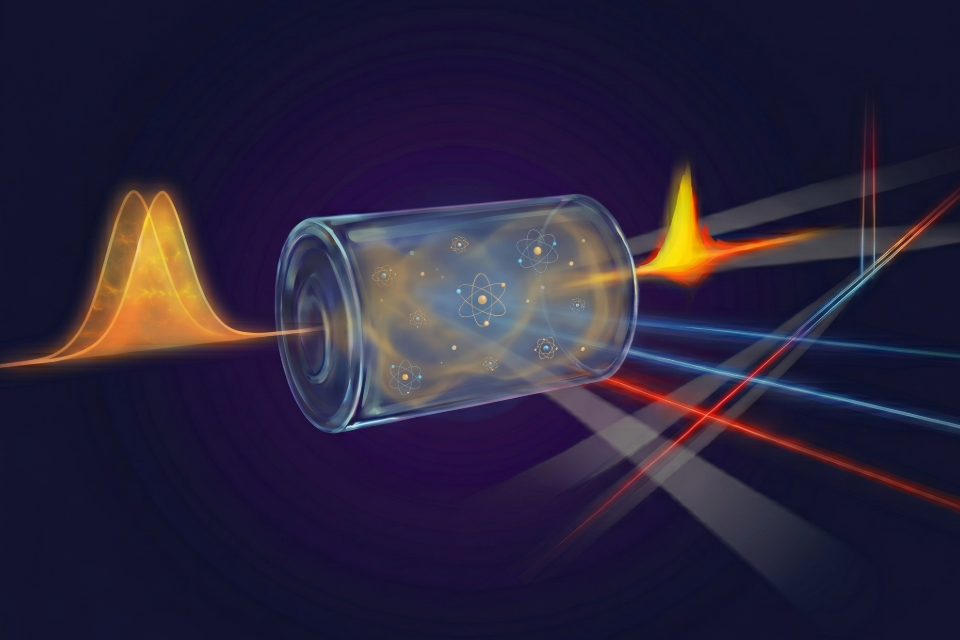
The team, led by Professor Ian Walmsley, used a photonic quantum memory, a device typically developed for quantum network applications, as a programmable mode filter. The memory, implemented using warm caesium vapour, works by shining a carefully shaped control laser pulse into the gas. This control pulse coherently maps a chosen temporal mode of the incoming signal light onto the atoms, storing it as a collective spin excitation. Light in any other temporal shape passes through largely unaffected. The stored excitation is then retrieved on demand by a second control pulse and detected using superconducting single-photon detectors.
By engineering this process with high accuracy, the team achieved mode selectivity of 99.6%, with crosstalk between modes of just 0.34%. Applying this approach to a signal composed of two closely spaced spectral lines, they resolved frequency separations as small as one twentieth of the signal linewidth — equivalent to distinguishing a frequency difference of just 265 kHz within a 5.3 MHz-wide signal. The technique demonstrated up to a 34-fold improvement in measurement precision compared with standard direct detection methods, the highest precision enhancement reported for time-frequency super-resolution estimation.
'Our memory-based platform can do more than just store quantum information – it can function as a programmable quantum sensor, unlocking super-resolving measurements in the MHz-GHz bandwidth regime,' said Dr Aonan Zhang of the Department of Physics, the corresponding author of the study. 'Beyond resolving two spectral lines, the platform's full programmability allows us to tackle more complex spectral structures, which is essential for multiparameter estimation tasks.'
The technique holds potential for applications including high-precision clock synchronisation, photon-efficient spectroscopy, and next-generation Doppler LiDAR systems capable of detecting motion and distance with extremely high sensitivity.
Professor Walmsley added: 'This research demonstrates a new way of processing optical signals for sensing applications using quantum memories. The technique is naturally compatible with future quantum networks, where multiple sensor nodes may need to synchronise, buffer and process quantum signals cooperatively. Combining precision measurement and quantum networking could enable a new generation of sensing technologies.'
The research was supported by the European Union's Horizon 2020 Research and Innovation Programme (STORMYTUNE project) and the Engineering and Physical Sciences Research Council via the Quantum Computing and Simulation Hub.
Super-resolving frequency measurement with mode-selective quantum memory, Shicheng Zhang, Aonan Zhang, Ilse Maillette de Buy Wenniger et al, Nature Sensors, 15 May 2026.