Home
Department Of Physics text logo
  • Research
    • Our research
    • Our research groups
    • Our research in action
    • Research funding support
    • Summer internships for undergraduates
  • Study
    • Undergraduates
    • Postgraduates
  • Engage
    • For alumni
    • For business
    • For schools
    • For the public
  • Support
Menu
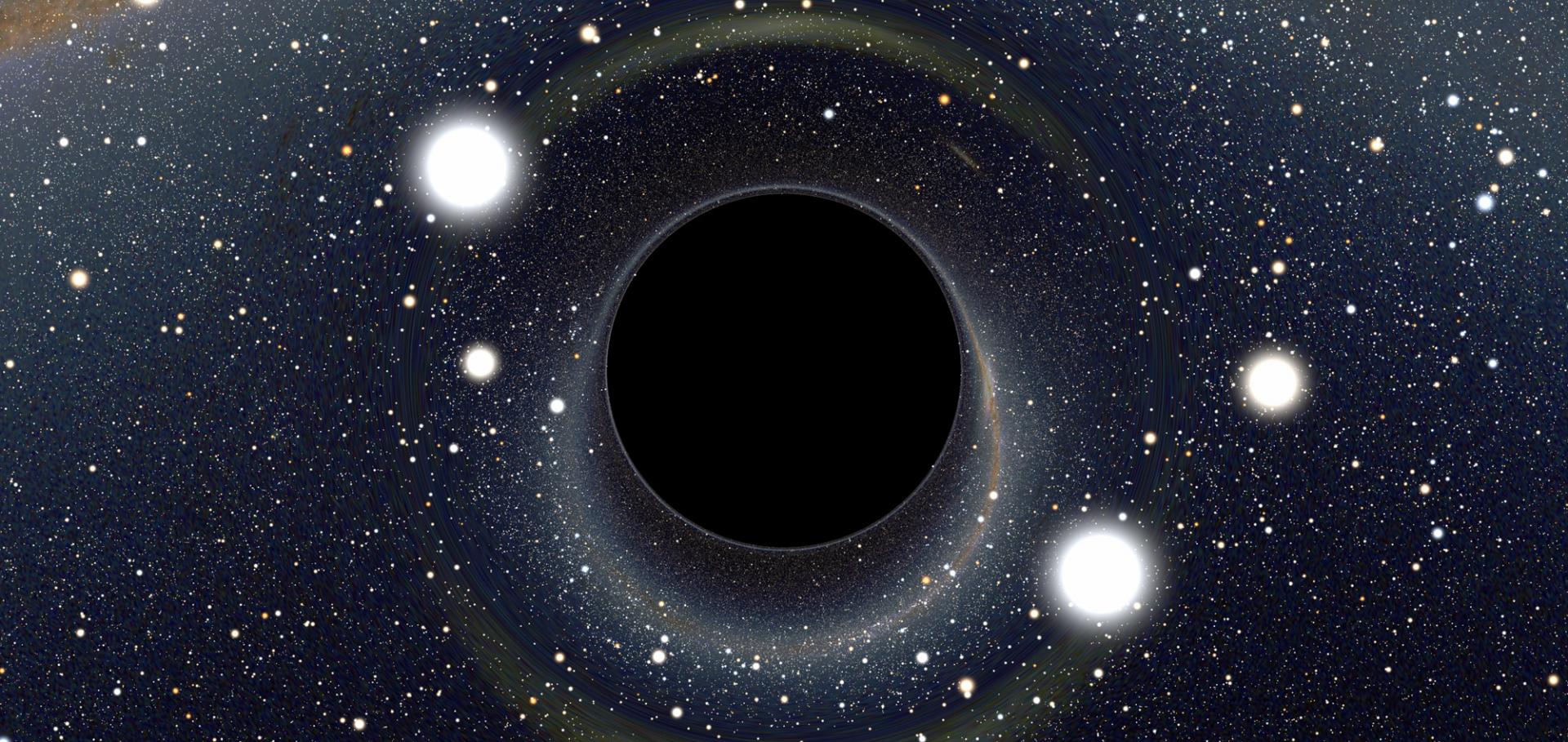
Black Hole

Lensing of space time around a black hole. At Oxford we study black holes observationally and theoretically on all size and time scales - it is some of our core work.

Credit: ALAIN RIAZUELO, IAP/UPMC/CNRS. CLICK HERE TO VIEW MORE IMAGES.

DR Babak Abi

Research Assistant

Research theme

  • Accelerator physics
  • Instrumentation
  • Fundamental particles and interactions

Sub department

  • Astrophysics

Research groups

  • Astronomical instrumentation
  • About
  • Publications

Search for anomaly-mediated supersymmetry breaking with the ATLAS detector based on a disappearing-track signature in pp collisions at sqrt(s) = 7 TeV

ArXiv 1202.4847 (2012)
Details from ArXiV

Search for strong gravity signatures in same-sign dimuon final states using the ATLAS detector at the LHC

Physics Letters B Elsevier 709:4-5 (2012) 322-340

Authors:

GD Carrillo Montoya, Carter, Carter, J Carvalho, F Cataneo, A Catinaccio, Catmore, A Cattai, G Cattani, L Cerrito, F Cerutti, Cetin, F Cevenini, MA Chelstowska, C Chen, H Chen, S Chen, L Chevalier, G Chiefari, L Chikovani, JT Childers, A Chilingarov, G Ciapetti, AK Ciftci, R Ciftci

Abstract:

A search for microscopic black holes has been performed in a same-sign dimuon final state using 1.3 fb−1 of proton–proton collision data collected with the ATLAS detector at a centre of mass energy of 7 TeV at the CERN Large Hadron Collider. The data are found to be consistent with the expectation from the Standard Model and the results are used to derive exclusion contours in the context of a low scale gravity model.

More details from the publisher
Details from ORA
More details

Search for pair-produced heavy quarks decaying to Wq in the two-lepton channel at sqrt(s) = 7 TeV with the ATLAS detector

ArXiv 1202.3389 (2012)
Details from ArXiV

Search for pair production of a heavy up-type quark decaying to a W boson and a b quark in the lepton+jets channel with the ATLAS detector

ArXiv 1202.3076 (2012)
Details from ArXiV

Combined search for the Standard Model Higgs boson using up to 4.9 fb-1 of pp collision data at sqrt(s) = 7 TeV with the ATLAS detector at the LHC

ArXiv 1202.1408 (2012)
Details from ArXiV

Pagination

  • First page First
  • Previous page Prev
  • …
  • Page 127
  • Page 128
  • Page 129
  • Page 130
  • Current page 131
  • Page 132
  • Page 133
  • Page 134
  • Page 135
  • …
  • Next page Next
  • Last page Last

Footer Menu

  • Contact us
  • Giving to the Dept of Physics
  • Work with us
  • Media

User account menu

  • Log in

Follow us

FIND US

Clarendon Laboratory,

Parks Road,

Oxford,

OX1 3PU

CONTACT US

Tel: +44(0)1865272200

University of Oxfrod logo Department Of Physics text logo
IOP Juno Champion logo Athena Swan Silver Award logo

© University of Oxford - Department of Physics

Cookies | Privacy policy | Accessibility statement

Built by: Versantus

  • Home
  • Research
  • Study
  • Engage
  • Our people
  • News & Comment
  • Events
  • Our facilities & services
  • About us
  • Giving to Physics
  • Current students
  • Staff intranet