

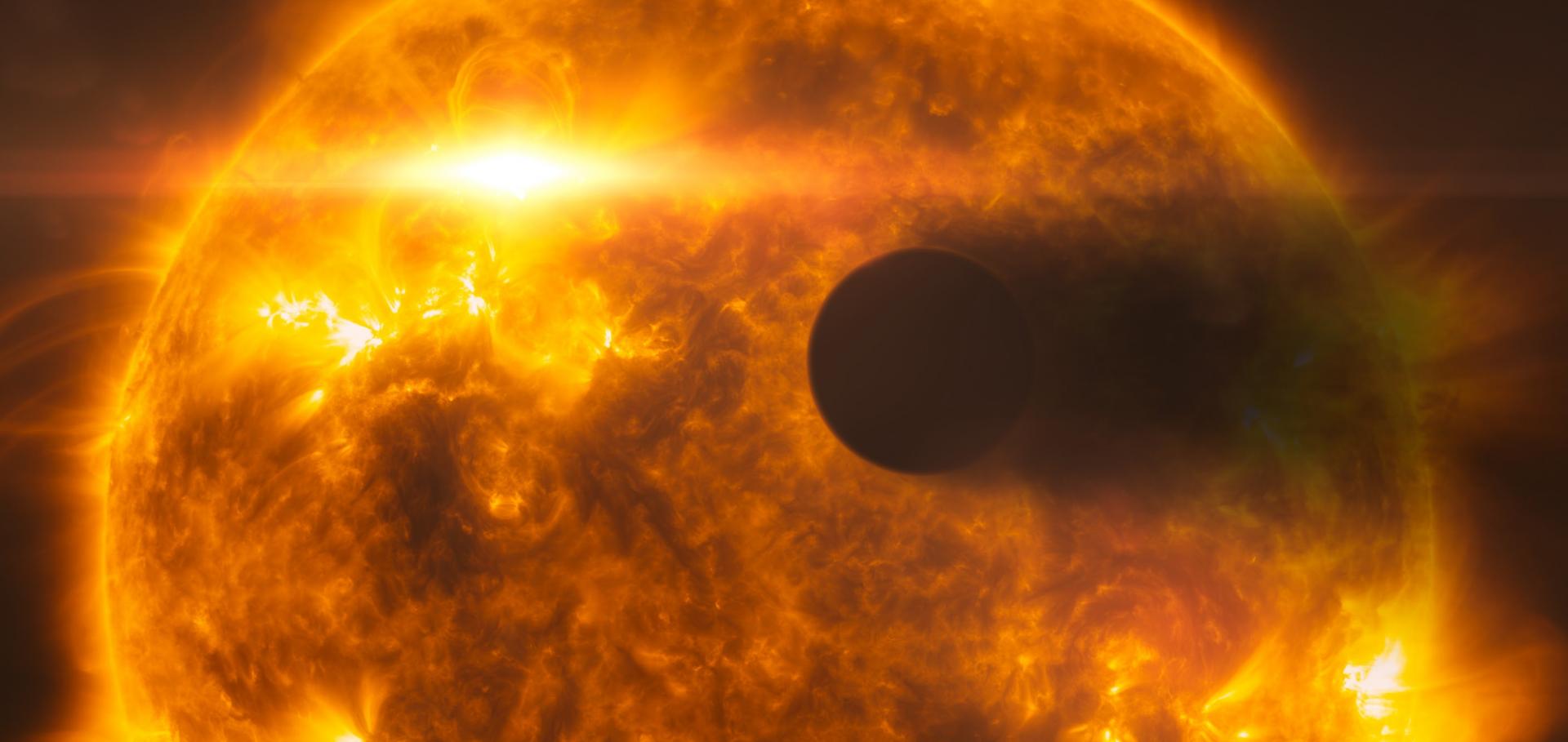

The secondary eclipse of the transiting exoplanet CoRoT-2b
Astronomy and Astrophysics 501:3 (2009) L23-L26
Abstract:
We present a study of the light curve of the transiting exoplanet CoRoT-2b, aimed at detecting the secondary eclipse and measuring its depth. The data were obtained with the CoRoT satellite during its first run of more than 140 days. After filtering the low frequencies with a pre-whitening technique, we detect a 0.0060±0.0020% secondary eclipse centered on the orbital phase 0.494±0.006. Assuming a black-body emission of the planet, we estimate a surface brightness temperature of TTransiting exoplanets from the CoRoT space mission: VII. The "hot-Jupiter"-type planet CoRoT-5b
(2009)
Transiting exoplanets from the CoRoT space mission VIII. CoRoT-7b: the first Super-Earth with measured radius
(2009)