Home
Department Of Physics text logo
  • Research
    • Our research
    • Our research groups
    • Our research in action
    • Research funding support
    • Summer internships for undergraduates
  • Study
    • Undergraduates
    • Postgraduates
  • Engage
    • For alumni
    • For business
    • For schools
    • For the public
Menu
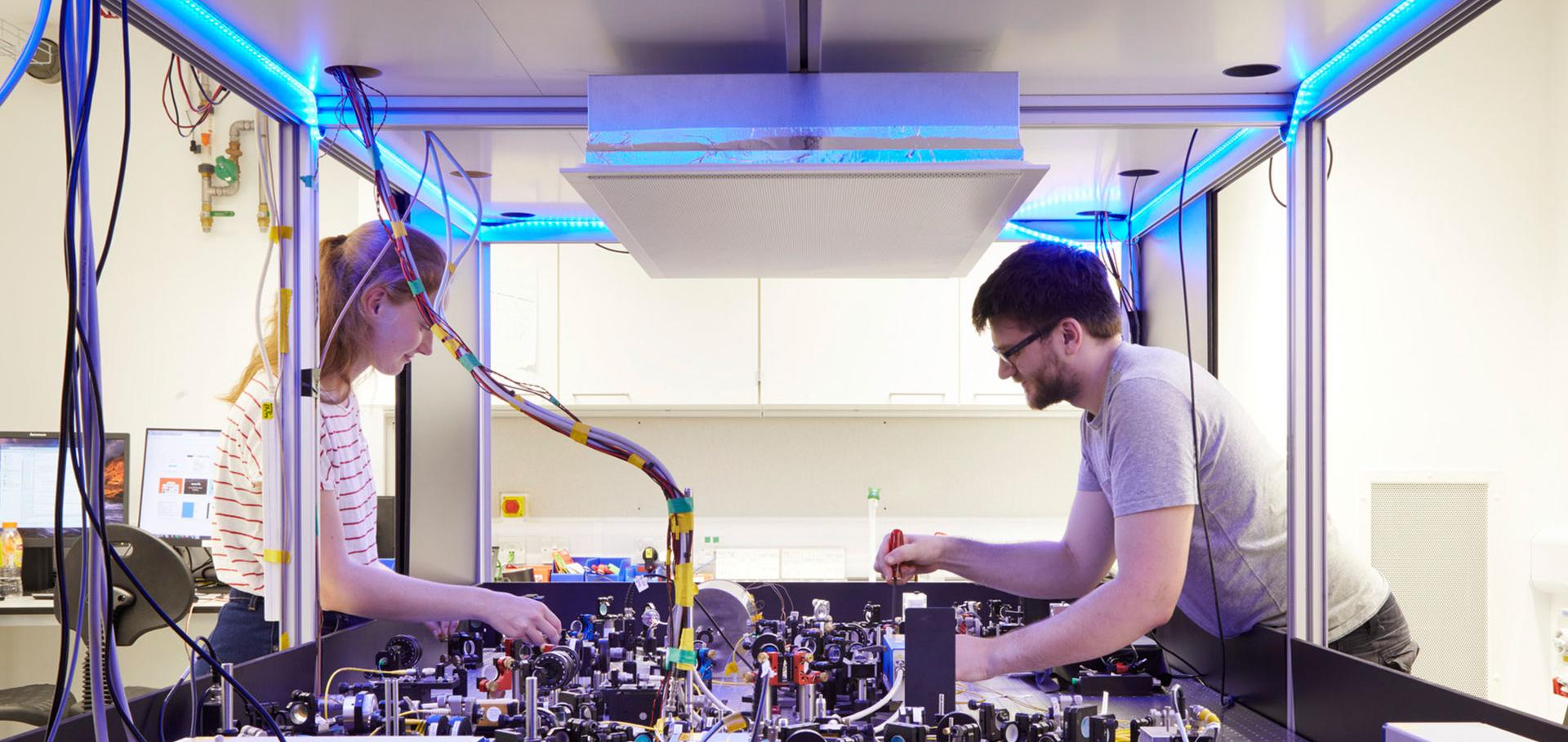
Atomic and Laser Physics
Credit: Jack Hobhouse

Karim ALAA EL-DIN

Graduate Student

Sub department

  • Atomic and Laser Physics

Research groups

  • Oxford Centre for High Energy Density Science (OxCHEDS)
  • Quantum high energy density physics
karim.alaael-din@physics.ox.ac.uk
Clarendon Laboratory
Personal Homepage
  • About
  • Publications

Resonant inelastic x-ray scattering in warm-dense Fe compounds beyond the SASE FEL resolution limit

Communications Physics Nature Research 7:1 (2024) 266

Authors:

Alessandro Forte, Thomas Gawne, Karim K Alaa El-Din, Oliver S Humphries, Thomas R Preston, Céline Crépisson, Thomas Campbell, Pontus Svensson, Sam Azadi, Patrick Heighway, Yuanfeng Shi, David A Chin, Ethan Smith, Carsten Baehtz, Victorien Bouffetier, Hauke Höppner, Alexis Amouretti, David McGonegle, Marion Harmand, Gilbert W Collins, Justin S Wark, Danae N Polsin, Sam M Vinko

Abstract:

Resonant inelastic x-ray scattering (RIXS) is a widely used spectroscopic technique, providing access to the electronic structure and dynamics of atoms, molecules, and solids. However, RIXS requires a narrow bandwidth x-ray probe to achieve high spectral resolution. The challenges in delivering an energetic monochromated beam from an x-ray free electron laser (XFEL) thus limit its use in few-shot experiments, including for the study of high energy density systems. Here we demonstrate that by correlating the measurements of the self-amplified spontaneous emission (SASE) spectrum of an XFEL with the RIXS signal, using a dynamic kernel deconvolution with a neural surrogate, we can achieve electronic structure resolutions substantially higher than those normally afforded by the bandwidth of the incoming x-ray beam. We further show how this technique allows us to discriminate between the valence structures of Fe and Fe2O3, and provides access to temperature measurements as well as M-shell binding energies estimates in warm-dense Fe compounds.
More details from the publisher
Details from ORA
More details

Efficient prediction of attosecond two-colour pulses from an X-ray free-electron laser with machine learning

Scientific Reports Springer Science and Business Media LLC 14:1 (2024) 7267

Authors:

Karim K Alaa El-Din, Oliver G Alexander, Leszek J Frasinski, Florian Mintert, Zhaoheng Guo, Joseph Duris, Zhen Zhang, David B Cesar, Paris Franz, Taran Driver, Peter Walter, James P Cryan, Agostino Marinelli, Jon P Marangos, Rick Mukherjee

Abstract:

AbstractX-ray free-electron lasers are sources of coherent, high-intensity X-rays with numerous applications in ultra-fast measurements and dynamic structural imaging. Due to the stochastic nature of the self-amplified spontaneous emission process and the difficulty in controlling injection of electrons, output pulses exhibit significant noise and limited temporal coherence. Standard measurement techniques used for characterizing two-coloured X-ray pulses are challenging, as they are either invasive or diagnostically expensive. In this work, we employ machine learning methods such as neural networks and decision trees to predict the central photon energies of pairs of attosecond fundamental and second harmonic pulses using parameters that are easily recorded at the high-repetition rate of a single shot. Using real experimental data, we apply a detailed feature analysis on the input parameters while optimizing the training time of the machine learning methods. Our predictive models are able to make predictions of central photon energy for one of the pulses without measuring the other pulse, thereby leveraging the use of the spectrometer without having to extend its detection window. We anticipate applications in X-ray spectroscopy using XFELs, such as in time-resolved X-ray absorption and photoemission spectroscopy, where improved measurement of input spectra will lead to better experimental outcomes.
More details from the publisher

Efficient prediction of attosecond two-colour pulses from an X-ray free-electron laser with machine learning

ArXiv 2311.14751 (2023)

Authors:

Karim K Alaa El-Din, Oliver G Alexander, Leszek J Frasinski, Florian Mintert, Zhaoheng Guo, Joseph Duris, Zhen Zhang, David B Cesar, Paris Franz, Taran Driver, Peter Walter, James P Cryan, Agostino Marinelli, Jon P Marangos, Rick Mukherjee
Details from ArXiV

Statistical learning on randomized data to verify quantum state k-designs

ArXiv 2305.01465 (2023)

Authors:

Lorenzo Versini, Karim Alaa El-Din, Florian Mintert, Rick Mukherjee
Details from ArXiV

Footer Menu

  • Contact us
  • Giving to the Dept of Physics
  • Work with us
  • Media

User account menu

  • Log in

Follow us

FIND US

Clarendon Laboratory,

Parks Road,

Oxford,

OX1 3PU

CONTACT US

Tel: +44(0)1865272200

University of Oxfrod logo Department Of Physics text logo
IOP Juno Champion logo Athena Swan Silver Award logo

© University of Oxford - Department of Physics

Cookies | Privacy policy | Accessibility statement

Built by: Versantus

  • Home
  • Research
  • Study
  • Engage
  • Our people
  • News & Comment
  • Events
  • Our facilities & services
  • About us
  • Giving to Physics
  • Current students
  • Staff intranet