Home
Department Of Physics text logo
  • Research
    • Our research
    • Our research groups
    • Our research in action
    • Research funding support
    • Summer internships for undergraduates
  • Study
    • Undergraduates
    • Postgraduates
  • Engage
    • For young people
    • For teachers
    • For the public
    • For alumni
    • For business
  • Support
Menu
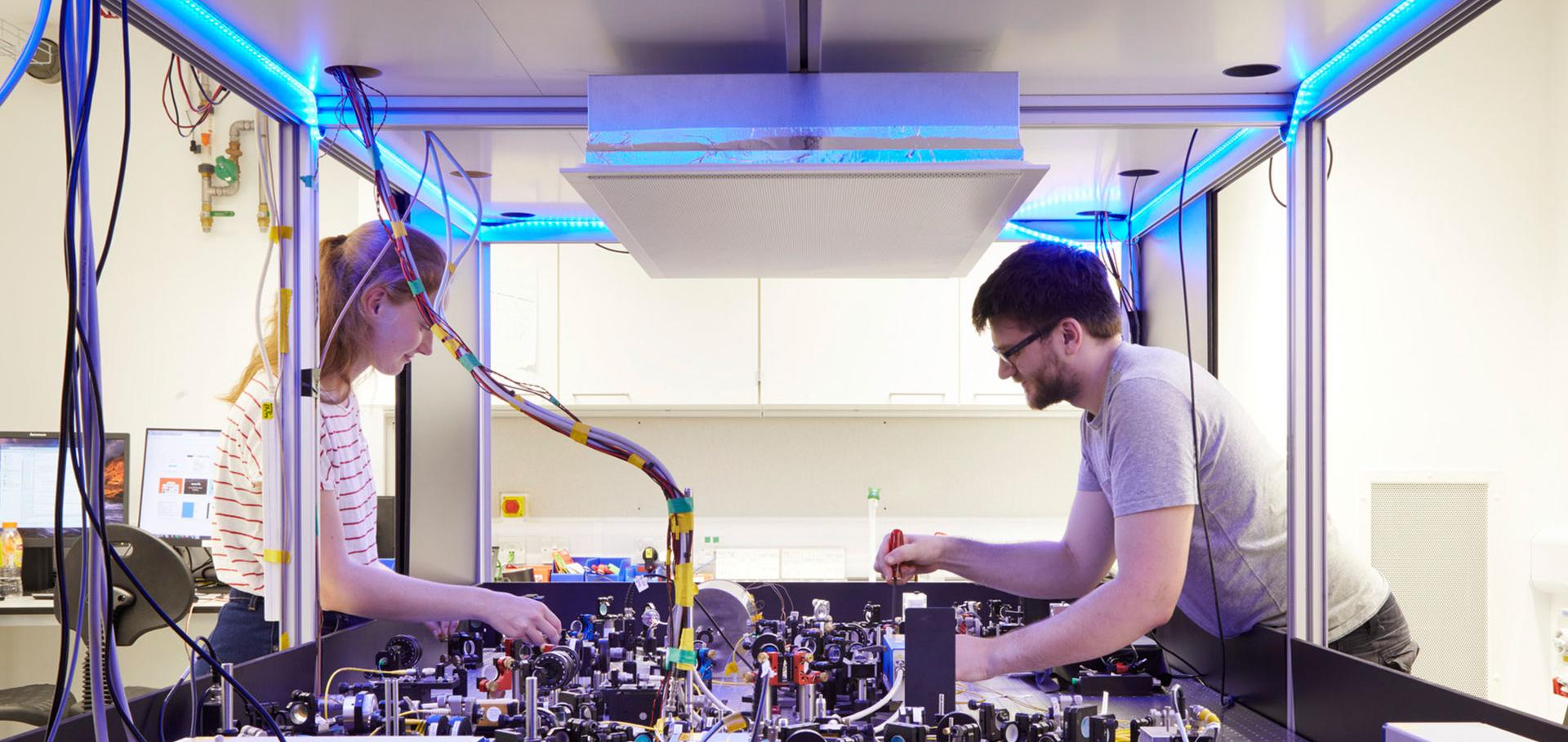
Atomic and Laser Physics
Credit: Jack Hobhouse

Ayush Agrawal

Graduate Student

Research theme

  • Quantum information and computation

Sub department

  • Atomic and Laser Physics

Research groups

  • Ion trap quantum computing
ayush.agrawal@physics.ox.ac.uk
Clarendon Laboratory
  • About
  • Research
  • Publications

Error Correction in a Distributed Quantum Computer

ArXiv 2609.13065 (2026)

Authors:

EM Ainley, A Agrawal, T Araki, AR Martínez, D Main, E Malinowski, JA Blackmore, S Chen, P Drmota, M Mallweger, DP Nadlinger, R Srinivas, SC Benjamin, G Araneda, DM Lucas
Details from ArXiV

Microwave-driven same-species sympathetic cooling for trapped ions

(2026)

Authors:

MC Smith, E Vandrey, AD Leu, N Drotleff, A Agrawal, K Miyanishi, DM Lucas, MF Gely
More details from the publisher
Details from ArXiV

Extending the fundamental limit of atomic clock stability

ArXiv 2604.01099 (2026)

Authors:

Ravid Shaniv, Ayush Agrawal, David B Hume
Details from ArXiV

Multipartite Mixed-Species Entanglement over a Quantum Network

(2025)

Authors:

D Main, P Drmota, EM Ainley, A Agrawal, D Webb, S Saner, O Bazavan, BC Nichol, R Srinivas, DP Nadlinger, G Araneda, DM Lucas
More details from the publisher
Details from ArXiV

Experimental quantum advantage in the odd-cycle game

Physical Review Letters American Physical Society 134 (2025) 070201

Authors:

Peter Drmota, Dougal Main, Ellis Ainley, Ayush Agrawal, Gabriel Araneda, David P Nadlinger, Bethan Nichol, Raghavendra Srinivas, Adán Cabello, David M Lucas

Abstract:

We report the first experimental demonstration of the odd-cycle game. We entangle two atoms separated by ∼ 2 m and the players use them to win the odd-cycle game with a probability ∼ 26σ above that allowed by the best classical strategy. The experiment implements the optimal quantum strategy, is free of loopholes, and achieves 97.8(3) % of the theoretical limit to the quantum winning probability. We perform the associated Bell test and measure a nonlocal content of 0.54(2) – the largest value for physically separate devices, free of the detection loophole, ever observed.

More details from the publisher
Details from ORA
More details
More details

Pagination

  • Current page 1
  • Page 2
  • Page 3
  • Next page Next
  • Last page Last

Footer Menu

  • Contact us
  • Giving to the Dept of Physics
  • Work with us
  • Media

User account menu

  • Log in

Follow us

FIND US

Clarendon Laboratory,

Parks Road,

Oxford,

OX1 3PU

CONTACT US

Tel: +44(0)1865272200

University of Oxfrod logo Department Of Physics text logo
IOP Juno Champion logo Athena Swan Silver Award logo

© University of Oxford - Department of Physics

Cookies | Privacy policy | Accessibility statement

Built by: Versantus

  • Home
  • Research
  • Study
  • Engage
  • Our people
  • News & Comment
  • Events
  • Our facilities & services
  • About us
  • Giving to Physics
  • Current students
  • Staff intranet