


Study of muon neutrino disappearance using the Fermilab Main Injector neutrino beam
Physical Review D - Particles, Fields, Gravitation and Cosmology 77:7 (2008)
Abstract:
We report the results of a search for νμ disappearance by the Main Injector Neutrino Oscillation Search. The experiment uses two detectors separated by 734 km to observe a beam of neutrinos created by the Neutrinos at the Main Injector facility at Fermi National Accelerator Laboratory. The data were collected in the first 282 days of beam operations and correspond to an exposure of 1.27×10²⁰ protons on target. Based on measurements in the Near Detector, in the absence of neutrino oscillations we expected 336±14 νμ charged-current interactions at the Far Detector but observed 215. This deficit of events corresponds to a significance of 5.2 standard deviations. The deficit is energy dependent and is consistent with two-flavor neutrino oscillations according to |Δm2|=2.74-0.26+0.44×10⁻³eV2/c4 and sin 22θ>0.87 at 68% confidence level. © 2008 The American Physical Society.Large-angle production of charged pions by 3-12.9 GeV/c protons on beryllium, aluminium and lead targets
European Physical Journal C 54:1 (2008) 37-60
Abstract:
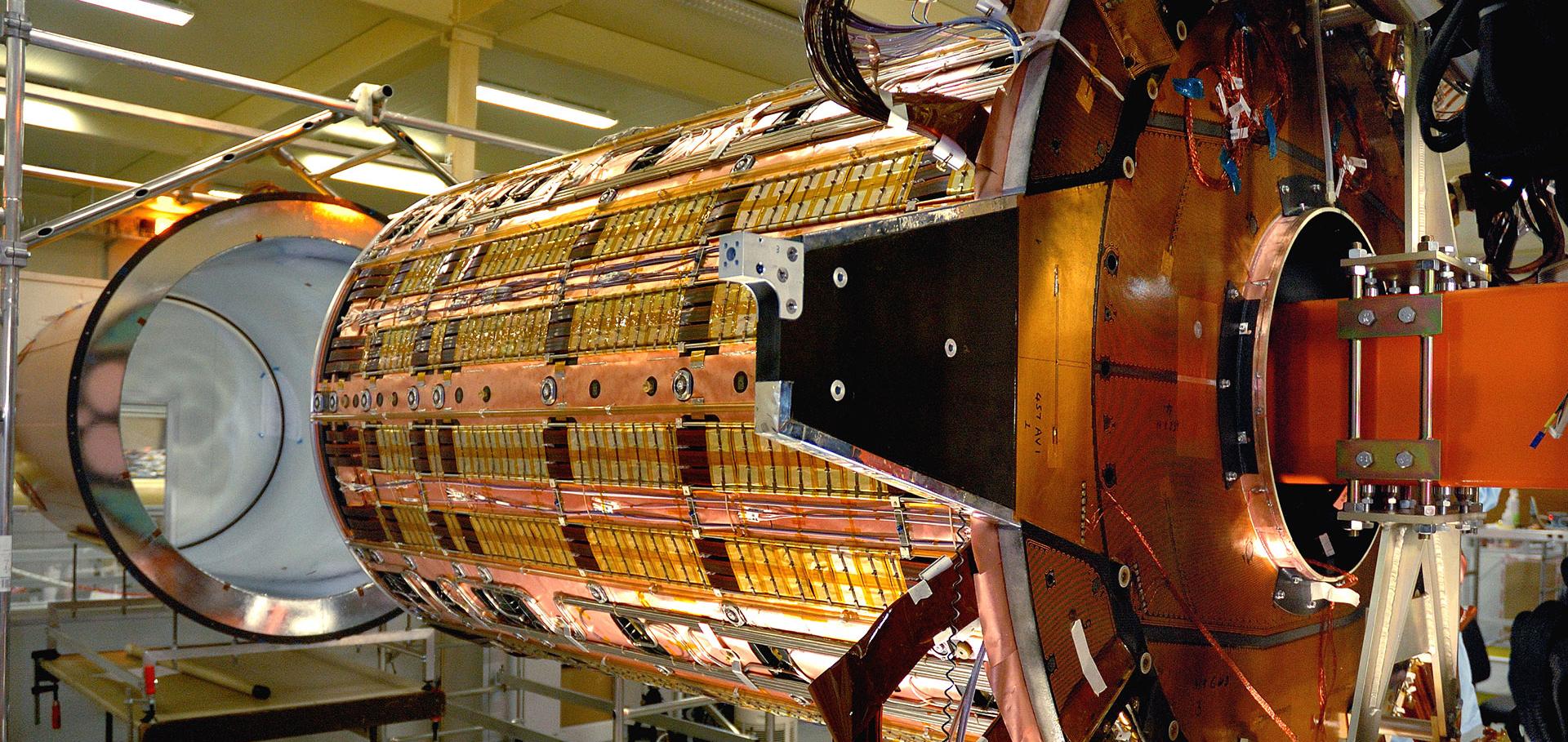
Measurements of the double-differential π± production cross-section in the range of momentum 100 MeV/c p<∈800 MeV/c and angle 0.35 rad∈ θ<∈ 2.15 rad in proton-beryllium, proton-aluminium and proton-lead collisions are presented. The data were taken with the HARP detector in the T9 beam line of the CERN PS. The pions were produced by proton beams in a momentum range from 3 GeV/c to 12.9 GeV/c hitting a target with a thickness of 5% of a nuclear interaction length. The tracking and identification of the produced particles was performed using a small-radius cylindrical time projection chamber (TPC) placed inside a solenoidal magnet. Incident particles were identified by an elaborate system of beam detectors. Results are obtained for the double-differential cross-sections d2σ/dpdθ at six incident proton beam momenta (3 GeV/c, 5 GeV/c, 8 GeV/c, 8.9 GeV/c (Be only), 12 GeV/c and 12.9 GeV/c (Al only)) and compared to previously available data. © 2008 Springer-Verlag / Società Italiana di Fisica.Forward π± production in p-O2 and p-N2 interactions at 12 GeV/c
Astroparticle Physics 30:3 (2008) 124-132
Abstract:
Measurements of double-differential charged pion production cross-sections in interactions of 12 GeV/c protons on OLarge-angle production of charged pions by 3 GeV/c-12 GeV/c protons on carbon, copper and tin targets
European Physical Journal C 53:2 (2008) 177-204
Abstract:
A measurement of the double-differential π± production cross-section in proton-carbon, proton-copper and proton-tin collisions in the range of pion momentum 100 MeV/c p<800 MeV/c and angle 0.35 rad θ<2.15 rad is presented. The data were taken with the HARP detector in the T9 beam line of the CERN PS. The pions were produced by proton beams in a momentum range from 3 GeV/c to 12 GeV/c hitting a target with a thickness of 5% of a nuclear interaction length. The tracking and identification of the produced particles was done using a small-radius cylindrical time projection chamber (TPC) placed in a solenoidal magnet. An elaborate system of detectors in the beam line ensured the identification of the incident particles. Results are shown for the double-differential cross-sections d2σ/dpdθ at four incident proton beam momenta (3 GeV/c, 5 GeV/c, 8 GeV/c and 12 GeV/c). © 2007 Springer-Verlag / Società Italiana di Fisica.Measurement of the production cross-sections of π± in p-C and π±-C interactions at 12 GeV/c
Astroparticle Physics 29:4 (2008) 257-281