Home
Department Of Physics text logo
  • Research
    • Our research
    • Our research groups
    • Our research in action
    • Research funding support
    • Summer internships for undergraduates
  • Study
    • Undergraduates
    • Postgraduates
  • Engage
    • For young people
    • For teachers
    • For the public
    • For alumni
    • For business
  • Support
Menu
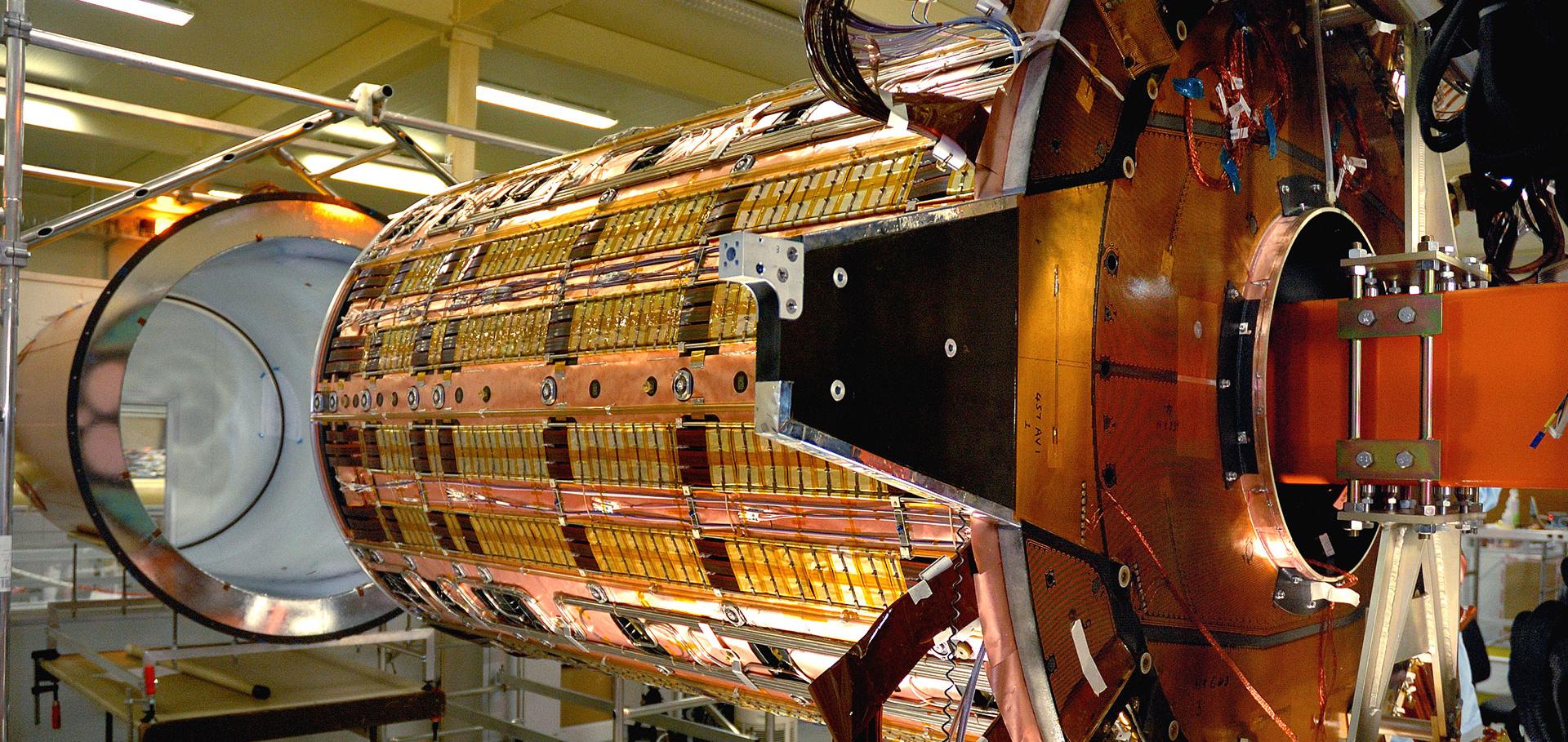
Insertion of STC into TRT at the Department of Physics, Oxford
Credit: CERN

Giles Barr

Professor of Physics

Sub department

  • Particle Physics

Research groups

  • Accelerator Neutrinos
Giles.Barr@physics.ox.ac.uk
Telephone: 01865 (2)73446
Denys Wilkinson Building, room 664a
  • About
  • Publications

Charge-separated atmospheric neutrino-induced muons in the MINOS far detector

Physical Review D - Particles, Fields, Gravitation and Cosmology 75:9 (2007)

Authors:

P Adamson, C Andreopoulos, KE Arms, R Armstrong, DJ Auty, S Avvakumov, DS Ayres, B Baller, B Barish, PD Barnes, G Barr, WL Barrett, E Beall, BR Becker, A Belias, T Bergfeld, RH Bernstein, D Bhattacharya, M Bishai, A Blake, B Bock, GJ Bock, J Boehm, DJ Boehnlein, D Bogert, PM Border, C Bower, E Buckley-Geer, A Cabrera, JD Chapman, D Cherdack, S Childress, BC Choudhary, JH Cobb, AJ Culling, JK De Jong, A De Santo, M Dierckxsens, MV Diwan, M Dorman, D Drakoulakos, T Durkin, AR Erwin, CO Escobar, JJ Evans, EF Harris, GJ Feldman, TH Fields, R Ford, MV Frohne, HR Gallagher, GA Giurgiu, A Godley, J Gogos, MC Goodman, P Gouffon, R Gran, EW Grashorn, N Grossman, K Grzelak, A Habig, D Harris, PG Harris, J Hartnell, EP Hartouni, R Hatcher, K Heller, A Holin, C Howcroft, J Hylen, D Indurthy, GM Irwin, M Ishitsuka, DE Jaffe, C James, L Jenner, D Jensen, T Joffe-Minor, T Kafka, HJ Kang, SMS Kasahara, MS Kim, G Koizumi, S Kopp, M Kordosky, DJ Koskinen, SK Kotelnikov, A Kreymer, S Kumaratunga, K Lang, A Lebedev, R Lee, J Ling, J Liu, PJ Litchfield, RP Litchfield, P Lucas, WA Mann, A Marchionni, AD Marino

Abstract:

We found 140 neutrino-induced muons in 854.24 live days in the MINOS far detector, which has an acceptance for neutrino-induced muons of 6.91×106cm2sr. We looked for evidence of neutrino disappearance in this data set by computing the ratio of the number of low momentum muons to the sum of the number of high momentum and unknown momentum muons for both data and Monte Carlo expectation in the absence of neutrino oscillations. The ratio of data and Monte Carlo ratios, R, is R=0.65-0.12+0.15(stat)±0.09(syst), a result that is consistent with an oscillation signal. A fit to the data for the oscillation parameters sin 22θ23 and Δm232 excludes the null oscillation hypothesis at the 94% confidence level. We separated the muons into μ- and μ+ in both the data and Monte Carlo events and found the ratio of the total number of μ- to μ+ in both samples. The ratio of those ratios, R^CPT, is a test of CPT conservation. The result R^CPT=0.72-0.18+0.24(stat)-0. 04+0.08(syst) is consistent with CPT conservation. © 2007 The American Physical Society.
More details from the publisher
More details

Measurement of Kμ 30 form factors

Physics Letters Section B Nuclear Elementary Particle and High Energy Physics 647:5-6 (2007) 341-350

Authors:

A Lai, D Marras, A Bevan, RS Dosanjh, TJ Gershon, B Hay, GE Kalmus, C Lazzeroni, DJ Munday, E Olaiya, MA Parker, TO White, SA Wotton, G Barr, G Bocquet, A Ceccucci, T Cuhadar-Dönszelmann, D Cundy, G D'Agostini, N Doble, V Falaleev, L Gatignon, A Gonidec, B Gorini, G Govi, P Grafström, W Kubischta, A Lacourt, A Norton, S Palestini, B Panzer-Steindel, H Taureg, M Velasco, H Wahl, C Cheshkov, P Hristov, V Kekelidze, L Litov, D Madigozhin, N Molokanova, Y Potrebenikov, S Stoynev, A Zinchenko, I Knowles, V Martin, R Sacco, A Walker, M Contalbrigo, P Dalpiaz, J Duclos, PL Frabetti, A Gianoli, M Martini, F Petrucci, M Savrié, A Bizzeti, M Calvetti, G Collazuol, G Graziani, E Iacopini, M Lenti, G Ruggiero, M Veltri, HG Becker, K Eppard, M Eppard, H Fox, A Kalter, K Kleinknecht, U Koch, L Köpke, P Lopes da Silva, P Marouelli, I Pellmann, A Peters, B Renk, SA Schmidt, V Schönharting, Y Schué, R Wanke, A Winhart, M Wittgen, JC Chollet, L Fayard, L Iconomidou-Fayard, J Ocariz, G Unal, I Wingerter-Seez, G Anzivino, P Cenci, E Imbergamo, P Lubrano, A Mestvirishvili, A Nappi, M Pepe, M Piccini, L Bertanza, R Carosi, R Casali, C Cerri

Abstract:

This Letter reports on a new high precision measurement of the form factors of the KL → π± μ∓ νμ decay. The data sample of about 2.3 × 10⁶ events was recorded in 1999 by the NA48 experiment at CERN. Studying the Dalitz plot density we measured a linear, λ+′ = (20.5 ± 2.2stat ± 2.4syst) × 10-3, and a quadratic, λ+″ = (2.6 ± 0.9stat ± 1.0syst) × 10-3 term in the power expansion of the vector form factor. No evidence was found for a second order term for the scalar form factor; the linear slope was determined to be λ0 = (9.5 ± 1.1stat ± 0.8syst) × 10-3. Using a linear fit our results were: λ+ = (26.7 ± 0.6stat ± 0.8syst) × 10-3 and λ0 = (11.7 ± 0.7stat ± 1.0syst) × 10-3. A pole fit of the form factors yields: mV = (905 ± 9stat ± 17syst)   MeV / c2 and mS = (1400 ± 46stat ± 53syst)   MeV / c2. © 2007 Elsevier B.V. All rights reserved.
More details from the publisher
More details

Particle identification algorithms for the HARP forward spectrometer

Nuclear Instruments and Methods in Physics Research, Section A: Accelerators, Spectrometers, Detectors and Associated Equipment 572:2 (2007) 899-921

Authors:

MG Catanesi, E Radicioni, R Edgecock, M Ellis, S Robbins, FJP Soler, C Gößling, S Bunyatov, G Chelkov, A Chukanov, D Dedovitch, M Gostkin, A Guskov, D Khartchenko, O Klimov, A Krasnoperov, Z Kroumchtein, D Kustov, Y Nefedov, B Popov, V Serdiouk, V Tereshchenko, A Zhemchugov, E Di Capua, G Vidal-Sitjes, A Artamonov, P Arce, S Giani, S Gilardoni, P Gorbunov, A Grant, A Grossheim, P Gruber, V Ivanchenko, A Kayis-Topaksu, J Panman, I Papadopoulos, J Pasternak, E Tcherniaev, I Tsukerman, R Veenhof, C Wiebusch, P Zucchelli, A Blondel, S Borghi, M Campanelli, A Cervera-Villanueva, MC Morone, G Prior, R Schroeter, I Kato, T Nakaya, K Nishikawa, S Ueda, U Gastaldi, GB Mills, JS Graulich, G Grégoire, M Bonesini, A De Min, F Ferri, M Paganoni, F Paleari, M Kirsanov, A Bagulya, V Grichine, N Polukhina, V Palladino, L Coney, D Schmitz, G Barr, A De Santo, C Pattison, K Zuber, F Bobisut, D Gibin, A Guglielmi, M Laveder, A Menegolli, M Mezzetto, J Dumarchez, F Vannucci, V Ammosov, V Koreshev, A Semak, V Zaets, U Dore, D Orestano, F Pastore, A Tonazzo, L Tortora, C Booth, C Buttar, P Hodgson, L Howlett, M Bogomilov, M Chizhov, D Kolev, R Tsenov, S Piperov

Abstract:

The particle identification (PID) methods used for the calculation of secondary pion yields with the HARP forward spectrometer are presented. Information from time of flight and Cherenkov detectors is combined using likelihood techniques. The efficiencies and purities associated with the different PID selection criteria are obtained from the data. For the proton-aluminium interactions at 12.9 GeV/c incident momentum, the PID efficiencies for positive pions are 86 % in the momentum range below 2 GeV/c, 92 % between 2 and 3 GeV/c and 98 % in the momentum range above 3 GeV/c. The purity of the selection is better than 92 % for all momenta. Special emphasis has been put on understanding the main error sources. The final PID uncertainty on the pion yield is 3.3 %. © 2007 Elsevier B.V. All rights reserved.
More details from the publisher
More details

Charged pion production in p+C collisions at 158 GeV/c beam momentum: Discussion

European Physical Journal C 49:4 (2007) 919-945

Authors:

G Barr, O Chvala, HG Fischer, M Kreps, M Makariev, C Pattison, A Rybicki, D Varga, S Wenig

Abstract:

The new data on pion production in p+C interactions from the NA49 experiment at the CERN SPS are used for a detailed study of hadronization in the collision of protons with light nuclei. The comparison to the extensive set of data from p+p collisions obtained with the same detector allows for the separation and extraction of the projectile and target contributions to the pion yield both in longitudinal and in transverse momentum. © 2007 Springer-Verlag.
More details from the publisher
More details

Inclusive production of charged pions in p+C collisions at 158 GeV/c beam momentum

European Physical Journal C 49:4 (2007) 897-917

Authors:

C Alt, B Baatar, D Barna, G Barr, J Bartke, L Betev, H Białkowska, C Blume, B Boimska, J Bracinik, R Bramm, P Bunčić, V Cerny, P Christakoglou, O Chvala, P Dinkelaker, J Dolejsi, V Eckardt, HG Fischer, D Flierl, Z Fodor, P Foka, V Friese, M Gaździcki, G Georgopoulos, C Höhne, A Karev, S Kniege, T Kollegger, VI Kolesnikov, E Kornas, M Kowalski, I Kraus, M Kreps, L Litov, M Makariev, AI Malakhov, M Mateev, GL Melkumov, M Mitrovski, G Pálla, AD Panagiotou, D Panayotov, C Pattison, A Petridis, R Renfordt, A Rybicki, A Sandoval, N Schmitz, P Seyboth, F Siklér, R Stock, H Ströbele, J Sziklai, P Szymanski, V Trubnikov, D Varga, M Vassiliou, GI Veres, G Vesztergombi, D Vranić, S Wenig, A Wetzler, J Zaranek

Abstract:

The production of charged pions in minimum bias p+C interactions is studied using a sample of 377000 inelastic events obtained with the NA49 detector at the CERN SPS at 158 GeV/c beam momentum. The data cover a phase space area ranging from 0 to 1.8 GeV/c in transverse momentum and from -0.1 to 0.5 in Feynman xF. Inclusive invariant cross sections are given on a grid of 270 bins per charge, thus offering for the first time a dense coverage of the projectile hemisphere and of the cross-over region into the target fragmentation zone. © 2007 Springer-Verlag.
More details from the publisher
More details

Pagination

  • First page First
  • Previous page Prev
  • …
  • Page 41
  • Page 42
  • Page 43
  • Page 44
  • Current page 45
  • Page 46
  • Page 47
  • Page 48
  • Page 49
  • …
  • Next page Next
  • Last page Last

Footer Menu

  • Contact us
  • Giving to the Dept of Physics
  • Work with us
  • Media

User account menu

  • Log in

Follow us

FIND US

Clarendon Laboratory,

Parks Road,

Oxford,

OX1 3PU

CONTACT US

Tel: +44(0)1865272200

University of Oxfrod logo Department Of Physics text logo
IOP Juno Champion logo Athena Swan Silver Award logo

© University of Oxford - Department of Physics

Cookies | Privacy policy | Accessibility statement

Built by: Versantus

  • Home
  • Research
  • Study
  • Engage
  • Our people
  • News & Comment
  • Events
  • Our facilities & services
  • About us
  • Giving to Physics
  • Current students
  • Staff intranet