Home
Department Of Physics text logo
  • Research
    • Our research
    • Our research groups
    • Our research in action
    • Research funding support
    • Summer internships for undergraduates
  • Study
    • Undergraduates
    • Postgraduates
  • Engage
    • For alumni
    • For business
    • For schools
    • For the public
Menu
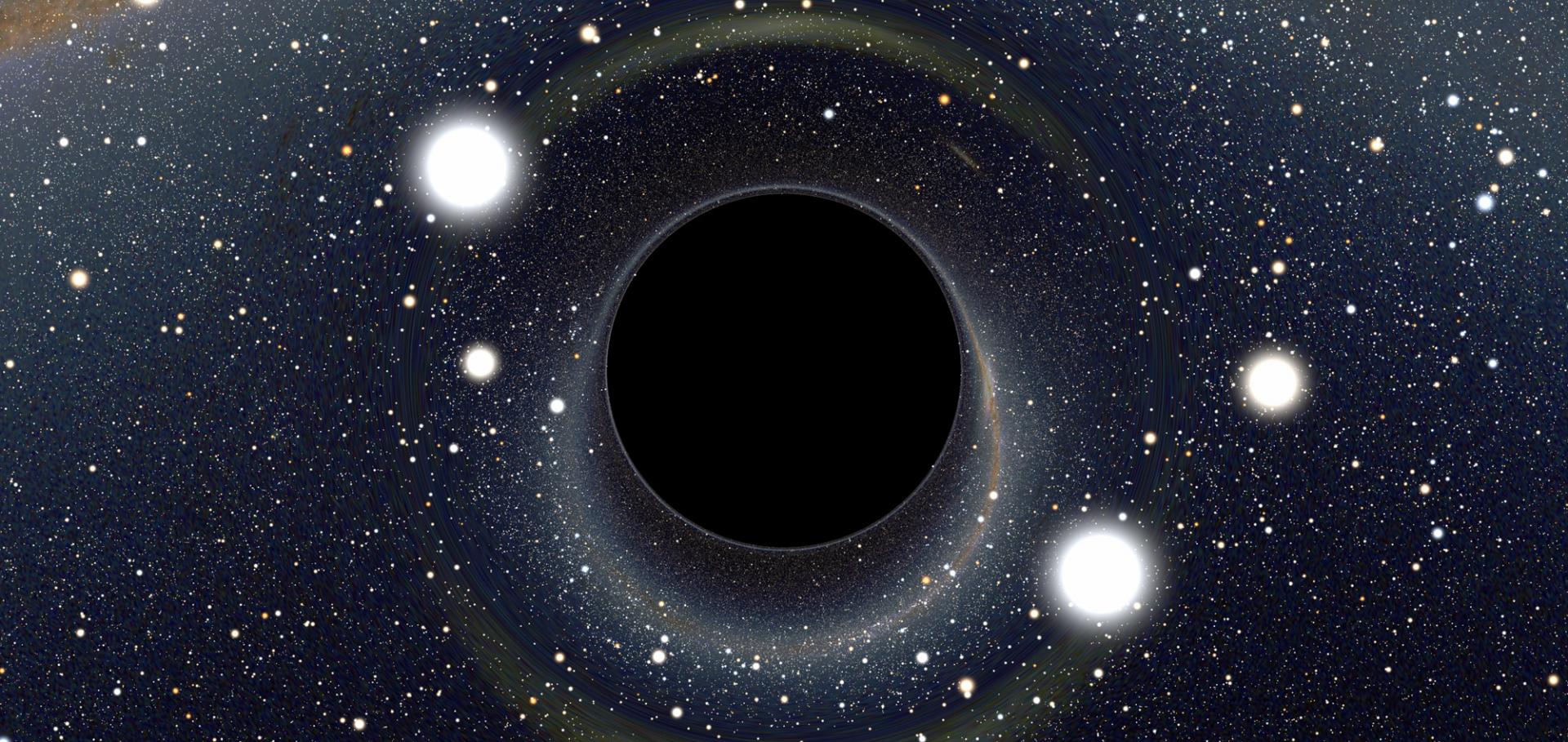
Black Hole

Lensing of space time around a black hole. At Oxford we study black holes observationally and theoretically on all size and time scales - it is some of our core work.

Credit: ALAIN RIAZUELO, IAP/UPMC/CNRS. CLICK HERE TO VIEW MORE IMAGES.

Martin Bureau

Professor of Astrophysics

Research theme

  • Astronomy and astrophysics

Sub department

  • Astrophysics

Research groups

  • Galaxy formation and evolution
  • Hintze Centre for Astrophysical Surveys
martin.bureau@physics.ox.ac.uk
Telephone: 01865 (2)73377
Denys Wilkinson Building, room 701
Home page
ORCID
  • About
  • Publications

Bar diagnostics in edge-on spiral galaxies. I. The periodic orbits approach

Astrophysical Journal 522:2 PART 1 (1999) 686-698

Authors:

M Bureau, E Athanassoula

Abstract:

We develop diagnostics to detect the presence and orientation of a bar in an edge-on disk, using its kinematical signature in the position-velocity diagram (PVD) of a spiral galaxy observed edge-on. Using a well-studied barred spiral galaxy mass model, we briefly review the orbital properties of two-dimensional nonaxisymmetric disks and identify the main families of periodic orbits. We use those families as building blocks to model real galaxies and calculate the PVDs obtained for various realistic combinations of periodic orbit families and for a number of viewing angles with respect to the bar. We show that the global structure of the PVD is a reliable bar diagnostic in edge-on disks. Specifically, the presence of a gap between the signatures of the families of periodic orbits in the PVD follows directly from the nonhomogeneous distribution of the orbits in a barred galaxy. Similarly, material in the two so-called forbidden quadrants of the PVD results from the elongated shape of the orbits. We show how the shape of the signatures of the dominant x1 and x2 families of periodic orbits in the PVD can be used efficiently to determine the viewing angle with respect to the bar, and to a lesser extent to constrain the mass distribution of an observed galaxy. We also address the limitations of the models when interpreting observational data.
More details from the publisher

The Nature of Boxy/Peanut-Shaped Bulges in Spiral Galaxies

The Astronomical Journal American Astronomical Society 118:1 (1999) 126-138

Authors:

M Bureau, KC Freeman
More details from the publisher

FCC 35 and Its H I Companion: Multiwavelength Observations and Interpretation

The Astronomical Journal American Astronomical Society 115:6 (1998) 2345-2355

Authors:

ME Putman, M Bureau, JR Mould, L Staveley-Smith, KC Freeman
More details from the publisher

The Nature of Boxy/Peanut Spiral Galaxies: Overview and New Results

Publications of the Astronomical Society of Australia Cambridge University Press (CUP) 14:2 (1997) 146-158

Authors:

M Bureau, KC Freeman
More details from the publisher

A New I-Band Tully-Fisher Relation for the Fornax Cluster: Implication for the Fornax Distance and Local Supercluster Velocity Field

The Astrophysical Journal American Astronomical Society 463 (1996) 60

Authors:

M Bureau, JR Mould, L Staveley-Smith
More details from the publisher

Pagination

  • First page First
  • Previous page Prev
  • …
  • Page 84
  • Page 85
  • Page 86
  • Page 87
  • Page 88
  • Page 89
  • Page 90
  • Current page 91
  • Page 92
  • Next page Next
  • Last page Last

Footer Menu

  • Contact us
  • Giving to the Dept of Physics
  • Work with us
  • Media

User account menu

  • Log in

Follow us

FIND US

Clarendon Laboratory,

Parks Road,

Oxford,

OX1 3PU

CONTACT US

Tel: +44(0)1865272200

University of Oxfrod logo Department Of Physics text logo
IOP Juno Champion logo Athena Swan Silver Award logo

© University of Oxford - Department of Physics

Cookies | Privacy policy | Accessibility statement

Built by: Versantus

  • Home
  • Research
  • Study
  • Engage
  • Our people
  • News & Comment
  • Events
  • Our facilities & services
  • About us
  • Giving to Physics
  • Current students
  • Staff intranet