Home
Department Of Physics text logo
  • Research
    • Our research
    • Our research groups
    • Our research in action
    • Research funding support
    • Summer internships for undergraduates
  • Study
    • Undergraduates
    • Postgraduates
  • Engage
    • For alumni
    • For business
    • For schools
    • For the public
Menu
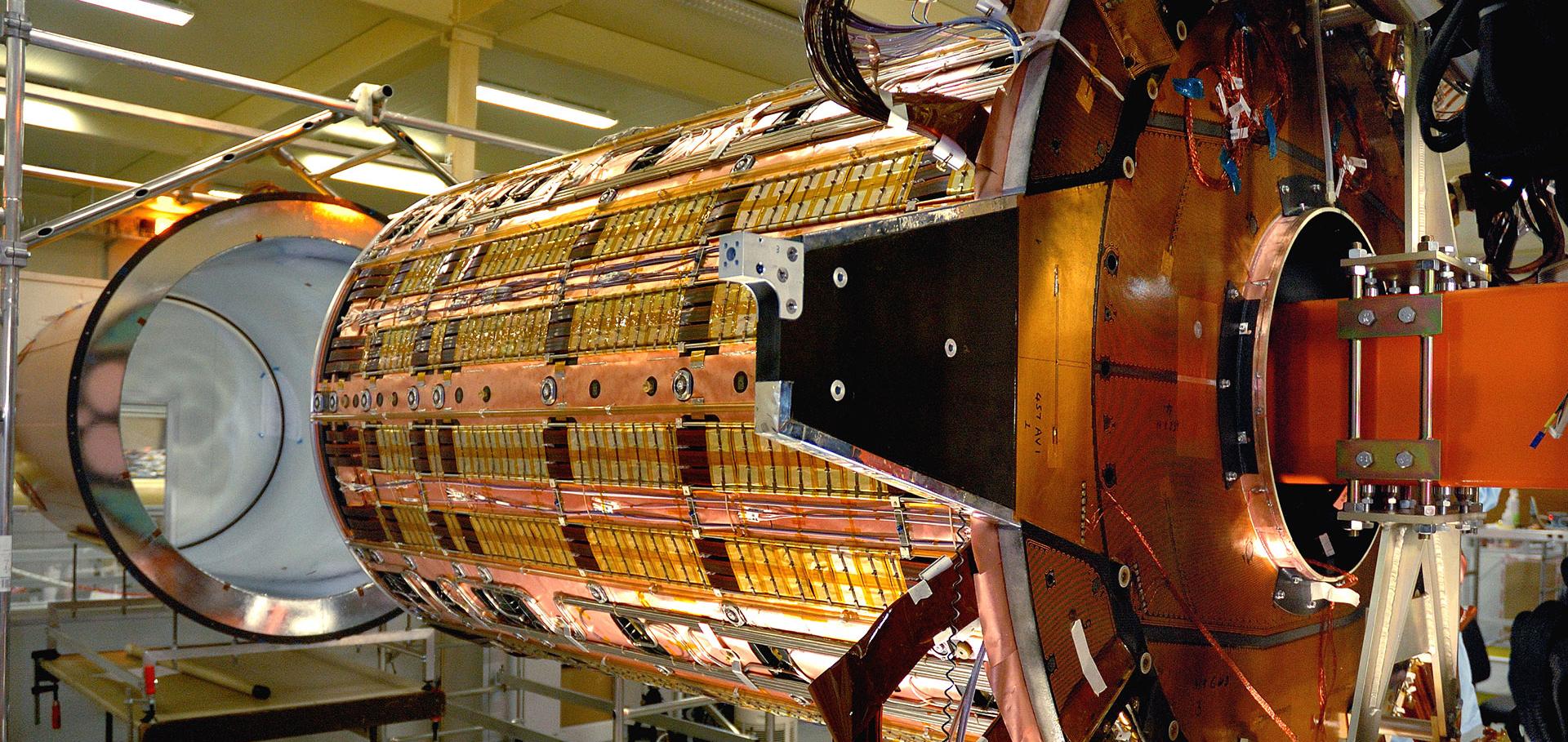
Insertion of STC into TRT at the Department of Physics, Oxford
Credit: CERN

Philip Burrows

Professor of Physics

Sub department

  • Particle Physics
Philip.Burrows@physics.ox.ac.uk
Telephone: 01865 (2)73451
Denys Wilkinson Building, room 615a
  • About
  • Publications

PRODUCTION AND DECAY OF CHARMED MESONS IN E+ E- ANNIHILATION AT SQUARE-ROOT-S-GREATER-THAN-28 GEV

ZEITSCHRIFT FUR PHYSIK C-PARTICLES AND FIELDS 44:3 (1989) 365-378

Authors:

W BRAUNSCHWEIG, R GERHARDS, FJ KIRSCHFINK, HU MARTYN, HM FISCHER, H HARTMANN, J HARTMANN, E HILGER, A JOCKSCH, R WEDEMEYER, B FOSTER, AJ MARTIN, E BERNARDI, J CHWASTOWSKI, A ESKREYS, K GATHER, K GENSER, H HULTSCHIG, P JOOS, H KOWALSKI, A LADAGE, B LOHR, D LUKE, P MATTIG, D NOTZ, JM PAWLAK, KU POSNECKER, E ROS, D TRINES, R WALCZAK, G WOLF, H KOLANOSKI, T KRACHT, J KRUGER, E LOHRMANN, G POELZ, W ZEUNER, RS GALIK, J HASSARD, J SHULMAN, D SU, I TOMALIN, A WATSON, F BARREIRO, A LEITES, J DELPESO, MG BOWLER, PN BURROWS, ME VEITCH, GE FORDEN, JC HART, DH SAXON, S BRANDT, M HOLDER, Y EISENBERG, U KARSHON, G MIKENBERG, A MONTAG, D REVEL, E RONAT, A SHAPIRA, N WAINER, G YEKUTIELI, A CALDWELL, D MULLER, S RITZ, D STROM, M TAKASHIMA, SL WU, G ZOBERNIG
More details

Analysis of multijet final states in e+e- annihilation

Physics Letters B 214:2 (1988) 286-294

Authors:

W Braunschweig, R Gerhards, FJ Kirschfink, HU Martyn, B Bock, HM Fischer, H Hartmann, J Hartmann, E Hilger, A Jocksch, R Wedemeyer, B Foster, AJ Martin, AJ Sephton, E Bernardi, J Chwastowski, A Eskreys, K Gather, K Genser, H Hultschig, P Joos, H Kowalski, A Ladage, B Löhr, D Lüke, P Mättig, D Notz, JM Pawlak, KU Pösnecker, E Ros, W Schütte, D Trines, R Walczak, G Wolf, H Kolanoski, T Kracht, J Krüger, E Lohrmann, G Poelz, W Zeuner, J Hassard, J Shulman, D Su, F Barreiro, A Leites, J Del Peso, C Balkwill, MG Bowler, PN Burrows, RJ Cashmore, GP Heath, PN Ratoff, IM Silvester, IR Tomalin, ME Veitch, GE Forden, JC Hart, DH Saxon, S Brandt, M Holder, L Labarga, Y Eisenberg, U Karshon, G Mikenberg, A Montag, D Revel, E Ronat, A Shapira, N Wainer, G Yekutieli, A Caldwell, D Muller, S Ritz, D Strom, M Takashima, SL Wu, G Zobernig

Abstract:

Data accumulated by the TASSO detector across the whole range of energies spanned at PETRA, 12≤ s≤46.8 GeV, have been analysed in terms of cluster algorithms. Using parameters optimised at 35 GeV CM energy, three perturbative QCD+fragmentation models were compared with the data. The O(αs2) model gives too few 4,5- cluster events, implying that higher order QCD contributions are required to describe the data. The parton cascade model, incorporating many orders in perturbation theory, gives a better description of the rates of ≥ 4 clusters, but shows a lack of hard gluon emission by giving too few 3-, and too many 2-cluster events. When hard gluon emission is taken into account, by the cascade model incorporating the O(αs) matrix element, all cluster rates are reproduced well. All the models describe the trend of the evolution of the cluster rates between 〈 s〉 = 14 and 43.8 GeV. We find that the rate of 3-jet events seen in the data decreases as s increases in a manner consistent with the Q2 dependence of αs as predicted by QCD. © 1988.
More details from the publisher
More details

Evidence for direct photons from quarks in electron-positron annihilation

Zeitschrift für Physik C Particles and Fields 41:3 (1988) 385-393

Authors:

W Braunschweig, R Gerhards, FJ Kirschfink, HU Martyn, B Bock, HM Fischer, H Hartmann, J Hartmann, E Hilger, A Jocksch, R Wedemeyer, B Foster, AJ Martin, AJ Sephton, F Barreiro, E Bernardi, J Chwastowski, A Eskreys, K Gather, K Genser, H Hultschig, P Joos, H Kowalski, A Ladage, B Löhr, D Lüke, P Mättig, D Notz, JM Pawlak, KU Pösnecker, E Ros, D Trines, T Tymieniecka, R Walczak, G Wolf, H Kolanoski, W Gerhardt, T Kracht, J Krüger, E Lohrmann, G Poelz, P Rehders, G Tysarczyk, W Zeuner, J Hassard, J Shulman, D Su, A Leites, J del Peso, C Balkwill, MG Bowler, PN Burrows, GP Heath, P Ratoff, I Silvester, IR Tomalin, ME Veitch, GE Forden, JC Hart, DH Saxon, S Brandt, M Holder, L Labarga, Y Eisenberg, U Karshon, G Mikenberg, A Montag, D Revel, E Ronat, A Shapira, N Wainer, G Yekutieli, D Muller, S Ritz, D Strom, M Takashima, SL Wu, G Zobernig

Abstract:

Hadronic events from e+e--annihilations with a high energy isolated photon have been investigated at C.M. energies between 14 GeV and 44 GeV. A forward-backward asymmetry Aγ of the positively charged jet with respect to the incident positron direction has been found:Aγγ=-0.32±0.07, providing evidence for photon bremsstrahlung from quarks. The forward-backward asymmetry of all hadronic events at C.M. energies between 30 GeV and 36 GeV has been measured. The value, corrected for the limited polar angle acceptance of the detector, is:A=+0.021±0.005. © 1988 Springer-Verlag.
More details from the publisher
More details

Jet fragmentation and QCD models in e+e- annihilation at c.m. energies between 12.0 and 41.5 GeV

Zeitschrift für Physik C Particles and Fields 41:3 (1988) 359-373

Authors:

W Braunschweig, R Gerhards, FJ Kirschfink, HU Martyn, B Bock, HM Fischer, H Hartmann, J Hartmann, E Hilger, A Jocksch, R Wedemeyer, B Foster, AJ Martin, AJ Sephton, E Bernardi, J Chwastowski, A Eskreys, K Gather, K Genser, H Hultschig, P Joos, H Kowalski, A Ladage, B Löhr, D Lüke, P Mättig, D Notz, JM Pawlak, KU Pösnecker, E Ros, D Trines, R Walczak, G Wolf, H Kolanoski, T Kracht, J Krüger, E Lohrmann, G Poelz, W Zeuner, J Hassard, J Shulman, D Su, F Barreiro, A Leites, J del Peso, C Balkwill, MG Bowler, PN Burrows, RJ Cashmore, GP Heath, PN Ratoff, IM Silvester, IR Tomalin, ME Veitch, GE Forden, JC Hart, DH Saxon, S Brandt, M Holder, L Labarga, Y Eisenberg, U Karshon, G Mikenberg, A Montag, D Revel, E Ronat, A Shapira, N Wainer, G Yekutieli, D Muller, S Ritz, D Strom, M Takashima, SL Wu, G Zobernig

Abstract:

The large amount of data accumulated by the TASSO detector at 35 GeV c.m. energy has been compared with the predictions of the latest generation of perturbative QCD+fragmentation models. By adjustment of the arbitrary parameters of these models, a very good description of the global properties of hadronic events was obtained. No one model gave the best description of all features of the data, each model being better than the others for some observables and worse in other quantities. We interpret these results in terms of the underlying QCD and hadronisation schemes. The trends of the data across the energy range 12.0≦W≦41.5 GeV are generally well reproduced by the models with the parameters optimised at 35 GeV. © 1988 Springer-Verlag.
More details from the publisher
More details

Predictions of QCD fragmentation models in e+e- annihilation up to {Mathematical expression} GeV

Zeitschrift für Physik C Particles and Fields 41:3 (1988) 375-384

Abstract:

Results on event and single particle characteristics are presented for the three most successful perturbative QCD+fragmentation models in the c.m. energy range 12.0≦W≦200 GeV. The models were optimised to describe the properties of the large sample of hadronic events obtained by TASSO at W=35 GeV. The energy evolution of the observables across the range spanned by the PETRA and PEP data, 12.0≦〈W〉≦41.5 GeV, is reasonably well described by all the models. However, for some quantities the predictions of the different models diverge at higher energies; distributions of observables are shown at c.m. energies of 93 and 200 GeV, where data are expected from the e+e- colliders currently under construction. The ability to describe simultaneously, with the same parameter values, hadronic event features both at PETRA/PEP and LEP/SLC energies will provide a severe test of the models. The effects of top quark production on the event properties are illustrated for a top mass of 60 GeV/c2. Predictions are given for the rates of multijet events up to W=200 GeV, where ≧4-jet events dominate the cross section and will form a background to events containing heavy states which decay into hadron jets. © 1988 Springer-Verlag.
More details from the publisher

Pagination

  • First page First
  • Previous page Prev
  • …
  • Page 71
  • Page 72
  • Page 73
  • Page 74
  • Current page 75
  • Page 76
  • Page 77
  • Page 78
  • Page 79
  • Next page Next
  • Last page Last

Footer Menu

  • Contact us
  • Giving to the Dept of Physics
  • Work with us
  • Media

User account menu

  • Log in

Follow us

FIND US

Clarendon Laboratory,

Parks Road,

Oxford,

OX1 3PU

CONTACT US

Tel: +44(0)1865272200

University of Oxfrod logo Department Of Physics text logo
IOP Juno Champion logo Athena Swan Silver Award logo

© University of Oxford - Department of Physics

Cookies | Privacy policy | Accessibility statement

Built by: Versantus

  • Home
  • Research
  • Study
  • Engage
  • Our people
  • News & Comment
  • Events
  • Our facilities & services
  • About us
  • Giving to Physics
  • Current students
  • Staff intranet